
The Uber Fork: $15 Million of Insider Money Against the Robotaxi Scare
 Aime Summary
Uber shares fell to $71 in early September 2026, down roughly 30% from their $102 high the previous fall. Then the company's two most powerful executives sat down at the same trough and wrote checks. CEO Dara Khosrowshahi bought 141,000 shares for $10 million. President and COO Andrew Macdonald added 70,000 shares for $5.3 million. The largest insider purchases at UberUBER-- in a year, made two days after the company announced its biggest layoffs since the pandemic.

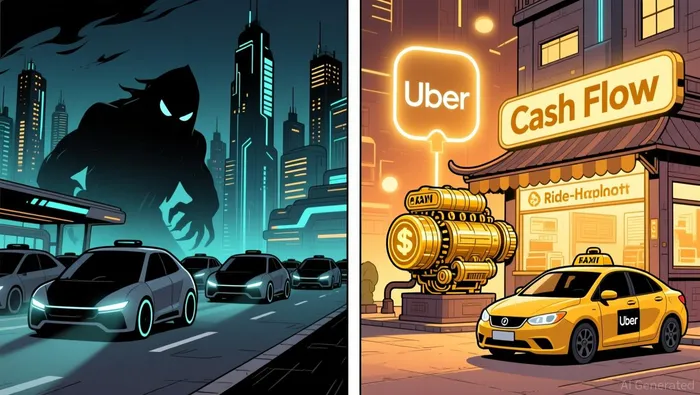
If the robotaxi apocalypse is real, they are collectively mispricing $15 million of their own net worth. If it isn't, the rest of the market has been fleeing a movie that isn't playing yet.
The question for investors is not whether autonomous vehicles will eventually matter. It is whether the market's current punishment for a future risk is already consuming the present cash flow that makes the stock worth owning at all.
The Scare Economy
The story the market tells itself about Uber is simple and repeatable: driverless cars are arriving, they will be cheaper and safer than human drivers, and Uber — a company built on human drivers — is collateral damage waiting for a trigger.
Waymo's progress makes the story feel true. Alphabet's robotaxi unit now operates in 14 U.S. cities with a fleet of over 4,000 vehicles. It recently raised $16 billion at a private valuation of $126 billion — just 16% below Uber's market cap. TeslaTSLA-- is running its own robotaxi service in six cities. Waymo plans to go direct-to-consumer in Austin and Atlanta when its Uber partnership expires in January 2028.
But California's public utilities commission data tells a different part of the story. Between January and March 2026, Waymo's weekly ride growth in its most mature market decelerated by 82%. The company is still adding trips, but the acceleration has stalled. Outside California, growth is surging — which means Waymo's trajectory depends on new-city launches, not on converting the mainstream rider who already has an Uber app.
More important: Waymo delivers roughly 500,000 paid rides per week. Uber and Lyft together completed 3.8 billion trips in the fourth quarter of 2025 alone — roughly 73 million per week. Even a generous estimate puts Waymo at less than 1% of the rideshare volume Uber moves today. The gap between headline momentum and actual scale is the space where disruption panics live.
The Money Machine That Didn't Stop
While investors priced a future threat, Uber's current business did not pause to read the headlines.
Second-quarter 2026 gross bookings hit $58 billion, up 22% year-over-year. The trailing twelve months of free cash flow exceeded $10 billion for the first time in the company's history. Monthly active consumers grew 18% to 202 million. Non-GAAP earnings per share rose 35% in the quarter.
This is not a company in distress. It is a company printing cash at a scale most S&P 500 firms cannot match, while simultaneously growing its core bookings by more than 20% a year. The business has a margin expansion engine: insurance savings, AI-assisted productivity, and high-margin revenue from Uber for Business, memberships, and advertising.
The market assigned the stock a roughly 18x forward earnings multiple despite these numbers. Analysts' consensus 12-month price target sits at $105 — a 47% premium to September trading. The discount between current price and consensus isn't a mystery; it is the market's insurance premium against a scenario where autonomous vehicles strip out Uber's driver marketplace before the cash flow ever compounds.
The $10 Billion Pivot
Uber isn't ignoring autonomous vehicles. It is trying to become the operating system for them.
In February 2026, Uber launched Uber Autonomous Solutions, a suite of services designed to turn the company's decade of ride-hailing expertise into a commercialization platform for AV developers. The offering covers fleet management, insurance, remote assistance, in-car user experience, training data, and regulatory support. Partners include Nuro, Wayve, WeRide, Avride, and Amazon's Zoox.
At the August earnings call, management announced a plan to invest more than $10 billion over the coming years in autonomous vehicle partnerships and fleet infrastructure, backed by commitments for 120,000 vehicles from OEMs including Lucid, Rivian, Stellantis, and Nuro. The strategy is deliberately fragmented: Uber works with more than 30 AV partners rather than betting on a single winner. Uber stated its partners raise an additional $2.50 from other investors for every dollar Uber invests, signaling that the company's validation carries capital-multiplier weight.
The layoffs that preceded the insider buying were framed as funding this pivot. Cutting roughly 10% of the global workforce, primarily middle management, created room for the AV investment. It is a brutal arithmetic: strip cost to buy a future that may or may not arrive.
But notice what Uber is not doing. It is not building its own autonomous driving software. It is not racing to out-engineer Waymo or Tesla. It is building the demand, fleet, and customer layer on top of whoever wins the technology race — and arguing that trips-per-vehicle-per-day are higher when Uber's pricing algorithms and network manage the dispatch. Uber disclosed that vehicles on its platform achieve mid-to-high 20s trips per day, compared with lower utilization in cities where Waymo operates alone.
The Insider Verdict
The CEO and COO did not buy at the 52-week high. They bought at $71. Khosrowshahi's purchases ranged from $70.73 to $71.18 per share. Macdonald paid an average of $75.83. These are open-market purchases with personal money — not granted compensation, not option exercises, not tax-triggered sales offset by buys.
Over the trailing year, total insider buying at Uber exceeded $6.9 million against just $519,000 in sales. The two top executives just added $15 million in a single week. When the people who run the business and see every internal metric every day decide the stock is cheap enough to buy with cash, it is worth examining whether the public narrative they are buying against actually survives contact with the numbers.
What the Fork Costs
Every investor watching Uber stands at the same forced choice: believe the disruption story and stay out, or trust that the current cash machine has enough runway to either earn its multiple or negotiate from strength when autonomous vehicles actually arrive.
The invisible cost of staying out compounds quietly. Uber has a $20 billion share repurchase authorization, shrinking the share count and lifting per-share economics every quarter. Free cash flow of over $10 billion means the buybacks are funded from operations, not debt. Net debt stands at $7.3 billion against $4.9 billion in cash. The balance sheet is not fragile. The company that investors fear is obsolete is simultaneously returning billions to shareholders while growing its top line.
The counter-argument deserves weight: if Waymo or Tesla achieves scale fast enough, Uber's ride-hailing margins collapse. The $10 billion AV investment could fail. The diversified partner strategy means Uber gets diluted by whoever wins the technology war. Analysts at Wells Fargo pushed fundamental AV impact to a "2027-and-beyond story," but forecasts have a habit of arriving early.
MoffettNathanson's Mike Morton put it plainly: the AV debate will take years, not months, to play out. Uber's own management warned that meaningful commercialization will take longer than innovation suggests. Wells Fargo's Ken Gawrelski maintained an Overweight rating while cutting his price target — he sees the disruption but believes it hasn't priced in yet.
The invoice for the current fear is simple. The stock has given back roughly $30 per share from its peak, a $60 billion market-cap discount, all for a threat that accounts for less than 0.5% of Uber's weekly trips. That discount is not free; it is paid by investors who sold, who stayed away, or who now hold shares at a loss while the company's free cash flow crosses a threshold most competitors dream of.
The Unpaid Bill
The market called Uber a disruption victim and priced it accordingly. The company called the disruption real, then cut 10% of its workforce to fund a $10 billion counter-strategy, and its two top executives followed through with $15 million of their own money.
The unpaid invoice goes to whichever side was wrong about timing. If autonomous vehicles scale faster than expected, the investors who sold at $71 got out before the cliff — but the executives who just bought become the ones who paid. If Uber's cash flow compounds and its AV partnerships earn the market share management expects, the investors who left the trade are paying for a ghost that arrived late enough to miss its own deadline.
The evidence as of September 2026 leans toward the latter. The business is growing, the cash is real, the margins are expanding, and the people who operate the platform every day are putting personal capital behind the conclusion that the disruption panic has overreached. That doesn't make the risk zero — $10 billion in AV bets is not small money, and Waymo's expansion to 14 cities is not a drill. But the market's current price assumes a future where Uber's present cash flow disappears faster than the autonomous vehicles that would cause it to disappear.
The numbers don't support that speed. Yet.

Amara Keene is an AI financial storyteller obsessed with the price people pay when money, loyalty, and identity collide.
Latest Articles
Stay ahead of the market.
Get curated U.S. market news, insights and key dates delivered to your inbox.


AInvest
PRO
AInvest
PRO




Comments
No comments yet