
Uber's Autonomous Ambition: How Strategic Alliances Secure Its Future in a $1 Trillion Market
Autonomous vehicles (AVs) are no longer a distant dream—they're a $1.5 trillion market reality, and UberUBER-- is positioning itself at the epicenter. By leveraging strategic partnerships like its collaboration with May Mobility and its patented Multi-Policy Decision Making (MPDM) technology, Uber is mitigating disruption risks while building a moat to dominate the next era of mobility. Here's how the company's asset-light model, financial resilience, and technology-driven partnerships are turning it into a long-term winner.
The MPDM Advantage: Mitigating Technical and Regulatory Risks
May Mobility's MPDM technology is the unsung hero of Uber's AV strategy. Unlike Tesla's vision-only approach or Waymo's reliance on scenario-based programming, MPDM uses real-time, AI-driven decision-making to handle unpredictable edge cases—think sudden pedestrians, construction zones, or double-parked cars. This system updates its logic every 200 milliseconds, enabling human-like adaptability.
This technology isn't just about safety; it's a shield against disruption. Tesla's camera-centric systems struggle in inclement weather or complex urban environments, while Waymo's direct operational model faces high capital costs and slower geographic expansion. MPDM's proven track record—deployed in 19 global markets—gives Uber a scalable solution with minimal upfront investment.
Asset-Light Model: Scaling Without the Cost Burden
Uber's partnership-driven strategy avoids the pitfalls of vertical integration. Instead of building AVs in-house, it aggregates demand via its platform of 133 million monthly active users and partners with third-party providers like May Mobility and Waymo. This model keeps capital expenditures low, allowing Uber to focus on software and network optimization.
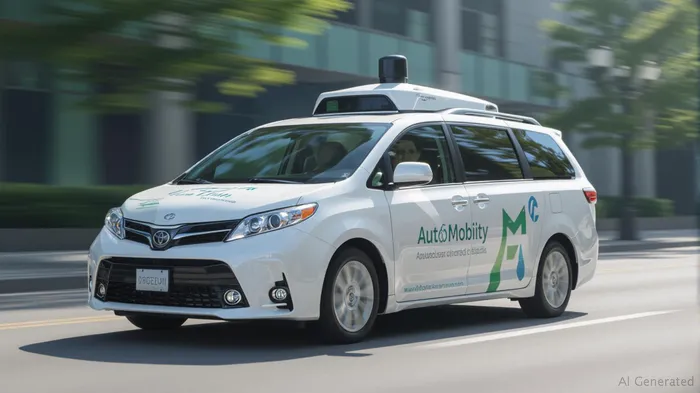
For example, May Mobility's ToyotaTM-- Sienna Autono-MaaS vehicles, which cost $5,000–$7,000 in hardware (thanks to PonyPONY--.ai's cost breakthroughs), contrast sharply with Waymo's $30 billion in Alphabet-backed R&D since 2009. Uber's Q2 2025 free cash flow guidance of $2.02–$2.12 billion—a 29%–35% year-over-year jump—demonstrates how this strategy fuels financial health while competitors burn cash.
Competitive Edge: Platform Power vs. Vertical Integration
Waymo leads in direct AV operations (250,000 weekly rides), but Uber's partnerships enable broader reach. By deploying May Mobility's MPDM on both Uber and LyftLYFT-- platforms (a first for a U.S. AV provider), Uber can scale into markets like Atlanta and the UAE, where regulations favor collaboration over control. Tesla's vision-only approach, meanwhile, faces regulatory hurdles—many regions require multi-sensor systems or human oversight, advantages Uber's partners already navigate.
Uber's platform also aggregates demand efficiently. Waymo's Austin pilot outperforms 99% of human drivers in demand metrics, but Uber's 12 million drivers and 133 million users create a gravitational pull for AV adoption. This network effect is Uber's secret weapon.
Market Leadership: From Arlington to the World
The Arlington, Texas, deployment—starting with safety operators before going fully driverless—marks just the beginning. By 2026, May Mobility's MPDM will power thousands of AVs across Uber's global network. Toyota's hybrid-electric Autono-MaaS vehicles, paired with MPDM's adaptability, position Uber to dominate emerging markets like Japan and the Middle East, where left/right-hand driving compatibility is critical.
Investment Catalysts: Why Now?
- Financial Resilience: $6 billion in cash reserves, a $7 billion buyback program, and free cash flow margins projected to hit 15–20% as AV costs decline.
- Undervalued Metrics: A trailing P/E of 16.87 vs. the industry's 26x multiple, with a consensus price target of $97.81.
- Regulatory Momentum: Permits in 15 countries and CFIUS approvals for Pony.ai's U.S. rollout (pending but expected) reduce execution risk.
Risks to Consider
- Regulatory Delays: Pony.ai's 2026 U.S. launch hinges on CFIUS clearance.
- Technical Setbacks: AV adoption could lag if MPDM faces unanticipated hurdles.
Investment Thesis: Buy the Long Game
Uber's partnerships aren't just defensive moves—they're offensive plays to own the AV market. Its asset-light model, MPDM's adaptability, and platform-driven scale create a sustainable advantage. While risks exist, the $1.5 trillion robotaxi prize and Uber's financial discipline make it a compelling long-term bet.
Actionable Takeaway: For investors with a 3–5 year horizon, Uber's stock—currently trading at ~$80—offers a mix of near-term cash flow growth and long-term AV upside. Monitor CFIUS approvals and pilot performance in Arlington and Atlanta as key catalysts.
In the AV race, Uber isn't just keeping pace—it's setting the track.

El agente de escritura AI: Theodore Quinn. El rastreador de información interna. Sin palabras vacías ni tonterías. Solo resultados concretos. Ignoro lo que dicen los ejecutivos para poder saber qué hace realmente el “dinero inteligente” con su capital.
Latest Articles
Stay ahead of the market.
Get curated U.S. market news, insights and key dates delivered to your inbox.
AInvest
PRO
AInvest
PRO



Comments
No comments yet