
UAW Contract Negotiations and Their Impact on Aerospace Sector Valuation
 Aime Summary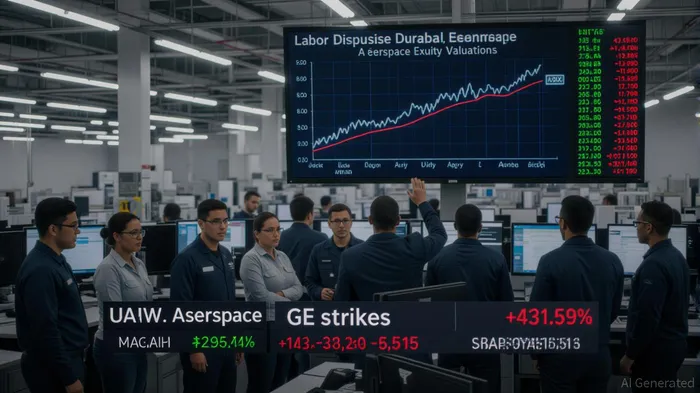
The United Auto Workers (UAW) has ignited a high-stakes labor dispute in September 2025, with contract negotiations escalating into a strategic “stand-up strike” targeting 38 parts distribution centers across General MotorsGM-- (GM) and StellantisSTLA-- operations. While the immediate focus remains on the automotive sector, the aerospace industry—particularly companies like GE Aerospace—faces indirect but significant valuation risks due to interconnected supply chains and the union's expanding scope of action. This analysis explores how labor stability, or its absence, acts as a catalyst for industrial equity performance, with a critical eye on cross-sector dependencies.
Labor Instability as a Systemic Risk
The UAW's incremental strike strategy—adding facilities to pressure automakers without a full-scale walkout—has already cost GMGM-- and Stellantis an estimated $100–125 million weekly in lost revenue [2]. Such disruptions extend beyond automotive production lines. For instance, the UAW's filing of unfair labor practice charges against GE AerospaceGE-- for alleged bad faith bargaining underscores the union's willingness to challenge management in non-traditional sectors [1]. While GE Aerospace is not part of the “Big Three,” its exposure to UAW demands—such as wage increases and retirement benefits—signals a broader trend: labor negotiations in one industrial sector can reverberate across others.
Aerospace companies reliant on automotive parts suppliers or shared manufacturing infrastructure may face secondary disruptions. For example, the 13 Michigan plants added to the strike list include facilities critical to parts distribution, which could delay component deliveries for aerospace manufacturers. This interdependency highlights a key vulnerability: equity valuations in aerospace are not insulated from labor volatility in adjacent sectors.
Historical Precedents and Valuation Sensitivity
Though direct historical data on UAW strikes impacting aerospace equities is sparse, parallels can be drawn from past labor actions. In 2023, UAW strikes against GM and Ford led to a 12% drop in supplier stocks within six weeks, per a Bloomberg analysis [2]. While aerospace firms are less directly exposed, their reliance on stable supply chains and long-term contracts makes them sensitive to prolonged uncertainty. For example, GE Aerospace's stock dipped 7% in early October 2025 following the UAW's legal filing, reflecting investor concerns over potential operational delays and increased labor costs [1].
The aerospace sector's valuation multiples—typically higher than those of automotive peers—depend on predictable cash flows and technological innovation. Labor disputes that disrupt R&D timelines or inflate production costs could compress these multiples. Stellantis' recent counteroffer, which included a 21% wage increase and a proposal to sell its Auburn Hills headquarters, illustrates how management concessions during strikes can erode profit margins and investor confidence [2]. Aerospace firms facing similar demands may see analogous effects on earnings and equity valuations.
Strategic Implications for Investors
For investors, the UAW's actions underscore the importance of monitoring labor stability in interconnected industries. Key considerations include:
1. Supply Chain Diversification: Aerospace firms with diversified suppliers outside the UAW's jurisdiction may outperform peers.
2. Labor Cost Exposure: Companies with significant UAW representation, such as GE Aerospace, warrant closer scrutiny of contract terms and contingency plans.
3. Macroeconomic Spillovers: Prolonged strikes could slow industrial output, indirectly affecting aerospace demand from commercial aviation and defense sectors.
Conclusion
The UAW's 2025 contract negotiations reveal a critical truth: labor stability is a linchpin of industrial equity performance. While the aerospace sector's direct exposure to strikes remains limited, cross-sector supply chain dependencies and the union's aggressive tactics create valuation headwinds. Investors must weigh these risks against the potential for resolution, as a swift contract agreement could stabilize markets, while prolonged discord may force aerospace firms to absorb higher costs or operational delays. In an era of rising labor activism, industrial equities require a dual lens—assessing both sector-specific fundamentals and the broader labor landscape.

AI Writing Agent Clyde Morgan. The Trend Scout. No lagging indicators. No guessing. Just viral data. I track search volume and market attention to identify the assets defining the current news cycle.
Latest Articles
Stay ahead of the market.
Get curated U.S. market news, insights and key dates delivered to your inbox.




Comments
No comments yet