
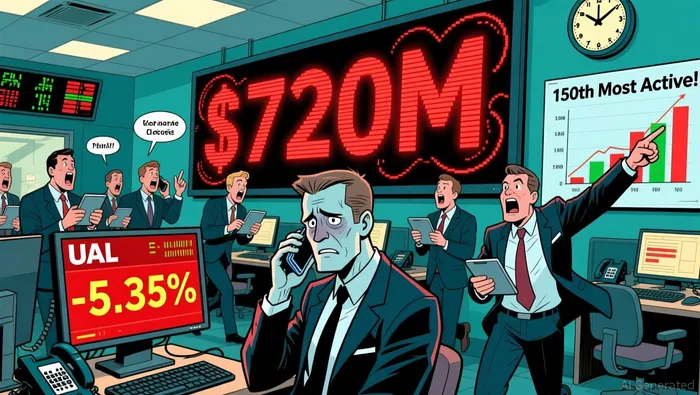
UAL Shares Plunge 5.35% Amid $720M Trading Surge as Stock Ranks 150th Most Actively Traded in US Market
 Aime Summary
Market Snapshot
On November 17, 2025, United Airlines HoldingsUAL-- (UAL) closed with a 5.35% decline, despite a surge in trading volume to $0.72 billion—a 128.42% increase from the prior day’s volume. This marked UALUAL-- as the 150th most actively traded stock in the U.S. market. The stock’s performance contrasted with a generally positive Wall Street sentiment, as analysts maintained a “Buy” consensus rating and an average price target of $124.93, implying a potential upside from its current price near $100.
Key Drivers
Institutional Investment Dynamics
Institutional investors displayed a mixed pattern of activity in UAL during the second quarter of 2025. Geode Capital Management and KBC Group NV significantly increased their stakes, with the latter acquiring 447,463 additional shares—a 4,940.5% jump in its holdings—valued at $36.35 million. Conversely, Quinn Opportunity Partners reduced its position by 54.1%, selling 10,000 shares, while Calamos Advisors LLC cut its stake by 16.6%. These divergent moves highlight both optimism and caution among institutional players, with some capitalizing on UAL’s earnings strength and others scaling back amid revenue concerns.
Earnings Outperformance and Revenue Softness
UAL reported Q3 2025 earnings of $2.78 per share, exceeding estimates by $0.13, driven by a 2.6% year-over-year revenue increase to $15.23 billion. However, revenue fell slightly below analyst projections of $15.31 billion, signaling potential challenges in maintaining growth momentum. The company also provided Q4 2025 guidance of $3.00–$3.50 EPS, aligning with analysts’ expectations of $12.96 EPS for the full year. While the earnings beat reinforced confidence in UAL’s operational efficiency, the revenue shortfall underscored competitive pressures in the aviation sector.
Analyst Optimism and Valuation Metrics
Wall Street analysts maintained a bullish stance, with 15 firms recommending a “Buy” and two a “Hold.” Price targets ranged from $105 to $156, averaging $124.93. Notably, JPMorgan and Morgan Stanley raised their targets in October, reflecting confidence in UAL’s buyback program and a strong dollar, which benefits airline profit margins. UAL’s valuation metrics—trading at a P/E of 9.98 and a market cap of $32.3 billion—positioned it as a value play, though its debt-to-equity ratio of 1.45 highlighted lingering leverage concerns.
Market Sentiment and Liquidity
The surge in trading volume on November 17 may reflect heightened liquidity demand, potentially linked to the recent institutional activity and earnings report. Despite the 5.35% price drop, UAL’s 52-week range of $52–$116 indicated a robust support level near $90. Analysts noted that the stock’s beta of 1.45 suggested it remained sensitive to broader market movements, which could amplify volatility in the near term. Institutional ownership of 69.69% further emphasized the stock’s appeal to long-term investors, even as short-term traders navigated mixed signals from earnings and stake adjustments.
Strategic Positioning in the Aviation Sector
UAL’s Q4 guidance and full-year EPS forecasts aligned with industry trends, including fuel cost optimization and demand recovery post-pandemic. The company’s recent partnership with AWS, highlighted in a separate announcement by Couchbase, underscored its focus on digital transformation to enhance operational efficiency. While the aviation sector faced macroeconomic headwinds, UAL’s strong balance sheet and strategic initiatives, including capacity management and route optimization, positioned it to outperform peers in a competitive landscape.
Conclusion
The interplay of institutional activity, earnings performance, and analyst sentiment painted a nuanced picture for UAL. While short-term volatility persisted, the stock’s fundamentals—strong EBIT margins, robust buybacks, and a disciplined approach to capacity—suggested long-term resilience. Investors appeared to weigh the immediate revenue softness against the company’s broader recovery trajectory, with the path to the $124.93 price target dependent on sustained execution and macroeconomic stability.

Stay ahead of the market.
Get curated U.S. market news, insights and key dates delivered to your inbox.
AInvest
PRO
AInvest
PRO



Comments
No comments yet