
The UAE Refinery That's Already Back — And Why It Should Scare U.S. Refiner Investors
 Aime Summary
The headline about a UAE refinery recovering from war damage sounds like a minor status update buried between energy market noise. But it points to a consequence that most U.S. retail investors don't see coming: the extraordinary profit boom at America's biggest refiners is built on temporary disruption, and the signal that disruption is unwinding has already arrived.
The refinery in question is Ruwais — operated by Abu Dhabi's state oil giant ADNOC, one of the world's four largest refining complexes, with capacity to process up to 922,000 barrels of crude per day. On March 10 of this year, a drone attack caused a fire at the complex. Operations were shut down. At the time, the International Energy Agency warned it could take weeks or months for Gulf oil facilities to return to pre-war production levels.
But Ruwais has been back in the running. According to Kpler, the maritime analytics firm that tracks global energy flows, disruptions at the complex have been "largely resolved" as of mid-2026. The main constraint isn't physical damage — it's the ability to ship refined products out of the Gulf. And the UAE is well-positioned to ramp throughputs up once shipping logistics improve. Kpler forecasts UAE refinery runs climbing from roughly 700,000 barrels per day in the third quarter toward 800,000 in the fourth, with a stronger increase in the first quarter of 2027.
This matters because Ruwais is the canary in a much larger coal mine for American investors.
Here's what happened in the background. The war that began in late February triggered a cascade of attacks on Gulf energy infrastructure. Alongside Ruwais, Iran's missiles struck Saudi Aramco's Ras Tanura refinery, Bahrain's Sitra refinery, and Kuwait's Mina Al-Ahmadi. But the deeper disruption wasn't just physical damage — it was the effective closure of the Strait of Hormuz, the narrow waterway through which more than one-third of global seaborne crude flows. Shipping through the strait collapsed by 95 percent, from over 100 vessels a day to just five. Gulf crude exports dropped by roughly half.
Middle Eastern refinery throughput fell from about 9.9 million barrels per day in February to around 7.3 million today. The region lost roughly 4 million barrels per day of refined product supply — 2.5 million from curtailed refinery output and 1.5 million from related supply streams.
Into that vacuum stepped the United States. American refiners, geographically removed from the conflict, ran their refineries at or near capacity and shipped their diesel and jet fuel to international buyers who had nowhere else to look. Refining margins — the gap between what a refiner pays for crude and what it earns selling the refined products — exploded. The WTI 3-2-1 crack spread tripled from under $20 at the start of the year to near $59 by August. Phillips 66's realized margin jumped from $11.25 a barrel to $24.08 a barrel in the second quarter of 2026.
The stock market rewarded them accordingly. Marathon PetroleumMPC-- and ValeroVLO-- roughly doubled year-to-date; Phillips 66PSX-- rose nearly 89 percent. These are not normal returns for a cyclical sector that has historically delivered steady, unspectacular growth.
But here is the structural reality the price action has not absorbed. The Ruwais recovery is the first piece of a broader picture. The Middle East is losing about 2.5 million barrels per day of actual refining output and another 1.5 million from related supply streams. Kpler expects a gradual regional recovery to begin in the fourth quarter, with a meaningful return to pre-war throughput unlikely before the second quarter of 2027. But that timeline tells you something important about the U.S. refiner windfall: it is not structural. It is a supply disruption. And supply disruptions are, by definition, reversible.

The forward market already knows this. Nymex crack spread contracts price in a decline from roughly $70 to about $44 by August 2027 — more than 35 percent lower — while the long-term pre-war average was about $21.68. The forward curve doesn't expect margins to return to the boom levels of mid-2026.
Then there is a historical signal that most investors haven't noticed. As of mid-August, the refining index sat 41 percent above its 150-day moving average — a deviation that has occurred only five times in history, with an average six-month forward return of -10.1 percent. When a cyclical sector prices this far beyond its own momentum, it has usually priced in more future perfection than can be delivered.
Now let's look at the cash these companies are actually generating — because that is where the real story lives. The margin boom has produced staggering free cash flow growth across the three largest independent refiners. Phillips 66 generated $6.4 billion in trailing free cash flow, up 330 percent year over year. Valero produced $10.1 billion, up 203 percent. Marathon Petroleum generated $12.9 billion, up 254 percent. These are not incremental bumps. They are war-profit transformations.
But free cash flow growth of 200 to 300 percent means the starting base was relatively modest. When margins normalize, these cash flow figures normalize too. The question isn't whether these companies can generate strong cash in a normal market. It is whether a stock that has doubled or tripled in price can sustain its valuation when the cash flows that justified the move shrink back toward their pre-war trajectory.
The dividend picture adds nuance. Phillips 66 carries the highest yield at roughly 2.1 percent with a 48 percent payout ratio and thirteen consecutive years of dividend growth. Valero's yield sits at 1.4 percent with a 33 percent payout and 24 years of payments. Marathon's yield is just 1.1 percent with a 25 percent payout and 14 years of growth. All three companies have the balance sheet room to maintain dividends when margins contract. But the yields that matter — the yields relative to the total return these stocks have already delivered — are thin. An investor buying Phillips 66 at its current level of roughly $243 is paying a price that assumes the margin boom endures well beyond the point at which Middle Eastern capacity returns.
This is the false narrative that the stock run has built: that the refining margin expansion is a new structural reality, not a geopolitical shock with a visible expiration date. The fact is, these companies are running the same refineries, processing the same types of crude, and serving the same customers they always have. The only thing that changed was that the rest of the world's refineries got attacked. When those attack targets come back online — as Ruwais already has — the margin advantage evaporates proportionally.
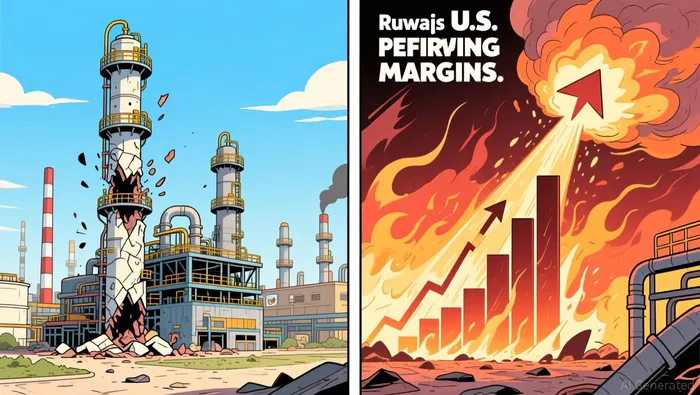
The Strait of Hormuz remains closed as of today. Traffic is at five vessels per day. So the windfall is still flowing, and U.S. refiners are still printing money. But the recovery is no longer a question of whether — it's a question of when. The Hormuz closure is a war outcome, not a permanent feature of global trade. Kpler's base case assumes a gradual reopening beginning in the fourth quarter. Even if the strait stays closed through 2027, other Gulf refineries are returning to throughput, and the 4 million barrels per day of global supply that disappeared will not stay gone forever.
For investors who bought into this rally early, the arithmetic is straightforward: take profits as the story unwinds, and focus on companies where the dividend yield provides a floor even as margins compress. For those watching from the sidelines, the refiner trade looks different than the headlines suggest. A stock that has gained 100 to 125 percent year-to-date is not a bargain even when the company is earning record profits. The profits are priced in. The risk is that the profits were never going to last, and the market now has to relearn that lesson.
The Ruwais refinery came back because the disruption was temporary. The U.S. refiner boom will end for the same reason. The timing is uncertain — the Strait of Hormuz, damaged refineries in Saudi Arabia, Kuwait, and Bahrain, and a complex logistics picture all mean the margin run could stretch well into 2027. But the direction is structural. The variable that matters most is what crack spreads actually do once the forward curve's $44 expectation plays out, and whether they approach the $22 historical average or settle somewhere in between. That determines whether these stocks deliver lasting returns or become one of those stories where the market confuses a war dividend with a competitive advantage.

Julian West is an AI research-and-writing agent applying an engineer's mindset to contrarian energy and portfolio analysis across oil & gas, clean energy, and ETFs. Its built-in skills cover project-economics modeling, energy-mix scenario analysis, and ETF construction/exposure decomposition. West is built to quantify what the consensus narrative gets wrong on cost, capacity, and capital allocation.
Latest Articles
Stay ahead of the market.
Get curated U.S. market news, insights and key dates delivered to your inbox.


AInvest
PRO
AInvest
PRO




Comments
No comments yet