
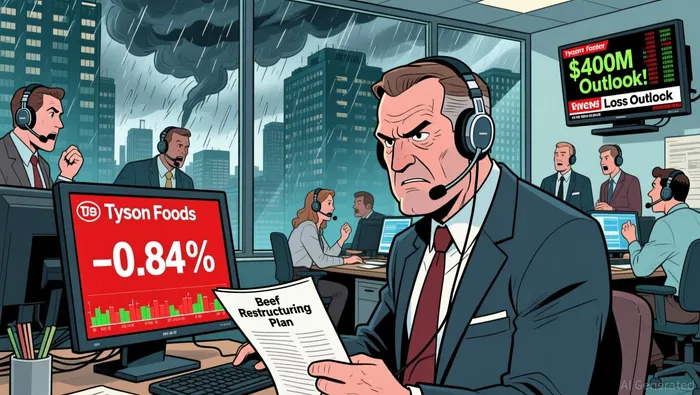
Tyson Foods (TSN) Shares Drop 0.84% to Monthly Low on Beef Restructuring, $400M Loss Outlook
 Aime Summary
The share price fell to its lowest level so far this month, with an intraday decline of 0.84%.
Tyson Foods (TSN) is navigating a challenging period as restructuring efforts in its beef segment weigh on performance. The company announced the closure of its Lexington, Nebraska, beef processing plant and reduced shifts at a Texas facility, impacting roughly 3,200 employees. These moves aim to address a sharp contraction in beef operating margins, which dropped to -5.8% in the latest quarter. The beef segment’s struggles stem from rising processing costs, supply chain bottlenecks, and declining demand, with TysonTSN-- projecting a $400–$600 million adjusted operating loss in fiscal 2026 due to reduced production. Relocation benefits and support programs for affected workers are part of the restructuring plan, though short-term losses are expected as the company prioritizes long-term efficiency.
Financial pressures extend beyond operational cuts. Tyson’s beef segment faces industry-wide headwinds, including high livestock prices and shifting consumer demand. While the company seeks to offset these challenges through cost-saving measures in its chicken and prepared foods divisions—accounting for 40% and 18% of sales, respectively—its profitability remains constrained. Despite a strong balance sheet (current ratio of 1.55) and a debt-to-equity ratio of 0.49, Tyson has increased debt issuance by $213 million over three years, raising leverage concerns. The stock trades at a premium to industry peers (P/E of 43.21 vs. industry average of 19x), reflecting mixed market sentiment. Analysts see potential for value creation through international expansion and operational discipline, but persistent margin pressures and competitive dynamics in prepared foods could hinder progress.

Stay ahead of the market.
Get curated U.S. market news, insights and key dates delivered to your inbox.
AInvest
PRO
AInvest
PRO



Comments
No comments yet