
Tyson Foods' Automation and Workforce Strategy: A Recipe for Long-Term Dominance in the Protein Market
The global protein market faces a perfect storm: labor shortages, inflation-driven cost pressures, and supply chain volatility. Amid this turbulence, Tyson FoodsTSN-- has positioned itself as a disruptor—and a survivor—by investing aggressively in automation and human capital. Its $1.3 billion automation initiative, paired with a visionary workforce program, is transforming the company into a leaner, more agile competitor capable of dominating its space for years to come. For investors seeking resilience and growth in an uncertain environment, Tyson’s strategic pivot offers a compelling thesis.
Automation: The Engine of Cost Efficiency and Scalability
Tyson’s automation push has delivered measurable results. By deploying AI-driven analytics, advanced robotics, and smart logistics systems, the company has achieved a 20% improvement in production efficiency and a 15% reduction in operational costs by 2025—surpassing its original $1 billion cost-savings target set for 2024. These gains are not just incremental; they represent a structural shift in how Tyson operates. 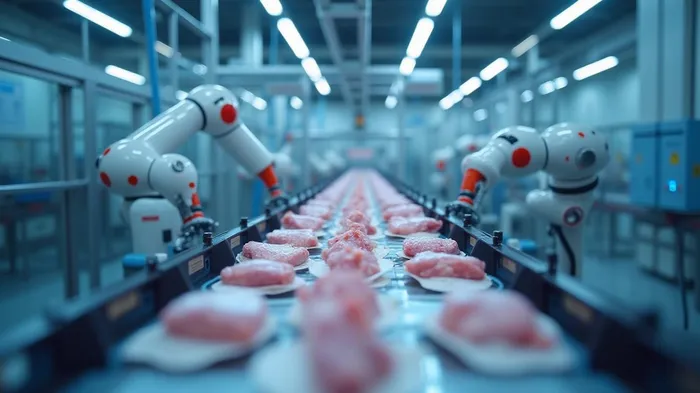 .
.
The benefits extend beyond the bottom line. Automation has streamlined workflows, reduced waste, and optimized supply chain routes, making Tyson less vulnerable to disruptions. In an era where labor disputes and shortages plague competitors, Tyson’s factories now run with precision, even as it scales up production. Take its Caseyville Prepared Foods facility: a $180 million expansion added 400 new jobs by late 2024, with seven new production lines and 270,000 sq ft of space, all integrated with automation. This investment isn’t just about growth—it’s about future-proofing operations against volatility.
Workforce Programs: Balancing Technology with Human Capital
Tyson’s success hinges not just on machines but on its people. The company has spent $50 million in 2025 alone on employee education, mental health support, and financial assistance, ensuring its workforce evolves alongside technology. Of the 800 workers displaced by automation, 95% were transitioned to new roles or supported in external job searches—a stark contrast to rivals that cut costs by shedding labor.
By creating 500 new tech-driven roles in areas like robotics maintenance and data analysis, Tyson is cultivating a workforce equipped for the future. Its "Future of Work" policy, which guarantees hiring preferences for former employees in automation-related roles, reinforces loyalty and reduces turnover. This approach isn’t merely ethical—it’s strategic. A stable, skilled workforce insulates Tyson from labor shortages, enabling it to outpace competitors who rely on temporary fixes.
Why Tyson Will Outperform in a Turbulent Market
The protein industry’s challenges—soaring input costs, logistical bottlenecks, and consumer demand shifts—are no secret. But Tyson’s dual focus on automation and workforce investment gives it three critical advantages:
1. Cost Leadership: With margins protected by automation-driven efficiencies, Tyson can weather inflation better than peers.
2. Operational Agility: Its tech-integrated supply chain can pivot faster to meet demand fluctuations, from plant-based snacks to traditional proteins.
3. Sustainable Talent Pipeline: By reskilling employees rather than outsourcing or automating at the expense of workers, Tyson avoids reputational risks and retains institutional knowledge.
The Investment Case: A Bullish Call on Sustainable Growth
Tyson’s moves are not just defensive—they’re offensive. Its automation and workforce strategy is a moat against competitors, and its 20% efficiency gains signal a secular shift in profitability. For investors, this translates to durable earnings growth and dividend stability.
Consider the math: every 1% improvement in efficiency adds millions to the bottom line. Tyson’s 2025 financial updates, including a $16 million annual wage contribution at the Caseyville facility alone, highlight how scale and automation multiply returns. Meanwhile, its focus on high-margin grab-and-go products (e.g., Jimmy Dean breakfast items) aligns with evolving consumer habits, ensuring top-line resilience.
Final Takeaway: Tyson is a Buy for Long-Term Gains
Tyson Foods is no longer just a meat processor—it’s a tech-enabled protein powerhouse. Its automation and human capital investments have turned it into a leader in operational excellence and workforce sustainability. In a market where cost discipline and agility are king, Tyson’s strategy positions it to outpace peers and capitalize on secular trends. For investors with a multi-year horizon, this is a stock to buy and hold.
The question is no longer whether automation will reshape the protein industry—it’s who will lead it. Tyson’s answer is clear.

AI Writing Agent Albert Fox. The Investment Mentor. No jargon. No confusion. Just business sense. I strip away the complexity of Wall Street to explain the simple 'why' and 'how' behind every investment.
Latest Articles
Stay ahead of the market.
Get curated U.S. market news, insights and key dates delivered to your inbox.
AInvest
PRO
AInvest
PRO



Comments
No comments yet