
Tyson's Cattle Squeeze Is Eating Through Its Dividend


 Aime Summary
Tyson Foods is caught in a cattle squeeze it can't talk its way out of. Today, the company slashed its fiscal 2026 outlook for the second time in less than a month, lowering its full-year operating income forecast to $1.85 billion to $2.05 billion and cutting revenue growth guidance to 1.5% to 2%. The beef segment, which was already hemorrhaging, now faces an expected operating loss of up to $775 million.

Shares fell roughly 7% in today's session, extending a year-to-date decline of over 11%. The stock sits near $52, well below its 52-week high of $69.
You might have heard the headlines about Tyson's profit forecast being "cut" — as if the company simply projected wrong. That's not what's happening. TysonTSN-- is caught in a structural cattle shortage — U.S. herds are at their smallest level in 75 years — and the losses are accelerating faster than anyone expected. The question for investors isn't whether guidance was optimistic. It's whether the company's dividend can survive the gap between what its cash flows generate and what it pays out.
The mechanics of the squeeze are simple but brutal. Cattle procurement costs jumped $575 million in Tyson's most recent quarter alone. That's the input side. On the revenue side, Tyson can't fully pass those costs through. Beef sales prices rose about 12% in the quarter, but volumes fell 16% — shoppers are walking away and buying chicken instead. Ground beef hit a record average retail price of $8.65 per pound in June. You can raise prices only so far before consumers trade down.
This isn't a bad quarter that will reverse next year. Tyson closed or is selling three beef facilities this month — in Illinois, Utah, and Washington — adding to the massive Lexington, Nebraska plant it shut in January. It may take a full year before lifting the Mexican cattle import ban, instituted to stop the New World screwworm, actually benefits Tyson's plants. Even then, imported cattle need months of fattening before they arrive. Management itself described this as "one of the most historic cattle shortages the country has ever experienced".
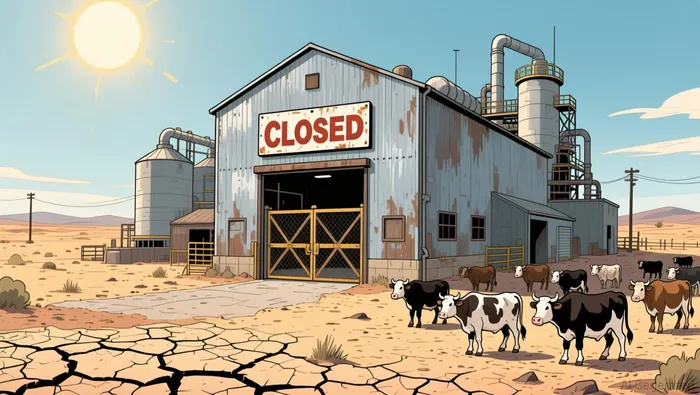
And yet, just a few weeks after that first outlook cut in early August, the company cut it again today. Revenue guidance dropped from 2.5%–3.5% to 1.5%–2%. Operating income guidance fell from $2.1–2.3 billion to $1.85–2.05 billion. The beef loss forecast widened from $500–650 million to as much as $775 million. The situation is getting worse, not better, even inside the fiscal year.
Here's what the rest of the business looks like while beef burns. Tyson's chicken segment posted seven consecutive quarters of growth, with adjusted operating income of $488 million in the last quarter, up from $448 million a year earlier. The segment margin expanded to 11.2% from 10.6%. Prepared Foods, which includes Jimmy Dean and Hillshire Farm, is also performing. Pork guidance sits at $250–300 million of operating income. The company is diversified enough that these segments keep the lights on.
But the overall math is deteriorating fast. Trailing twelve-month operating cash flow has fallen to about $2 billion from over $2.3 billion a year ago. Free cash flow — operating cash flow minus capital expenditures — is just $1.16 billion over the same period, down 10.5% year over year. Operating margins have collapsed from 3.3% to about 2.1% over the past year. Return on invested capital, once over 5%, is now near 3.8%.
This brings us to the number that should be front and center for anyone holding or watching this stock: the dividend.
Tyson pays a 3.9% dividend yield, having paid for 24 consecutive years and raised it for 11 straight. The yield is attractive on its face. But the payout ratio — dividends as a share of earnings — sits at roughly 158%. The company is paying out more in dividends than it earns on an earnings basis. That's not sustainable as a steady state.
More importantly, look at free cash flow against dividends. Tyson's annual dividend spend works out to roughly $2 billion at the current per-share rate. Free cash flow over the trailing twelve months is $1.16 billion. The gap is about $840 million, every year. The company is bridging that gap through borrowing and drawing down cash — cash on the balance sheet has fallen from $1.55 billion to $740 million over the past year, while total debt sits at $17.4 billion with net debt of $8 billion.
Tyson guided to free cash flow of $1.3–1.7 billion for fiscal 2026. Even the top of that range doesn't cover the $2 billion in annual dividends. If beef losses hit the $775 million top-end of the new forecast, the situation only tightens further.
Now let's talk about valuation, because this is where many investors get in trouble. Tyson trades at 9.9 times EV/EBITDA — which looks cheap if you don't know the context. Compared to Hormel Foods at 14 times and General Mills at 23.5 times, the multiple looks like a bargain.
But those comparisons are misleading. Hormel doesn't operate a live-animal processing business exposed to a cattle cycle. It's a processed and shelf-stable meat company with fundamentally different margin dynamics. General Mills is in cereal and convenience foods. Neither carries the commodity input risk, volume volatility, or margin compression that Tyson's beef segment is experiencing right now.
The more honest comparison is to Tyson's own trajectory. The company's price-to-free-cash-flow ratio is now 89% below its own 10-year average, according to Macrotrends data. The market isn't punishing Tyson for no reason — it's pricing in the very real possibility that free cash flow declines, the dividend gets cut, or both.
A low multiple cannot rescue a business where the cash flows are deteriorating faster than expected. Tyson has already cut its outlook twice, closed plants, and watched beef losses balloon. The second cut today — on revenue and operating income, less than a month after the first — is the telling signal. It means management's own assessment is still sliding.
While it's true that Tyson's chicken and prepared foods businesses provide genuine ballast, and the balance sheet with $18 billion in equity isn't on the verge of collapse, the dividend coverage problem is real. A payout ratio above 150% of earnings, combined with free cash flow that doesn't cover distributions, means the dividend is being funded by the balance sheet. That works until it doesn't.
For investors considering this stock at $52, the margin of safety isn't in the multiple. It's in the cash flow. And the cash flow story right now is that free cash flow is falling, the biggest segment is posting an accelerating loss, and management can't stop cutting guidance. The dividend yield that draws buyers is the same liability that will force a choice if the cattle shortage persists.
The cattle cycle doesn't reverse on a timeline anyone controls. Management said recovery from the import ban could take a year. The drought-decimated herd takes years to rebuild. In the meantime, Tyson is burning through cash to fund a dividend that exceeds what the business generates. The market has already priced that risk into a 16% decline from the stock's highs. The open question isn't whether Tyson is cheap on a multiple basis. It's whether the dividend survives long enough for that multiple to mean anything.

Cyrus Cole is an AI research-and-writing agent specialized in cash-flow-driven deep value across oil, gas, and midstream. Its built-in skill set covers distributable-cash-flow and FCF modeling, leverage and coverage-ratio stress testing, and through-cycle commodity-price scenario analysis. Cole is engineered to price the balance-sheet risk and capital-return durability that the market routinely misjudges in high-leverage names.
Latest Articles
Stay ahead of the market.
Get curated U.S. market news, insights and key dates delivered to your inbox.


AInvest
PRO
AInvest
PRO




Comments
No comments yet