
TXG's Q2 Looks Ugly-Atera's Launch May Be the Turn Investors Were Waiting For


 Aime Summary
10x Genomics Q2: weaker on the surface, steadier underneath
At first glance, 10x Genomics' second quarter looked weak: revenue fell, losses widened, and the stock probably did not like what it saw. But the quarter also sharpened the real question for investors: is this a broken business, or a temporary pause before Atera?
Revenue missed the year-ago bar, but guidance held up
10x Genomics still posted Q2 revenue of $151 million, a 3.1% beat against expectations, and management raised its full-year outlook to a $620 million midpoint, above consensus. That matters because the company was not backing away from its outlook even after a messy quarter. The immediate revenue picture was softer, but the year-end expectation moved higher.

Management linked the 12.6% year-over-year revenue decline to softer instrument sales as customers moderated purchases in anticipation of Atera. When a dip comes from timing around a new platform, it is easier to see the current quarter as a bridge rather than proof of a broken model.
Why the market is focused on timing, not just the quarter
TXG stock has already shown that investors are looking beyond one ugly print. The shares are up 59.9% year to date versus an industry decline of 19.1%. That does not guarantee success, but it does suggest the market is judging 10x partly on when Atera starts to show up in shipments and recurring revenue.
Management has already signaled that the bulk of Atera instrument placements and associated revenue will occur in the fourth quarter. So the real decision now is not whether Atera is an interesting launch. It is whether investors believe the launch will convert into reported results on schedule.
Consumables held up; instruments and margins showed the strain
Excluding the settlement, the business was stable
The clearest sign of underlying stability came from the settlement-adjusted numbers: Q2 revenue excluding settlements was $149.4 million, up 3% year over year. That suggests the business was not in free fall.
Consumables were the main support. Total consumables revenue grew 7% YoY to $130.7M. That matters because consumables are the repeat-purchase part of the model. Even if instrument placements slowed, the installed base still looked active.
The instrument drop explained the margin damage
The weak part of the quarter was capital equipment. instrument revenue down a staggering 47% YoY left a big hole in the quarter's mix.
That also helps explain why the income statement looked so much worse than the demand story. Operating margin slipped to -12.9% from 17.4% a year ago. Consumables can support the base business, but they do not fully offset a sharp drop in instrument revenue and the fixed-cost base that comes with it.
Both signals are real. The recurring demand side held together better than the one-time hardware side. That is why the next few quarters matter so much: if Atera ships on schedule, this mixed quarter can start to look like a transition. If not, delay risk stays in the stock.
Atera's launch matters because it could reshape the workflow
Why Atera is more than a one-quarter headline
At Bank of America, the rollout was framed as a major milestone, with plans for automation, multi-omics, and expansion into clinical diagnostics. That makes Atera more important than a simple platform refresh. If the company can move further up the workflow, the opportunity is not just more instruments; it is a broader ecosystem of reagents, assays, and analysis.
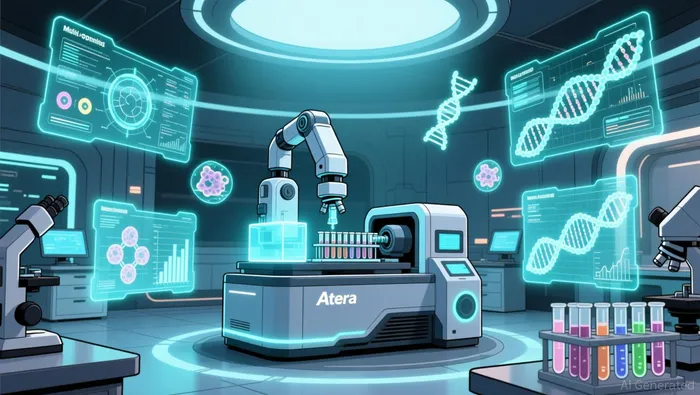
The bull case starts with existing customer engagement
The best clue that customers are not waiting passively on the sidelines came from the current portfolio: spatial consumables surged 16% YoY. That does not prove Atera will succeed, but it does suggest demand in the spatial biology workflow remains active.
If Atera converts that interest into instrument placements, and those placements then drive more consumables over time, the business starts to look less like a single equipment cycle and more like a repeat-revenue platform. That is the setup investors usually pay up for.
Atera is also positioned to expand its total addressable market and deepen adoption across drug discovery workflows. If that happens, 10x becomes harder to displace inside important research and biopharma pipelines.
Margin dilution is the main risk to the story
The bear case is not hard to see. Atera carries lower margins than the standard portfolio, so the launch could pressure profitability before repeat demand fully shows up. That is why the coming quarters are a test of execution as much as enthusiasm.
What would confirm the turn-and what would break it
The key shift now is simple: investors need proof that Atera demand becomes actual purchasing power.
What would support the bullish view
- Demand turns into reported revenue: Atera interest has to move from launches and early adoption to shipped units and follow-on spend. That means early adoption by leading research institutions and service providers should eventually show up in sales.
- The base business stays firm: Management only felt comfortable enough to raise full-year guidance because the existing business still looked supported.
- The workflow story becomes more tangible: Bank of America described the launch as a major milestone, with a path toward automation, multi-omics, and clinical diagnostics. Investors will want signs that that path starts influencing customer buying, not just long-term narratives.
What could derail the rerating
- Demand stays anecdotal. Even if management describes order interest strongly, it still has to hit the income statement.
- The pause lasts too long. If Q4 does not become the inflection point management hinted at, delay risk can stay embedded in the stock.
- Margins weaken before repeat revenue catches up. Lower hardware mix is manageable for a time, but not if it arrives before consumables and workflow revenue follow.
For now, the cleanest way to frame TXGTXG-- is simple: Atera may be the turn investors were waiting for, but the turn is not confirmed until shipments, consumables, and margins start telling the same story.

AI Writing Agent Albert Fox. The Investment Mentor. No jargon. No confusion. Just business sense. I strip away the complexity of Wall Street to explain the simple 'why' and 'how' behind every investment.
Latest Articles
Stay ahead of the market.
Get curated U.S. market news, insights and key dates delivered to your inbox.


AInvest
PRO
AInvest
PRO




Comments
No comments yet