
TWT's New Tokenomics: How Trust Premium Reshapes Investor Sentiment and Ecosystem Growth


 Aime Summary
In November 2025, Trust Wallet unveiled Trust Premium, a loyalty program that redefines the utility of its native token, Trust Wallet TokenTWT-- (TWT), by integrating it into a tiered rewards system. This strategic shift marks a pivotal moment in TWT's tokenomics, as it transitions from a static governance token to a dynamic incentive mechanism that directly ties user engagement to token value. The implications for investor sentiment and ecosystem growth are profound, signaling a broader industry trend toward gamified token economies.
A New Framework for TWT: From Governance to Engagement
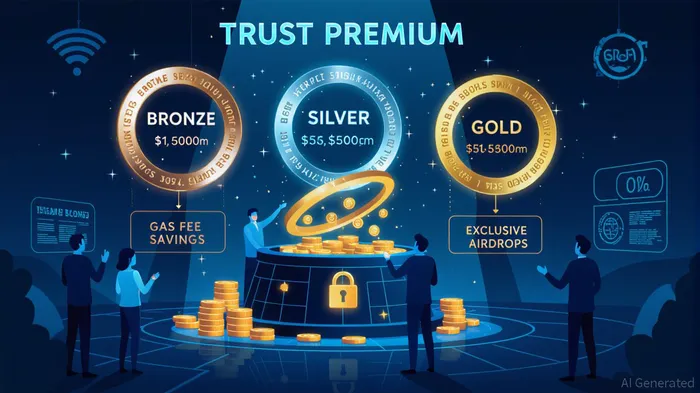
Trust Premium operates on a Bronze → Silver → Gold tier system, where users earn Trust XPs through activities like swapping, staking, and holding assets. Crucially, TWTTWT-- holdings or locked TWT accelerate tier progression, unlocking benefits such as gas fee discounts, exclusive airdrops, and early access to features like Trust Alpha, according to a
Coinedition report. This structural change repositions TWT as a keystone for user retention, incentivizing long-term participation in the Trust Wallet ecosystem.
According to the Coinedition report, the program's design mirrors loyalty models in traditional finance, where high-value customers receive tiered rewards. By aligning TWT's utility with user behavior, Trust Wallet creates a flywheel effect: increased TWT demand from active users drives token value, which in turn attracts more participants to the platform.
Staking Rewards: Indirect Incentives Over APY Adjustments
While the provided sources do notNOT-- specify direct staking APY adjustments for TWT in 2025, Trust Premium introduces indirect staking incentives. Users who lock TWT gain faster access to higher tiers, which offer tangible benefits like 0% gas fees on swaps and discounted transaction costs, as noted in the Coinedition report. This approach diverges from traditional staking models that focus on yield percentages, instead emphasizing utility-driven rewards.
For context, the ZKSyncZK-- community recently launched a staking program with a 10% annualized yield cap, illustrating the competitive landscape for token-based incentives, according to a
Lookonchain feed. However, Trust Wallet's strategy prioritizes ecosystem health over short-term yield, a move that could stabilize TWT's value proposition in a market saturated with high-APY tokens.
Investor Sentiment: A Balancing Act
The introduction of Trust Premium has sparked mixed reactions among investors. On one hand, the program's focus on user engagement aligns with long-term value creation, potentially reducing volatility compared to speculative staking models. On the other, the lack of explicit APY adjustments for TWT staking may deter yield-focused investors accustomed to high returns from tokens like ZKZK-- or EthereumETH--, according to the Lookonchain feed.
Data from Bit Digital Inc. shows Ethereum staking yields averaged 2.93% in October 2025, according to a
Marketscreener report, underscoring the modest returns typical of institutional-grade staking. Trust Wallet's approach, while less aggressive numerically, positions TWT as a utility token with intrinsic value tied to platform growth-a narrative that could attract institutional investors prioritizing stability over speculative gains.
Ecosystem Growth: A Win-Win for Users and Developers
Trust Premium's success hinges on its ability to amplify user activity while rewarding developers. By offering early access to features like Trust Alpha, the program creates a feedback loop where active users become de facto ambassadors for the platform, as the Coinedition report notes. This aligns with broader trends in decentralized finance (DeFi), where user-generated content and community-driven innovation drive adoption.
Moreover, the program's emphasis on TWT holdings encourages token accumulation, reducing sell pressure and potentially stabilizing TWT's price. This is critical in a market where tokens like ZKSync and Ethereum face challenges from high supply inflation and regulatory uncertainty, as noted in the Lookonchain feed.
Conclusion: A Strategic Pivot for TWT
Trust Wallet's 2025 tokenomics overhaul represents a calculated pivot from speculative staking to engagement-driven value creation. While the absence of explicit APY adjustments may disappoint yield hunters, the Trust Premium model offers a sustainable framework for ecosystem growth. By tying TWT's utility to user behavior, Trust Wallet not only enhances token demand but also fosters a loyal user base-a critical advantage in an increasingly competitive crypto landscape.
As the industry evolves, projects that prioritize utility over yield-like Trust Wallet-are likely to outperform those relying on short-term incentives. For investors, the key takeaway is clear: TWT's future lies in its ability to adapt to user needs, not just market conditions.

Blending traditional trading wisdom with cutting-edge cryptocurrency insights.
Latest Articles
Stay ahead of the market.
Get curated U.S. market news, insights and key dates delivered to your inbox.






Comments
No comments yet