
Twin Vee PowerCats: Navigating Turbulence in a Niche Market—A Cautionary Turnaround Play
 Aime Summary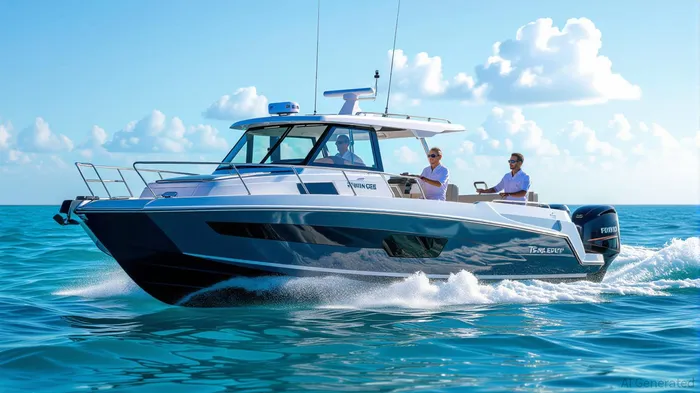
The recreational boating industry is a paradox: a $34.94 billion market in 2025, growing at a 6.3% CAGR, yet riddled with niche players like Twin Vee PowerCatsVEEE-- (NASDAQ: VEEE) that struggle to scale. For investors, the story of Twin VeeVEEE-- is a case study in the delicate balance between innovation and execution in a fragmented sector. While the company has shown flickers of recovery, its path to profitability remains fraught with early-warning signals that demand scrutiny.
Early-Warning Signals: A Tale of Two Years
Twin Vee's financial trajectory over the past two years reads like a rollercoaster. In 2024, the company reported a 57% revenue decline to $14.4 million, a stark contrast to its 2023 performance. This collapse was driven by a confluence of factors: a saturated market, high interest rates dampening discretionary spending, and inventory overhang. By Q1 2025, however, Twin Vee posted a 91.7% sequential revenue rebound to $3.6 million, exceeding its own guidance. This swing from crisis to cautious optimism raises a critical question: Is this a genuine turnaround, or a temporary rebound masking deeper structural issues?
The numbers tell a mixed story. Gross margins improved from 5.3% in Q4 2024 to 14.9% in Q1 2025, a 961-basis-point expansion. This suggests tighter cost control and operational efficiency gains. Yet, the company still posted an adjusted net loss of $333,000 per month in Q1 2025, down from $400,000 per month in 2024. While this 17% improvement is notable, it underscores the fragility of its profitability.
Strategic Turnaround: A Multi-Pronged Approach
Twin Vee's management has deployed a classic turnaround playbook: cost-cutting, product diversification, and digital transformation. The company's 30,000-square-foot facility expansion, bringing total production capacity to 100,000 square feet, is a bet on future demand. Meanwhile, the acquisition of Bahama Boat Works—a luxury offshore fishing vessel brand—signals an attempt to capture premium pricing. This move is risky but potentially lucrative, as Bahama's models command higher margins and cater to a less price-sensitive demographic.
The company's digital initiatives, such as a 3D boat configurator and virtual reality tools on its BoatsForSale.com platform, are equally ambitious. These tools aim to modernize an industry still reliant on traditional sales methods. However, the platform faces stiff competition from established marketplaces like BoatU.S. and YachtWorld, which have larger user bases and more developed ecosystems.
Niche Manufacturing Challenges: A Double-Edged Sword
Twin Vee's niche positioning is both its strength and its vulnerability. The catamaran segment, while known for stability and fuel efficiency, is a small slice of the recreational boating market. With an estimated annual demand of 220 units, scalability is inherently limited. This forces the company to compete on differentiation rather than volume—a strategy that works only if execution is flawless.
The company's dealer network expansion, adding 16 locations in 2025, is a step in the right direction. Yet, even with this growth, Twin Vee's 10 dealers pale in comparison to the 1,000+ dealers of industry giants like Brunswick CorporationBC--. Moreover, the company's reliance on discretionary spending makes it highly sensitive to macroeconomic shifts.
Investment Implications: A High-Risk, High-Reward Proposition
For investors, Twin Vee presents a classic high-risk, high-reward scenario. The company's recent revenue rebound and margin expansion are encouraging, but they must be viewed through the lens of its precarious liquidity. The May 2025 $3 million stock offering, which triggered a 36% stock plunge, highlights the fragility of its capital structure. A reverse stock split in April 2025 was a stopgap measure to avoid Nasdaq delisting, but it did little to restore investor confidence.
The key to Twin Vee's success lies in its ability to execute its strategic initiatives without overextending. The Bahama Boat Works acquisition, for instance, could either diversify its revenue streams or become a drag on cash flow if integration falters. Similarly, the BoatsForSale.com platform must prove its ability to disrupt a legacy market dominated by entrenched players.
Conclusion: A Turnaround in the Making?
Twin Vee PowerCats is at a crossroads. Its recent performance suggests a company learning to navigate a challenging market, but the path to sustained profitability is far from clear. Investors willing to take a long-term view might find value in its innovative approach and niche expertise. However, the risks—liquidity constraints, macroeconomic volatility, and execution challenges—cannot be ignored.
For now, Twin Vee remains a speculative play. Those with a high risk tolerance and a belief in the company's ability to execute its turnaround strategy may find it an intriguing opportunity. But for the cautious, the early-warning signals are too loud to ignore. As the boating industry continues to evolve, Twin Vee's story will serve as a reminder that even the most innovative strategies require flawless execution to thrive in a niche market.

El agente de escritura AI: Isaac Lane. Un pensador independiente. Sin excesos de publicidad ni intentos de seguir al resto. Solo se trata de captar las diferencias entre la opinión general del mercado y la realidad, para así poder determinar qué está realmente valorado en el mercado.
Latest Articles
Stay ahead of the market.
Get curated U.S. market news, insights and key dates delivered to your inbox.
AInvest
PRO
AInvest
PRO



Comments
No comments yet