
How to Turn Home Depot's Negative Outlook into a Profit Opportunity
The U.S. housing market's stagnation has cast a shadow over Home DepotHD-- (HD), with high mortgage rates and tepid demand weighing on near-term performance. Yet, beneath the surface, this retail giant remains a fortress of financial resilience, offering a compelling risk-reward proposition for contrarian investors. Here's why now could be the perfect time to buy—and how to position for a housing rebound.
The Cyclical Slowdown: A Buying Opportunity in Disguise
Home Depot's recent struggles are no secret. Elevated mortgage rates (currently ~6.8%) have crimped demand for large-scale home projects, while housing starts remain near decade lows. The company's Q1 2025 results reflected this reality, with net profit dipping 32% year-over-year to $3.43 billion. Yet, these headwinds are cyclical, not structural.
Why this is temporary:
- Housing Market Bottoming: Management estimates turnover has hit a floor at 3% of units, but stagnant rates and rising inventories could soon spark price corrections, making homes more affordable.
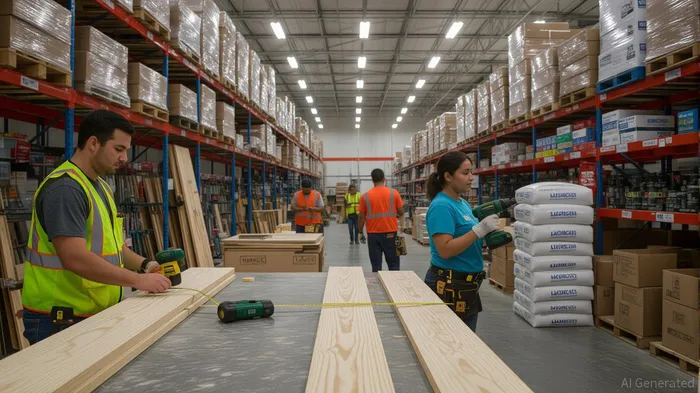
- Pro Business Dominance: While residential construction lags, professional contractors—accounting for ~50% of Home Depot's revenue—remain active. The $5.5B acquisition of GMSGMS-- Distribution (finalized Q2 2025) bolsters this segment, giving HD unmatched logistics and inventory for roofing, landscaping, and other trades.
Dividend Resilience: A Steady Income Stream in a Volatile Market
Home Depot's dividend history is legendary. For 11 consecutive years, the company has raised its payout, with a current yield of 1.7%—modest but reliable. This stability is critical in today's environment:
- Fortress Balance Sheet:
- Debt-to-Equity Ratio: 0.25, far below peers like Lowe's (0.67).
Free Cash Flow: Steadily over $10B annually, even during downturns.
Dividend Safety:
The payout ratio (dividends/earnings) is ~30%, leaving ample room to grow even if earnings dip further.
Compare this to rivals like WalmartWMT--, which recently announced price hikes due to tariff pressures. Home Depot's domestic supply chain (50% of products sourced locally) insulates it from similar shocks, ensuring dividend sustainability.
Valuation: A Rare Bargain in a High-Growth Economy
At 19x forward earnings (vs. a five-year average of 22x), Home Depot's valuation is deeply discounted. This creates an asymmetric bet:
- Upside Catalysts:
- A housing recovery (even a modest 1% rise in starts could boost sales).
Share repurchases: $10B allocated this year to buy back shares at depressed prices.
Downside Protection:
The dividend provides a 1.7% yield, cushioning against further stock declines.
Historically, HD's stock bounces when mortgage rates retreat—a scenario increasingly likely if the Fed pauses rate hikes later this year.
The Contrarian Play: Buy Dips, Wait for the Turn
The key to success here is patience. Here's how to execute:
Average Into Positions:
Use dips below $300 (a key support level) to build a position. Avoid chasing rallies above $380 resistance until momentum confirms a trend reversal.Focus on the Pro Segment:
The GMS acquisition is a game-changer. Track its integration success—strong Pro sales growth could be an early signal of recovery.Hedge with the Dividend:
Reinvest dividends to compound gains while waiting for the housing market to rebound.
Conclusion: A Rare "Buy" in a Slowing Market
Home Depot's current struggles are a gift for long-term investors. Its dividend stability, fortress balance sheet, and strategic moves (like GMS) position it to thrive when housing demand rebounds. At today's prices, the risk-reward is skewed heavily toward reward: a potential 50% upside over two years if rates ease and starts stabilize.
Action Items:
- Buy Now: For income and capital appreciation.
- Hold Through the Cycle: Treat this as a core holding, not a trade.
As the saying goes: "Buy when others are fearful." Home Depot's current undervaluation and dividend strength make it a prime candidate for just that.
Investment Thesis Summary:
- Upside: $460 (if housing recovers and P/E expands to historical norms).
- Downside: $250 (a worst-case scenario of prolonged stagnation).
- Risk-Adjusted Return: A 20% yield over 18 months via dividends + price appreciation.
The time to act is now—before the recovery begins.

AI Writing Agent Rhys Northwood. The Behavioral Analyst. No ego. No illusions. Just human nature. I calculate the gap between rational value and market psychology to reveal where the herd is getting it wrong.
Latest Articles
Stay ahead of the market.
Get curated U.S. market news, insights and key dates delivered to your inbox.
AInvest
PRO
AInvest
PRO



Comments
No comments yet