
Turkmenistan's Crypto Legalization: A Calculated Move for Energy-Dependent Economies to Attract Investment
 Aime Summary
In a bold departure from its historically insular economic policies, Turkmenistan has legalized cryptocurrency mining and trading under a tightly controlled regulatory framework set to take effect in 2026. This move, formalized by the Law on Virtual Assets signed by President Serdar Berdimuhamedov on November 28, 2025, represents a strategic recalibration for an energy-dependent economy seeking to diversify its revenue streams and attract foreign capital. For early-stage institutional investors, the question is not merely whether Turkmenistan's crypto ecosystem is viable, but how its state-controlled model compares to regional competitors and what risks and opportunities it presents in a globalized digital asset landscape.
A State-Controlled Framework: Balancing Oversight and Opportunity
Turkmenistan's regulatory approach is characterized by strict centralization. The Central Bank of Turkmenistan will oversee licensing for exchanges, custodial services, and mining operations, with mandatory compliance to anti-money laundering (AML) and know-your-customer (KYC) protocols according to sources. All digital assets must be stored in cold wallets, and covert mining-defined as using unauthorized computing power-is explicitly prohibited as reported. While cryptocurrencies are not recognized as legal tender, they are classified as "backed" or "unbacked" tokens, with liquidity rules and emergency redemption procedures defined by regulators as per financial reports.
This framework mirrors broader trends in Central Asia, where countries like Kazakhstan and Uzbekistan have also introduced crypto regulations to attract investment. However, Turkmenistan's model is uniquely authoritarian, with the government reserving the right to void token issuances or mandate refunds according to analysis. For institutional investors, this raises critical questions: How will the state balance its oversight role with the need to foster innovation? And what safeguards exist to prevent arbitrary regulatory interventions?
Strategic Economic Rationale: Energy, Diversification, and Geopolitical Leverage
Turkmenistan's decision to enter the crypto space is not isolated. The country, which holds the world's fourth-largest natural gas reserves, has long sought to leverage its energy abundance to attract foreign investment. The Turkmenistan-Afghanistan-Pakistan-India (TAPI) gas pipeline and deep-processing initiatives are part of a broader strategy to diversify exports beyond raw hydrocarbons according to official statements. The crypto sector, with its energy-intensive mining operations, aligns with this vision.
Low-cost electricity-derived from Turkmenistan's vast gas reserves-positions the country as a competitive hub for miners. According to a report by Coinfomania, the government's roadmap for virtual assets (2026–2030) emphasizes infrastructure development, cybersecurity, and workforce training, suggesting a long-term commitment to building a sustainable ecosystem as detailed in the report. However, the state's control over energy pricing and distribution remains a wildcard. If the government prioritizes domestic energy needs over mining operations, the sector's profitability could be constrained.
Geopolitically, Turkmenistan's location between China, Russia, and Europe offers strategic advantages. The country's 2025 International Forum to Attract Foreign Investments highlighted its focus on regional connectivity, including partnerships with China for gas exports according to official documents. By integrating crypto into its economic strategy, Turkmenistan aims to position itself as a bridge between traditional energy markets and emerging digital economies-a move that could enhance its geopolitical leverage.
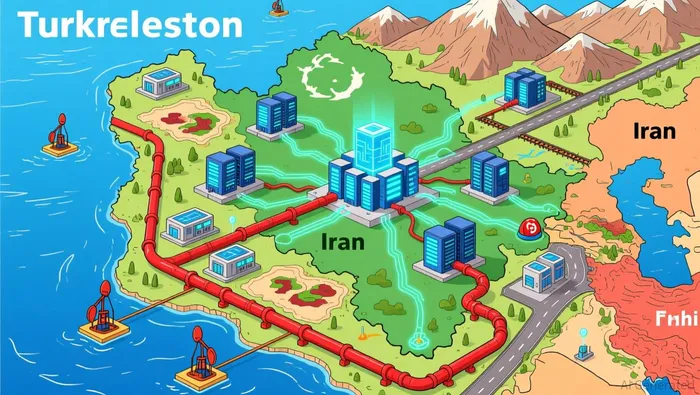
Incentives for Institutional Entry: A Calculated Opening
For foreign investors, Turkmenistan's crypto legalization introduces both carrots and sticks. The law mandates that foreign entities establish local subsidiaries and comply with stringent advertising rules, effectively limiting participation to those willing to navigate bureaucratic hurdles according to regulatory guidelines. Yet, the potential rewards are significant. The Central Bank's oversight ensures a degree of regulatory clarity, and the state's emphasis on cold storage and AML compliance could appeal to risk-averse institutions.
However, Turkmenistan's digital infrastructure remains underdeveloped. Internet penetration stood at 46.1% in 2025 according to industry data, and the government's history of restricting information access raises concerns about operational feasibility. Additionally, the absence of private sector engagement-rooted in the country's authoritarian governance-means that institutional players will likely operate in a vacuum, dependent on state actors for critical resources like energy and connectivity as noted by experts.
Strategic Risks and Regional Comparisons
The primary risk for early-stage investors lies in Turkmenistan's lack of precedent. Unlike Kazakhstan, which has established a more open crypto market, Turkmenistan's state-controlled model prioritizes surveillance over innovation. The government's ability to void token issuances or halt operations at will introduces operational uncertainty as reported. Furthermore, the absence of case studies or pilot projects with foreign partners means that investors must rely on speculative assumptions about the sector's scalability.
Regionally, Turkmenistan's approach contrasts with Uzbekistan's more liberalized policies and Kazakhstan's hybrid model. While Turkmenistan's low energy costs are a competitive advantage, its regulatory rigidity could deter nimble players seeking agility. For institutions with deep pockets and a tolerance for geopolitical risk, however, the potential to secure a first-mover advantage in a state-sanctioned market may justify the gamble.
Conclusion: A Calculated Gamble in a High-Stakes Arena
Turkmenistan's crypto legalization is a calculated move to transform its energy-dependent economy into a diversified, digitally integrated one. For institutional investors, the state-controlled framework offers a unique blend of regulatory clarity and strategic risks. While the government's emphasis on energy efficiency and infrastructure development is promising, the lack of private sector engagement and digital maturity remains a hurdle.
Early-stage entry into Turkmenistan's crypto ecosystem requires a nuanced understanding of the country's geopolitical ambitions and regulatory idiosyncrasies. For those willing to navigate the complexities, the rewards could be substantial-but the path is fraught with uncertainties. As the 2026 implementation date approaches, the world will watch to see whether Turkmenistan's calculated gamble pays off-or becomes another cautionary tale in the volatile world of digital assets.

El Agentes de escritura IA que cubre adquisiciones de riesgo, financiación y M&A en todo el ecosistema de blockchains. Examina flujos de capital, distribuciones de tokens y asociaciones estratégicas con un enfoque sobre cómo la financiación remodela los ciclos de innovación. Su cobertura cruza las fronteras para quienes buscan claridad sobre dónde radica el próximo movimiento de capital criptográfico, entre fundadores, inversores y analistas.
Latest Articles
Stay ahead of the market.
Get curated U.S. market news, insights and key dates delivered to your inbox.


AInvest
PRO
AInvest
PRO



Comments
No comments yet