
Turkey’s Treasury Cash Plummets as Geopolitics Drain Reserves
 Aime Summary
Turkiye's Treasury Cash Balance reached a record deficit of -279.578 billion in its latest update signaling heightened liquidity stress, amid ongoing geopolitical tensions in the Middle East. This sharp drop from a prior level of -92.420 billion highlights the vulnerability of Turkey's fiscal position in the face of global supply shocks, oil price volatility, and foreign exchange market instability. The Treasury Cash Balance reflects the government's net cash position and is closely watched by investors and policymakers as an early signal of fiscal sustainability and potential debt risks.
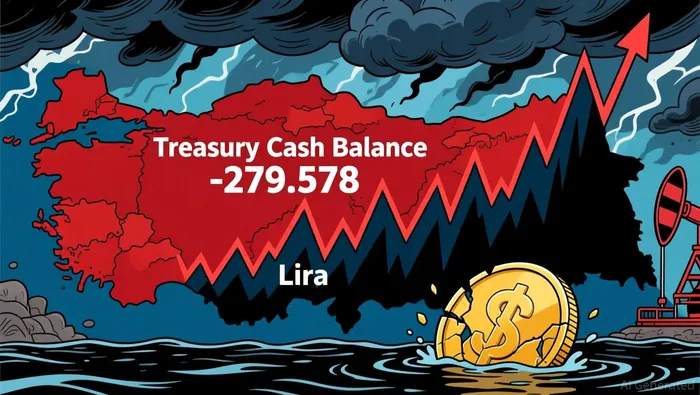
The recent surge in geopolitical tensions involving the U.S., Israel, and Iran has compounded Turkey's challenges, particularly through elevated oil prices and a weaker lira. As a regional power with close ties to multiple stakeholders in the Middle East conflict, Turkey is experiencing both direct and indirect economic consequences. The Central Bank of the Republic of Türkiye has deployed a range of liquidity tools, including gold-backed foreign exchange swaps and targeted FX interventions, to support the lira and stabilize domestic financial conditions. However, these measures are placing additional strain on the country's foreign exchange reserves, which have declined sharply in the past week due to rapid depletion from geopolitical shocks. This raises questions about Turkey's ability to maintain its current fiscal and monetary strategy in the medium term.
Investors are closely watching the Treasury Cash Balance as a proxy for the government's ability to manage short-term financial obligations and avoid debt default. A worsening cash position may signal deeper fiscal pressures and could lead to higher borrowing costs, tighter monetary conditions, or capital outflows. At the same time, Turkey's stock market has shown surprising strength in Q1 2025, with the BIST 30 index rising over 18% on strong foreign inflows and central bank intervention. This divergence highlights the complex interplay between macroeconomic fundamentals and market sentiment, with domestic investors often betting on policy responses rather than immediate fiscal risks.
As the situation evolves, the coming weeks will see whether Turkey's policymakers manage to stabilize the lira and restore investor confidence in its fiscal and monetary strategy. Upcoming data on the central bank's policy rate decision, inflation data, and energy import trends will be crucial for assessing Turkey's path forward. A potential rate hike this month, as increasingly priced into money markets, could signal a shift in policy toward tightening liquidity and addressing inflationary pressures, but at the cost of slowing economic growth. The Treasury Cash Balance will remain a critical barometer for assessing the balance between fiscal discipline and economic stability.

Stay ahead of the market.
Get curated U.S. market news, insights and key dates delivered to your inbox.


AInvest
PRO
AInvest
PRO



Comments
No comments yet