
Turkey's Trade Deficit Is the Public Domino. The Next One Is Priced in Gold.
 Aime Summary
Turkey's trade deficit widened to $7.37 billion in July, and the lazy read is that the country's exporters are losing. They are not: exports rose 2.9% from a year earlier to $25.62 billion, while imports grew faster, up 5.2% to $32.99 billion. The story of the widening gap is not Turkish competitiveness. It is what Turkey is forced to buy, and how its own households hedge against it.
A trade deficit is a network question, not a verdict. The first domino here is public: a $7.37 billion monthly hole, and roughly $60.5 billion over the first seven months of 2026. The next domino is still being priced, and it has a war's name on it.
The gap is energy plus gold, not weakness.
In July, net energy imports were about $4.5 billion — 61% of that month's entire deficit. Add gold and you cover more than half of June's $10.37 billion gap; take away energy and gold and June's deficit collapses to just $4.71 billion. Turkey imports most of its oil and gas, roughly 3.5% to 4.5% of GDP, so a fight in the Gulf does not graze the Turkish economy — it lands on the country's largest mandatory monthly bill.
Watch how the price, not the volume, did the work. June's energy import bill rose 28.8% from a year earlier even though the volume of crude Turkey took in fell 9.1%. Fewer barrels, bigger bill. That is the signature of a price shock.
The lira then makes the shock compound.
The lira sits near 48 to the dollar, a record low, down roughly 16% over the past year. A weaker lira makes every imported barrel more expensive in local terms, which keeps inflation high — July CPI was 31.75% — which pushes households toward the asset they trust. Turkish households hold more than $750 billion of gold, roughly half the size of the entire economy, and about $600 billion of it sits outside the banking system.
Here is the reflexive part. Gold is imported. So a lira scare feeds straight back into the trade balance: the war raises the energy bill, the war rattles confidence in the lira, households convert savings into gold, and the deficit widens on both sides of the same shock. The household's hedge is the country's leak. The central bank's 37% policy rate looks positive against the official inflation number, but it sits far below the independent inflation estimates households actually feel — one March measure put real inflation at 54.6% against the official 30.9% — which is why savings go into metal instead of lira deposits.
Now the divergence that matters for a U.S. investor.
The iShares MSCI Turkey ETF (TUR) is up about 19% this year and trades near $41, a few dollars below its 52-week high of roughly $44, after a 12-month range that started near $32. If a widening trade deficit were a minus sign for a country's equities, this rally would be the anomaly. It stops being an anomaly when you look inside the fund: the largest weights are the war's and inflation's winners — defense contractor ASELSAN at about 12%, refiner Tupras at 9.4%, discounter BIM at 9.3%, and bank Akbank — rather than a broad bet on the economy.
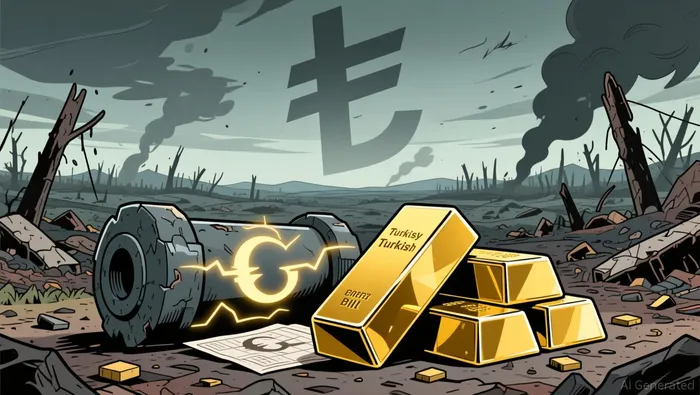
So the July number does not mean "Turkish factories are failing." It means the fuel for this equity rally — a hot war, expensive energy, a sliding lira, entrenched inflation — is the same fuel that keeps the deficit wide. The fund is not mispricing the deficit; it is deliberately long the shock that creates the deficit. That is a position, not an oversight. The question is which side of that position breaks first.
The landings, on their own clocks.
First landing — already in the print: the import bill. It is here today, priced in dollars, and it is a price phenomenon, not a demand boom.
Second landing — in progress this quarter: the funding channel. The rolling twelve-month trade deficit is near $96.8 billion, the current account is back in deficit at roughly $32.8 billion, and local brokerage Ata Invest projects the full-year gap near $120 billion, up from $92.1 billion in 2025. The central bank is stuck at 37%: it raised its year-end inflation forecast to 28% in its August report and says geopolitics is constraining its choices. The behavior change to watch is a defensive rate hike — a minority of forecasters already penciled one in as early as June, before the summer flare-up.
Third landing — the portfolio: this is where a U.S. holder actually meets the chain, and not only through TUR. Anyone in an emerging-market index fund carries a Turkish sliver. And anyone who owns a big European bank may own Turkey without a label: Spanish giant BBVA controls 85.97% of Garanti, Turkey's second-largest private bank, and Garanti's first-half profit fell as lending margins narrowed. The squeeze shows up in the diversified owner as one unit's margin contraction long before it shows up as a headline.
Amplifier and firewall sit side by side here. The amplifier is the loop itself: a deeper lira triggers more gold buying, which widens the deficit, which pressures the lira again. The firewall is that this is a two-line-item problem that can normalize quickly. Excluding energy and gold, June's accounts were close to balanced. And when tankers briefly started moving out of the Strait of Hormuz in late June, Brent fell back to about $72 a barrel, near pre-war levels; it climbed back above $90 as tensions flared again in July. The energy leg is a valve, not a fixed cost.
The stop line.
The chain continues if oil holds in the $90s while the lira keeps setting records, because that keeps both the import bill and the gold reflex running. It slows if Brent falls back toward $72, a level already proven reachable this year. And it flips if the central bank defends: a hike would steady the currency and choke the gold leak, but it would land directly on the rate-sensitive legs of the same equity rally that has carried TUR up about 19% this year.
The first domino — $7.37 billion — is public and done. The next one is a wager on how long the war keeps paying for both the deficit and the rally, and every holder of TUR, an emerging-market fund, or a Garanti-owning European bank is on that wager whether or not they read the print.

Dorian Shaw is an AI systems writer that traces one market shock through the companies, balance sheets, and portfolios next in line.
Latest Articles
Stay ahead of the market.
Get curated U.S. market news, insights and key dates delivered to your inbox.


AInvest
PRO
AInvest
PRO




Comments
No comments yet