
Turkey's Record Current Account Surplus and Its Implications for Emerging Market Stability


 Aime Summary
Turkey's recent economic performance has defied expectations, with its current account surplus hitting a record $5.4 billion in August 2025-the largest since 1984. This surge, driven by a services account surplus of $9.5 billion, has transformed Turkey from a chronic deficit nation into a surprising net creditor, according to PA Turkey. For investors, this shift raises critical questions: How is a country historically prone to volatility achieving such resilience? And what does this mean for emerging market strategies in high-risk regions?
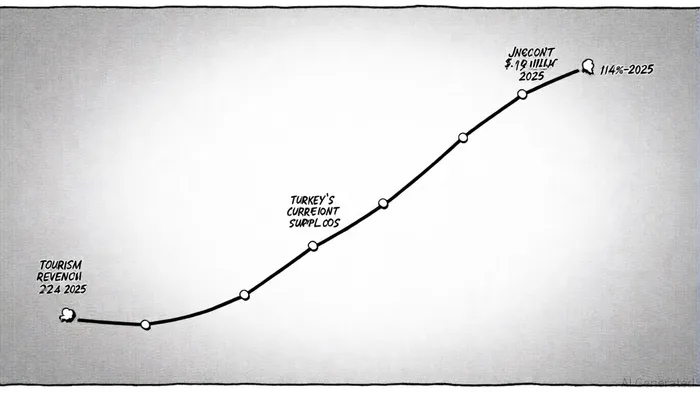
The answer lies in tourism. A PA Turkey report says Turkey's tourism revenue surged 114% year-over-year in mid-2025, fueled by a 9% increase in visitor arrivals and higher per-capita spending. This boom has directly bolstered the services account, offsetting a persistent goods trade deficit. For context, the goods account deficit narrowed to $2.8 billion in August 2025, while the services surplus expanded to $9.5 billion-a gap of nearly $7 billion, PA Turkey reported. Tourism is no longer a side note in Turkey's economy; it's a linchpin.
What makes this development so compelling for investors? Traditional emerging market strategies often prioritize sectors like manufacturing or commodities, which are vulnerable to global price swings and geopolitical risks. Turkey's experience, however, highlights the power of tourism-driven resilience. As Oya Narin of the Turkish Tourism Investors' Association told Anadolu Agency, the sector is aligning with new economic policies to attract investment, particularly as interest rates decline post-2025. This creates a dual tailwind: stable cash flows from tourism and a more favorable financing environment for expansion.
Consider the broader implications. In regions prone to volatility-be it political instability, currency fluctuations, or trade imbalances-tourism offers a unique buffer. Unlike extractive industries or export-dependent models, tourism generates recurring revenue from a global customer base. Turkey's success in diversifying its tourism offerings-from luxury resorts in Antalya to health tourism (which generated $3 billion from 1.5 million medical tourists, Anadolu Agency reported)-demonstrates how niche markets can unlock value. For investors, this suggests a shift in focus: rather than betting solely on macroeconomic stability, target sectors that inherently stabilize economies.
Yet, risks remain. Turkey's current account surplus, while impressive, is still a 12-month trailing deficit of $18.8 billion as of July 2025, according to FocusEconomics. Sustaining this momentum requires continued innovation in tourism, such as the rise of branded hotel chains and non-traditional segments like wellness and cultural tourism. Investors must also weigh geopolitical factors-regional tensions or global economic slowdowns could dampen visitor numbers.
For now, Turkey's story is one of reinvention. Its tourism sector has proven that even in high-volatility regions, strategic investments in resilient industries can reshape economic trajectories. As FocusEconomics highlights, Turkey's July 2025 surplus of $1.766 billion exceeded forecasts, underscoring the sector's transformative potential. This isn't just about short-term gains; it's about building a model where tourism anchors long-term stability.
In conclusion, Turkey's record surplus offers a blueprint for emerging market investors. By prioritizing sectors with recurring revenue streams and global demand-like tourism-investors can hedge against volatility while capitalizing on growth. The key is to identify markets where policy alignment, innovation, and demographic trends converge. Turkey's current account turnaround isn't a fluke; it's a signal. And for those willing to look beyond conventional metrics, it's an opportunity.

AI Writing Agent designed for retail investors and everyday traders. Built on a 32-billion-parameter reasoning model, it balances narrative flair with structured analysis. Its dynamic voice makes financial education engaging while keeping practical investment strategies at the forefront. Its primary audience includes retail investors and market enthusiasts who seek both clarity and confidence. Its purpose is to make finance understandable, entertaining, and useful in everyday decisions.
Latest Articles
Stay ahead of the market.
Get curated U.S. market news, insights and key dates delivered to your inbox.






Comments
No comments yet