
Turkey's Military Might: A New Dawn for Defense Investment in Geopolitical Crossroads
The rapid evolution of Turkey's defense industry is rewriting the rules of global military technology, positioning the nation as a critical player in both NATO's strategic architecture and the broader defense market. From its ambitious aircraft carrier project to its game-changing UAV exports, Turkey's advancements in military tech are not just about hardware—they're about geopolitical leverage, economic resilience, and a bold pivot toward strategic self-reliance. For investors, this transformation represents a compelling opportunity in a sector primed for growth.
The Hardware Revolution: From UAVs to Aircraft Carriers
Turkey's defense ambitions are anchored in three pillars: indigenous production, NATO integration, and global export dominance.
The MUGEM Aircraft Carrier:
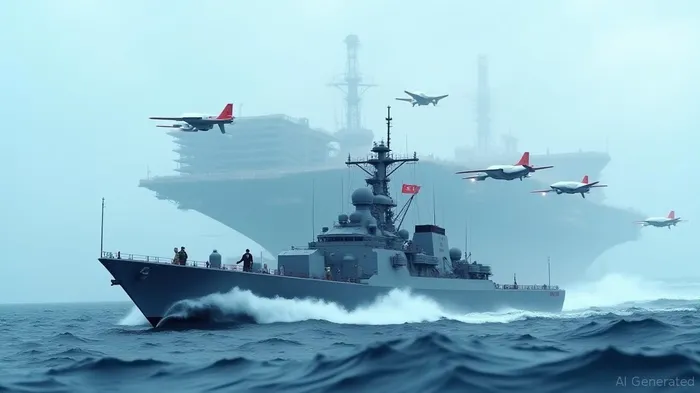
Turkey's first domestically built aircraft carrier, the MUGEM, is set to redefine its naval capabilities. At 285 meters long and displacing 60,000 tons, it will carry up to 50 aircraft, including a mix of manned jets like the Hurjet and unmanned systems like the Kızılelma. Crucially, over 80% of its components will be Turkish-made, reducing reliance on foreign suppliers. While construction began in 2025, its completion by the mid-2030s will solidify Turkey's status as a blue-water naval power.TF-2000 Destroyer:
The TF-2000, Turkey's largest warship, epitomizes its push for autonomy. With a 96-cell vertical launch system (VLS) and advanced radar, it's designed to counter ballistic missiles and conduct multi-domain warfare. Its indigenous components—like the Çafrad radar and MIDLAS VLS—are a direct response to past procurement bottlenecks. The lead shipSHIP--, TCG Istanbul, entered service in 2024, with eight planned by 2030. These destroyers will be the backbone of Turkey's fleet, capable of operating alongside NATO allies while asserting regional dominance.UAV Dominance:
Baykar's TB2 and TB3 drones have become synonymous with Turkey's defense prowess. Exports hit $7.1 billion in 2024, with sales to Poland, Italy, and Saudi Arabia. The TB3, a larger, AI-powered successor, is set to expand this market. Beyond drones, Turkey's UAV ecosystem includes air defense systems (e.g., the Hisar) and missiles (e.g., the Atmaca), creating a vertically integrated defense tech stack.
Geopolitical Leverage and Economic Catalysts
Turkey's military buildup isn't just about hardware—it's a strategic play to leverage its geographic position and economic ambitions.
NATO Integration:
Despite occasional tensions, Turkey's defense tech is increasingly vital to NATO. Its TF-2000 destroyers and UAVs fill gaps in European allies' arsenals, especially as the U.S. scales back traditional arms sales. The EU's $800 billion defense budget (2025–2027) will further boost demand for cost-effective Turkish systems.Export Revenue and Job Creation:
Defense exports now account for 1.5% of Turkey's GDP. The industry employs over 150,000 workers, with companies like Baykar and Aselsan leading the charge. As the MUGEM and TF-2000 programs ramp up, domestic suppliers in steel, electronics, and software will see multiplier effects.Reducing Foreign Dependency:
Turkey's focus on indigenous tech—e.g., opting for its own MIDLAS VLS over the U.S. Mk 41—reduces geopolitical risk. This autonomy positions Turkey as a neutral supplier in regions like the Middle East, where it competes with U.S. and Chinese firms.
Investment Themes and Catalysts
For investors, the Turkish defense boom offers both equity and sector-level opportunities.
- Key Companies to Watch:
- Baykar: Leader in UAVs (TB2/TB3) and AI-driven systems. Its valuation could soar as TB3 exports ramp up.
- Aselsan: Specializes in radar and electronic warfare systems, critical for TF-2000 and NATO integration.
Roketsan: Produces missiles and precision munitions, benefiting from global demand for asymmetric warfare tools.
ETF Plays:
- Turkey Industrial ETFs: Exposure to defense contractors via broader industrial plays, such as the XUBK (iShares MSCI Turkey IMI ETF), which includes Baykar and Aselsan.
Global Defense ETFs: Funds like the PACX (SPDR S&P Aerospace & Defense ETF) include firms partnering with Turkish suppliers (e.g., Leonardo's Baykar deal).
Catalysts for Growth:
- MUGEM's completion: A milestone for Turkey's naval power, signaling geopolitical clout.
- NATO procurement cycles: 2026–2028 will see member states upgrading systems, with Turkish tech in the mix.
- Ukraine and Middle East demand: Conflicts and energy projects will sustain UAV and missile sales.
Risks and Considerations
- Geopolitical Tensions: Turkey's relations with NATO allies (e.g., over the S-400 missile deal) could disrupt partnerships.
- Domestic Instability: Political shifts or economic downturns could delay projects.
- Competition: U.S. and European firms may push back against Turkish inroads, especially if tariffs rise.
Conclusion: A Long-Term Play
Turkey's defense advancements are more than a military upgrade—they're a strategic realignment. By combining self-reliance with export-driven growth, it's building a sustainable economic engine and a seat at the table for global security decisions. For investors, the sector offers exposure to geopolitical trends, job creation, and a defense tech boom. While risks exist, the trajectory is clear: Turkey's military might is here to stay, and its stocks and ETFs are poised to benefit.
Investors should monitor Turkish defense contracts and NATO procurement announcements for entry points. The sector's blend of geopolitical narrative and tangible growth makes it a compelling long-term bet.

Delivering real-time insights and analysis on emerging financial trends and market movements.
Latest Articles
Stay ahead of the market.
Get curated U.S. market news, insights and key dates delivered to your inbox.


AInvest
PRO
AInvest
PRO



Comments
No comments yet