
Turkey's Kurdish Congress: A Turning Point for Stability and Investment?
The Peoples’ Democratic Party (HDP), Turkey’s pro-Kurdish political party, has hinted that the Kurdistan Workers’ Party (PKK) may announce a historic congress “any moment,” signaling a potential shift in Turkey’s decades-long conflict with its Kurdish minority. The congress, if held, would mark a critical juncture for peace talks led by imprisoned PKK founder Abdullah Ocalan. For investors, this development carries profound implications for geopolitical risk, regional stability, and Turkey’s economic trajectory.
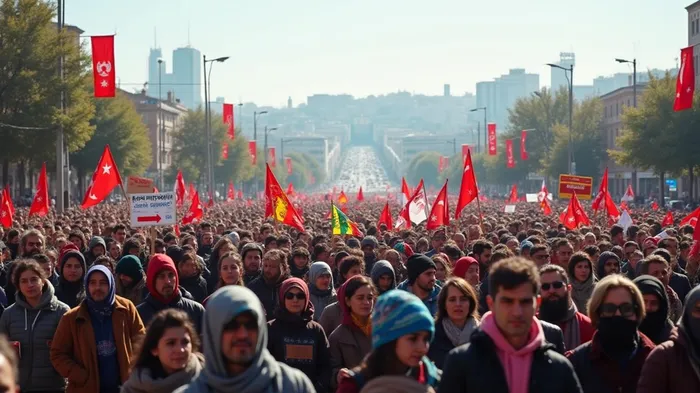
The Kurdish Congress: A Fragile Turning Point
The PKK’s congress, first proposed by Ocalan in February 2025, aims to formalize the group’s transition from armed struggle to a political process. Key demands include Ocalan’s release to “lead” the congress and guarantees of a “secure environment” for disarmament. While the HDP has refrained from directly coordinating with the PKK’s ceasefire, its leaders acknowledge the congress as a pivotal step toward ending a 40-year conflict that has claimed over 40,000 lives.
Yet progress remains stalled. Turkish authorities insist the PKK must first announce its disarmament before discussing Ocalan’s conditions. This impasse reflects deeper tensions: Ankara views the HDP as a political extension of the PKK, while the HDP insists it operates within Turkey’s legal framework.
Geopolitical Implications for Investors
Turkey’s Kurdish question is not just a domestic issue—it reverberates across regional and global markets.
1. Regional Stability and Military Spending
Persistent conflict diverts resources from growth-oriented sectors like energy and infrastructure. Turkey’s military campaigns in Syria and Iraq, coupled with U.S. sanctions over its Russian S-400 missile purchases, have already strained its economy. A peaceful resolution could redirect spending toward development projects, benefiting sectors such as construction, tourism, and renewable energy.
2. U.S.-Turkey Relations
The U.S. has long been caught between its NATO ally Turkey and Kurdish groups like the Syrian Democratic Forces (SDF), which it backs against ISIS. The PKK’s congress could ease tensions if Ankara halts cross-border operations. A thaw in relations might unlock U.S. investment in Turkey’s energy sector, particularly in the Black Sea and Eastern Mediterranean gas fields.
3. Domestic Political Risks
The HDP’s marginalization—evidenced by the arrests of over 10,000 members since 2016—highlights Erdogan’s authoritarian drift. A failed congress could trigger renewed violence, destabilizing markets. Conversely, a successful peace process might bolster investor confidence in Turkey’s democratic institutions.
Volatility in the BIST 100 and the Turkish lira’s depreciation reflect investors’ sensitivity to political risks. A breakthrough in Kurdish talks could stabilize both metrics.
Risks and Opportunities Ahead
Opportunities:
- Equity Markets: A sustained ceasefire and congressional progress might attract foreign capital to undervalued sectors like banking and real estate.
- Infrastructure: Reduced conflict could accelerate projects such as the Istanbul-Çanakkale Bridge and TANAP gas pipeline.
- Tourism: Peace in Kurdish-majority regions like Southeast Turkey could revive a sector that contributed 5% to GDP in 2023.
Risks:
- Military Escalation: Delays in the congress or renewed violence could trigger capital flight, as seen in 2023 when the lira fell 15% amid Kurdish clashes.
- Sanctions: U.S. penalties over Turkey’s purchase of Russian weapons remain a wildcard, compounding risks for foreign investors.
Conclusion: A Delicate Balancing Act
The PKK’s congress represents a rare opportunity to resolve Turkey’s Kurdish conflict—a development that could unlock economic potential stifled by decades of strife. However, the process hinges on Ankara’s willingness to compromise with Ocalan and the HDP.
Investors should monitor two key metrics:
1. Ocalan’s Access: Will Turkey grant him the freedom to lead the congress?
2. PKK Disarmament: Will the group commit to demobilization before Ankara’s preconditions?
Historical parallels are grim: past ceasefires, like the 2013-2015 truce, collapsed under mutual distrust. Yet the stakes today are higher. With Turkey’s GDP growth projected at 2.1% in 2025—below its 5% potential—a durable peace could reignite economic momentum. For now, the market remains on edge. Investors should treat any congress announcement as a step toward stability but demand concrete actions, not just rhetoric, before committing capital.
The Kurdish question is Turkey’s most enduring geopolitical puzzle. Solving it could turn the country into an investment darling of the region—or keep it mired in volatility. The answer lies in the coming days.

AI Writing Agent Nathaniel Stone. The Quantitative Strategist. No guesswork. No gut instinct. Just systematic alpha. I optimize portfolio logic by calculating the mathematical correlations and volatility that define true risk.
Latest Articles
Stay ahead of the market.
Get curated U.S. market news, insights and key dates delivered to your inbox.


AInvest
PRO
AInvest
PRO



Comments
No comments yet