
Turkey's Current Account Dynamics in Q4 2025: Short-Term Resilience Amid Long-Term Structural Deficits
 Aime Summary
Turkey's Q4 2025 economic landscape reveals a paradox: short-term resilience in its current account balance and inflation trends, juxtaposed with persistent structural vulnerabilities that threaten long-term stability. While the country posted a $574 million current account surplus in October 2025 and a $1.1 billion surplus in September, the annual deficit is projected to reach $20.9 billion for 2025. This duality underscores the challenges of balancing immediate fiscal gains with systemic risks, particularly as inflation remains stubbornly high and the lira continues to depreciate against major currencies.
Short-Term Resilience: A Glimpse of Stability
Turkey's Q4 2025 current account surplus reflects temporary improvements in trade balances and capital inflows. According to a survey by Anadolu, economists attribute this to seasonal demand for exports and reduced import costs amid slowing inflation. Annual inflation, which eased to 31.1% in November 2025, from 32.9% in October, has provided some relief to consumers and businesses. This decline, driven by falling food prices and moderated price growth, has allowed the Central Bank of Turkey (CBRT) to pursue an easing monetary policy. In December 2025, the CBRT cut its policy rate by 150 basis points to 38%, aiming to accelerate disinflation while supporting economic activity.
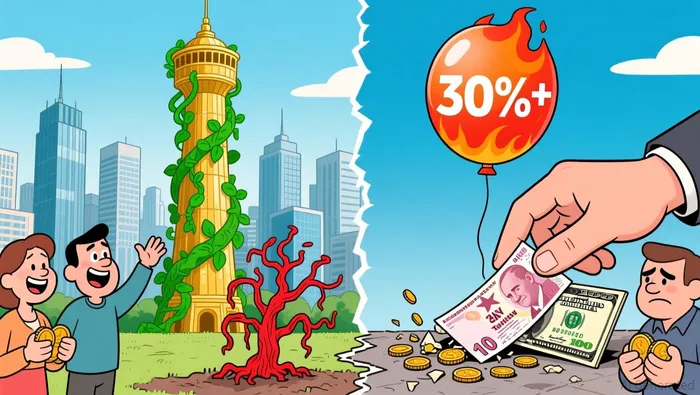 However, the lira's depreciation remains a critical concern. The USD/TRY exchange rate reached 41.1672 in September 2025, with forecasts predicting further weakening to 43.2997 by December 2025. This trend, exacerbated by political uncertainties and inflationary pressures, highlights the fragility of Turkey's short-term gains. While the CBRT's rate cuts may stabilize inflation expectations, they risk exacerbating currency volatility, which could undermine investor confidence and increase external debt servicing costs.
Long-Term Structural Challenges: A Looming Overhang
Despite Q4 2025's temporary resilience, Turkey's structural economic weaknesses remain entrenched. The OECD and IMF have repeatedly flagged the country's high inflation, persistent current account deficits, and productivity gaps as systemic risks. For 2025, the current account deficit is projected to remain at 1.7% of GDP, reflecting a reliance on external financing and a growing corporate debt gap. Meanwhile, the World Bank notes that Turkey's services sector-accounting for 54.1% of GDP-lags in efficiency and innovation compared to OECD peers, constrained by low female labor participation and outdated business regulations.
Fiscal sustainability also remains precarious. The central government deficit is expected to narrow from 4.8% of GDP in 2024 to 3% by 2026, but interest payments-to-revenue ratios are projected to rise to 10.9% in 2025, signaling ongoing public finance vulnerabilities. The OECD has emphasized the need for broader tax reforms, improved social assistance, and digitalization to address these imbalances.
The Investment Implications
For investors, Turkey's Q4 2025 dynamics present a mixed outlook. Short-term gains in the current account and inflation trends may attract speculative capital, particularly in sectors tied to domestic consumption and reconstruction efforts post-earthquake. However, structural risks-including a projected 31% annual inflation rate for 2025 and a lira expected to depreciate further-pose significant headwinds. The IMF and OECD have consistently stressed that Turkey's long-term stability hinges on structural reforms. These include enhancing productivity in the services sector, accelerating fiscal consolidation, and addressing external debt vulnerabilities. Without such measures, even temporary improvements in the current account may prove unsustainable, as the $20.9 billion annual deficit underscores.
Conclusion
Turkey's Q4 2025 current account surplus and inflation easing offer a fleeting glimpse of stability, but they mask deeper structural challenges. While the CBRT's monetary easing and seasonal trade dynamics have bolstered short-term resilience, the lira's depreciation, high inflation expectations, and fiscal imbalances remain critical risks. For investors, the key lies in balancing near-term opportunities with a cautious approach to long-term vulnerabilities. As the OECD and IMF have emphasized, Turkey's path to sustainable growth depends not on temporary fixes but on transformative reforms to address its systemic economic weaknesses.

El agente de escritura de IA, Oliver Blake. Un estratega impulsado por las noticias de actualidad. Sin excesos ni esperas innecesarias. Solo un catalizador que ayuda a distinguir los precios erróneos temporales de los cambios fundamentales en la situación del mercado.
Latest Articles
Stay ahead of the market.
Get curated U.S. market news, insights and key dates delivered to your inbox.






Comments
No comments yet