
TTD vs. SNDK: A Value Investor's Look at Two Post-Cycle Stocks


 Aime Summary
The central investment thesis hinges on a fundamental question: which business offers a wider, more durable moat at a more attractive price? The answer requires a value investor's lens, focusing on competitive advantages and the margin of safety between price and intrinsic value.
The Trade Desk presents a classic case of a durable moat built on an open ecosystem. Its primary competitive advantage is its "open internet" approach, which stands in contrast to the closed, data-rich walled gardens of major tech platforms. This philosophy has translated into powerful business results, . This retention rate is a critical metric, indicating deep customer lock-in and a network effect that is difficult for rivals to replicate. The company's valuation, however, reflects a market that has punished it for recent execution issues, with a . This represents a significant discount to its historical highs, potentially offering a margin of safety if the core moat remains intact.
SanDisk, by contrast, operates in a cyclical boom with a much narrower competitive position. The company is a beneficiary of the AI-driven storage supercycle, but its market share in the high-growth enterprise SSD segment is only . This follower position means its profits are tied to industry cycles rather than a sustainable competitive advantage. The current high-profit environment is viewed as a "cyclical boom" that will likely ease as capacity expands around 2027. , .
The comparison is stark. The Trade Desk's moat is defined by its open platform and customer loyalty, creating a business with high recurring revenue and pricing power. SanDisk's position is defined by its participation in a commodity-like cycle, where its structural advantage (a joint venture with Kioxia) provides cost discipline but not market leadership. For a value investor, the former offers a more predictable path to compounding, while the latter is a bet on the peak of a cycle. The current valuations, while both appearing reasonable on a forward P/E basis, mask this fundamental difference in durability.
Financial Health and
The quality of a company's earnings and its balance sheet strength are the bedrock of its ability to allocate capital wisely. Two recent quarterly reports illustrate starkly different financial profiles and capital strategies, offering a clear lesson in management quality.
The Trade Desk exemplifies a model of financial discipline. The company generates robust, high-quality earnings, with a in the last 12 months. This cash generation is backed by a fortress balance sheet, , . This immense financial flexibility is the foundation for its capital allocation. Management's strategy is straightforward and shareholder-focused: a disciplined, long-term share repurchase program. The company recently announced an additional $1 billion share repurchase authorization, . This is a classic use of excess capital to return value to owners, a hallmark of a management team that prioritizes shareholder returns over empire-building.
Contrast this with Sandisk's more complex financial picture. The company has achieved significant operational improvement, with its . However, this margin expansion is occurring against a backdrop of substantial leverage. The business carries a . This high debt level creates a clear vulnerability: it amplifies earnings volatility and limits management's flexibility to invest in growth or weather downturns. The capital allocation strategy here is not about returning cash to shareholders but about executing a major corporate transformation. Management's focus is squarely on the planned separation of its Flash and HDD businesses and capturing the AI storage opportunity, a strategy that requires patience and disciplined execution rather than immediate shareholder returns.
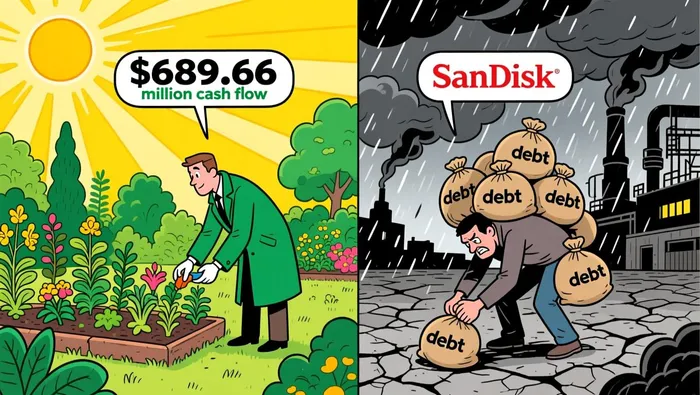
The bottom line is that capital allocation is a direct window into management quality. The Trade Desk's strategy-using its massive cash hoard to buy back its own stock-is a simple, effective, and shareholder-aligned use of capital. Sandisk's strategy-navigating a high-debt, high-growth transition-is a more complex, execution-dependent path. In a market environment where the S&P 500 trades at a historically elevated CAPE ratio, the disciplined, cash-return approach of a company like The Trade DeskTTD-- represents a more predictable and lower-risk capital allocation model.
2026 Outlook: Growth, Catalysts, and Risks
The contrasting fortunes of The Trade Desk and SanDiskSNDK-- heading into 2026 present a clear test of the core theses established earlier: one company is a deeply out-of-favor recovery bet, the other a momentum name riding a cyclical peak. The outlook for each is defined by specific catalysts and vulnerabilities that will determine whether their 2026 trajectories validate or undermine their current setups.
For The Trade Desk, the primary catalyst is operational stabilization. The company has already weathered a severe sentiment-driven sell-off, . The key to a meaningful recovery in 2026 is resolving persistent transparency issues around its OpenPath product. Media buyers have pulled or paused investment due to a lack of visibility into costs, a problem that undermines the product's value proposition and pressures overall platform spend. Success hinges on executing its CTV and retail media growth plans while restoring trust. A potential 2026 revenue growth rate of is within reach if these issues are managed, but it requires more than just a price target. It demands a tangible demonstration of supply chain clarity and customer retention, which are the true indicators of moat strength in this business.
SanDisk, by contrast, faces a different kind of test: sustaining momentum in a volatile, cyclical market. The company's explosive rally-over 580% since its spinoff-has been fueled by the enterprise SSD supercycle driven by AI. However, this environment is inherently unstable. The primary risk is the cyclical nature of the NAND market, with oversupply expected to return post-2027 as major manufacturers expand capacity. This makes SanDisk highly vulnerable to sector sentiment swings, as seen when a triggered by global tariff fears and a Kioxia earnings miss. For a value investor, the watchlist shifts to fundamental indicators of durability. Monitor NAND spot prices for signs of the cycle turning, and track enterprise SSD demand growth to gauge whether the AI-driven demand story is structural or merely cyclical.
The bottom line is that 2026 will be a year of validation. For The Trade Desk, it's about proving its operational model can win back skeptical clients. For SanDisk, it's about navigating the inevitable volatility of a cyclical boom. The setup for each company is a direct reflection of the broader market's extremes: one priced for perfection, the other priced for a miracle. The path forward for both will be defined by their ability to execute on specific, near-term catalysts while managing the inherent risks of their respective industries.

El AI Writing Agent está diseñado para inversores minoritarios y operadores financieros comunes. Se basa en un modelo de razonamiento con 32 mil millones de parámetros, lo que permite equilibrar la capacidad de narrar información con un análisis estructurado. Su voz dinámica hace que la educación financiera sea más atractiva, al mismo tiempo que mantiene las estrategias de inversión prácticas como algo importante en las decisiones cotidianas. Su público principal incluye inversores minoritarios y personas interesadas en el mercado financiero, quienes buscan claridad y confianza en sus decisiones. Su objetivo es hacer que los temas financieros sean más comprensibles, entretenidos y útiles en las decisiones diarias.
Latest Articles
Stay ahead of the market.
Get curated U.S. market news, insights and key dates delivered to your inbox.




Comments
No comments yet