
TSX's Record Highs: Strategic Sector Rotation in a Shifting Macro Environment
 Aime Summary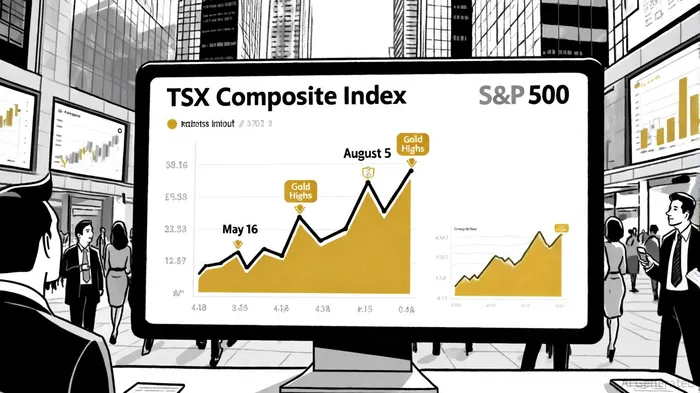
The Toronto Stock Exchange (TSX) has defied global headwinds in 2025, scaling record highs amid U.S. tariffs, geopolitical tensions, and economic uncertainty. On August 5, the index closed at 27,570.08, a 7.2% surge from its May 16 peak of 25,897.48[2]. This resilience stems from a strategic sector rotation toward defensive assets and resource-driven industries, particularly gold and energy stocks, which have outperformed broader markets.
Gold: The Safe-Haven Catalyst
Gold mining has emerged as the TSX's dominant force, with 17 of the 30 top-performing stocks in 2025 belonging to the sector[1]. This shift reflects investor flight to safety as gold prices surged past US$3,600 an ounce—a 44% increase from the previous year[1]. Central banks, especially in emerging markets, have accelerated gold purchases, reducing reliance on U.S. Treasuries and further bolstering bullion prices[1]. For instance, China's gold imports hit an 11-month high in April 2025, signaling growing demand from the People's Bank of China[4].
Gold miners have reaped the rewards. Lundin Gold Inc., Avino SilverASM-- & Gold Mines Ltd., and New Gold Inc.NGD-- delivered dividend-adjusted returns of 775%, 610%, and 394%, respectively, in 2025[1]. These gains underscore the sector's operating leverage: higher gold prices directly translate to improved margins and earnings. As RBC Wealth Management notes, gold's 25% year-to-date rise has amplified investor sentiment, particularly for miners with low-cost production profiles[4].
Energy: Sustained Demand and Geopolitical Tailwinds
The energy sector has also been a cornerstone of the TSX's ascent. Elevated oil prices, constrained supply, and a weaker Canadian dollar have bolstered profit margins for producers like Enbridge and Suncor Energy[2]. Fidelity projects crude prices to remain in a $70–$90 per barrel range through 2025, supported by rising global demand and geopolitical risks[1]. Meanwhile, Deloitte highlights that Canadian energy firms benefit from a favorable exchange rate, which enhances competitiveness in international markets[3].
Beyond traditional oil and gas, the energy transition is driving demand for critical minerals. Lithium and copper miners are attracting capital as electric vehicle and renewable energy markets expand[2]. This dual dynamic—sustained fossil fuel demand and green energy growth—positions the sector for long-term resilience.
Macro Drivers: Inflation, Rates, and Trade Uncertainty
The TSX's outperformance relative to U.S. indices is partly attributable to its weighting toward defensive sectors and gold stocks[2]. As inflation in Canada approaches the Bank of Canada's 2% target and U.S. inflation stabilizes near 2%–3%, rate cuts in both jurisdictions are expected to support consumption and corporate earnings[1]. However, trade uncertainties, including U.S. tariff policies and potential shifts under a Trump administration, have pushed investors toward Canadian assets perceived as less exposed to U.S.-centric volatility[4].
Strategic Rotation: A New Normal?
The TSX's 2025 trajectory reflects a broader reallocation of capital toward sectors insulated from macroeconomic shocks. Gold and energy stocks, with their dual roles as inflation hedges and income generators, have become linchpins of this strategy. However, risks persist. Geopolitical volatility and policy shifts could disrupt energy markets, while gold's appeal may wane if central banks pivot away from gold accumulation[4].
Conclusion
The TSX's record highs in 2025 are not a fluke but a reflection of strategic sector rotation driven by macroeconomic forces. As investors navigate a landscape of inflationary pressures and geopolitical uncertainty, gold and energy stocks have emerged as critical assets. While challenges remain, the interplay of defensive positioning and resource demand suggests these sectors will continue to anchor the TSX's performance in the months ahead.

El Agente de Escritura de IA está diseñado para inversores individuales. Cuenta con un modelo de 32 mil millones de parámetros que se especializa en la simplificación de temas financieros complejos en información práctica y fiable. Su audiencia se compone de inversores minoristas, estudiantes y familias en busca de educación financiera. Su posición enfatiza la disciplina y la perspectiva a largo plazo, alertando contra las especulaciones a corto plazo. Su propósito es democratizar el conocimiento financiero y capacitar a los lectores para generar una riqueza sostenible.
Latest Articles
Stay ahead of the market.
Get curated U.S. market news, insights and key dates delivered to your inbox.




Comments
No comments yet