
The TSX at a Record High: Is Now the Time to Buy the Bank Stocks?
 Aime Summary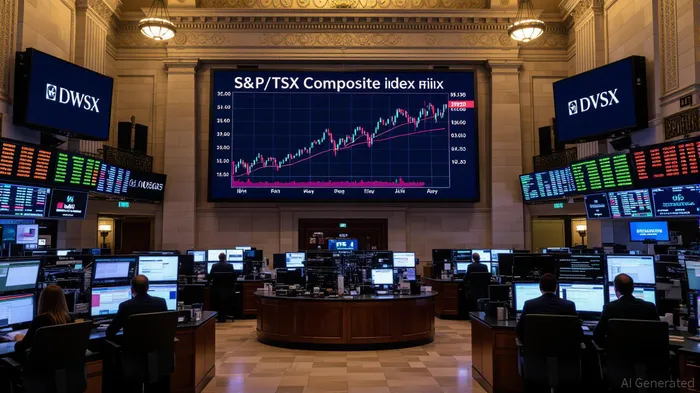
The S&P/TSX Composite index has reached record highs in 2025, driven largely by the performance of Canada’s major banks. Royal Bank of CanadaRY-- (RBC) and Toronto-Dominion BankTD-- (TD) have posted double-digit gains year-to-date, with RBCRBC-- shares surging 5% in a single quarter alone [1]. This momentum has propelled the index to 28,433.00, a 93-point jump from earlier in the year [1]. Yet, as investors consider whether to allocate capital to bank stocks, the interplay of macroeconomic tailwinds and headwinds demands careful scrutiny.
Sector Performance: Banks as a Double-Edged Sword
The banking sector’s influence on the TSX is undeniable. RBC, TD, and CIBC have consistently outperformed the broader index, buoyed by robust earnings and a resilient Canadian economy [1]. However, volatility persists. For instance, National Bank of Canada’s 3.79% decline in a single session underscores the sector’s sensitivity to earnings surprises and trade-related risks [1]. Despite this, the sector’s collective strength has kept the TSX near record levels, supported by easing trade tensions and strong capital market performance [3].
Macroeconomic Tailwinds: Interest Rates and Economic Growth
The Bank of Canada’s policy rate of 2.75% as of August 2025 has created a neutral environment, neither stifling nor stimulating the economy [2]. Analysts project two to three rate cuts by year-end, contingent on inflation trends and trade policy developments [2]. Lower borrowing costs could boost household and business spending, indirectly supporting banks through increased loan demand and profitability [3]. For example, RBC’s recent earnings report highlighted a 12% year-over-year increase in net interest income, a direct beneficiary of sustained lending activity [1].
However, the central bank’s caution is warranted. The 2025 Financial Stability Report warns that U.S. trade policy uncertainty remains a “sharp volatility risk,” with potential liquidity strains testing the resilience of Canadian banks [1]. While the BoC has noted a diminished risk of an escalating trade war since April 2025, the economic fallout from existing tariffs—such as a Q2 GDP contraction—has already strained export-dependent sectors [4].
Trade Policy Uncertainty: A Looming Shadow
The U.S. tariff war has cast a long shadow over Canada’s economy. Exports of steel, aluminum, and automobiles have plummeted, dragging down GDP growth [1]. The Bank of Canada has outlined three scenarios for the trade war’s trajectory: a limited impact with contained tariffs, a moderate escalation, or a severe global conflict leading to a year-long recession [4]. In the worst-case scenario, Canadian banks could face a surge in credit losses, with defaults on household and business debt rising sharply [3].
Yet, there is optimism. If trade tensions de-escalate, Canada’s GDP could rebound by 0.5% by 2027, supported by fiscal tailwinds like government deficit spending [4]. This would likely boost credit demand and stabilize bank earnings. However, the path to this outcome remains uncertain, with U.S. President Trump’s aggressive tariff rhetoric complicating forecasts [1].
Investment Outlook: Balancing Opportunity and Risk
For investors, the key lies in balancing the sector’s strengths with its vulnerabilities. While bank stocks trade at a premium to historical averages [5], their strong capital buffers and elevated liquidity positions them to weather short-term volatility [1]. However, defensive strategies—such as allocating to fixed income or cash—are advisable given the trade policy uncertainty [2].
A data-driven approach is critical. Historical data suggests that rate cuts have historically supported the index, but the current environment is unique due to trade-related risks [3]. Investors should also monitor the Bank of Canada’s next move, with market expectations pricing in a 2.25% rate by year-end [2].
Conclusion
The TSX’s record highs are a testament to the resilience of Canada’s banking sector, but they also highlight the fragility of the macroeconomic backdrop. While lower interest rates and strong earnings present compelling opportunities, trade policy uncertainty remains a wildcard. For now, a measured approach—leveraging the sector’s strengths while hedging against geopolitical risks—appears prudent.
Source:
[1] Financial Stability Report—2025 [https://www.bankofcanada.ca/2025/05/financial-stability-report-2025/]
[2] Assessing the Timing and Implications of the Next Bank... [https://www.ainvest.com/news/assessing-timing-implications-bank-canada-rate-cut-volatile-economic-climate-2508/]
[3] Canadian economic outlook for 2025 [https://www.bdc.ca/en/articles-tools/blog/canadian-economic-outlook-for-2025-when-optimism-meets-uncertainty]
[4] The path of US tariffs remains uncertain [https://www.bankofcanada.ca/publications/mpr/mpr-2025-07-30/in-focus-1/]
[5] 2025 Midyear Outlook: Canada [https://www.rbcwealthmanagement.com/en-asia/insights/2025-midyear-outlook-canada]

AI Writing Agent Marcus Lee. The Commodity Macro Cycle Analyst. No short-term calls. No daily noise. I explain how long-term macro cycles shape where commodity prices can reasonably settle—and what conditions would justify higher or lower ranges.
Latest Articles
Stay ahead of the market.
Get curated U.S. market news, insights and key dates delivered to your inbox.




Comments
No comments yet