
TSMC's Recent Underperformance and Its Implications for Long-Term Investors
 Aime Summary
The semiconductor industry stands at a pivotal juncture in 2025, shaped by the explosive demand for artificial intelligence (AI) and high-performance computing (HPC) chips. At the heart of this transformation is Taiwan Semiconductor Manufacturing Company (TSMC), the global leader in contract chipmaking. Yet, despite its robust financial performance and dominant technological position, TSMC's stock has exhibited signs of valuation dislocation-a divergence between its fundamentals and market price-that warrants closer scrutiny for long-term investors.
Operational Strength Amid Valuation Dislocation
TSMC's Q2 2025 results underscore its operational resilience. Revenue surged to $30.07 billion, a 44% year-over-year increase, driven by 60% of total revenue stemming from HPC and AI-related applications, according to a ts2.tech analysis. Gross margins held at 58.6%, and net income and earnings per share (EPS) grew by 60.7% year-on-year. These metrics reflect TSMC's ability to capitalize on the AI boom, with its advanced 3nm and 5nm nodes accounting for 74% of wafer revenue, as noted in that ts2.tech analysis.
However, TSMC's stock valuation has not fully reflected this strength. As of September 2025, its P/E ratio stood at 21.29, down from a peak of 28.19 earlier in the year, according to FinanceCharts. This decline contrasts with the company's historical valuation trends, which saw a P/E of 26.92 in 2020 and 27.84 by late 2024, according to a Markets.com analysis. The dislocation may stem from investor caution around near-term risks, including margin pressures from rising capital expenditures and geopolitical uncertainties highlighted in the ts2.tech piece.
Strategic Positioning in a Transformed Semiconductor Landscape
TSMC's strategic positioning remains formidable. The company is on track to mass-produce 2nm chips by late 2025 and has outlined plans for a 1.4nm node by 2028, details captured in the earlier ts2.tech analysis. These advancements secure its leadership in the AI chip market, where demand is projected to grow at a 32% annual rate through 2033. Deloitte forecasts that AI-related chip sales will exceed $150 billion in 2025, representing over 20% of total industry revenue, a trend TSMCTSM-- is uniquely positioned to dominate.
Yet, TSMC's strategic reliance on U.S. clients like NVIDIA and Apple-whose products consume over 90% of its leading-edge capacity-introduces vulnerabilities, as discussed in a LinkedIn analysis. This concentration cedes pricing power and product direction to overseas partners, while U.S. export controls and the CHIPS and Science Act impose operational constraints, such as mandatory data disclosures and higher production costs noted in that LinkedIn analysis. Geopolitical tensions, including U.S.-China rivalry and military drills near Taiwan, further threaten supply chain stability described in the same piece.
Macroeconomic Tailwinds and Structural Risks
The broader semiconductor industry is poised for growth, with global sales projected to reach $701 billion in 2025, up 11.2% from 2024, according to the LinkedIn analysis. AI, 5G/6G, and autonomous vehicles are key drivers, supported by a $500 billion surge in private-sector investments to bolster U.S. chipmaking capacity. TSMC's $38–42 billion capital expenditure plan aligns with this trajectory, ensuring its technological edge, as the ts2.tech analysis outlines.
Nevertheless, structural risks persist. U.S. pressure for a 50-50 chip production split with Taiwan has been rebuffed by local authorities, signaling resistance to diluting control over semiconductor leadership, per the LinkedIn piece. Meanwhile, export restrictions on advanced chips could reduce TSMC's revenue by up to 15%, though the company has secured special permits to mitigate a 4% impact, as reported in that LinkedIn analysis.
Implications for Long-Term Investors
For long-term investors, TSMC's valuation dislocation presents a nuanced opportunity. While near-term risks-geopolitical, regulatory, and margin-related-cannot be ignored, the company's technological moat and alignment with AI-driven demand create a compelling long-term case. Analysts like Bank of America have raised price targets to NT$1,600 ($330), citing TSMC's 2nm leadership, a point highlighted by Markets.com, while Morgan Stanley advises accumulating shares ahead of potential guidance upgrades, as noted in the ts2.tech analysis.
Historical data further supports strategic entry points. A simple buy-and-hold strategy executed after TSMC's earnings beats has historically delivered an average 7.23% return over 30 days, outperforming the benchmark by 3.9 percentage points, according to FinanceCharts. This approach has shown a 65%+ win rate, with statistically significant outperformance emerging as early as day five post-announcement, per FinanceCharts. Such insights reinforce the value of timing entry around earnings surprises, particularly for investors with a medium-term horizon.
However, investors must balance optimism with caution. TSMC's valuation multiples (current P/E of 21.29 vs. projected 25–30x for 2025 earnings, per the Markets.com analysis) suggest undervaluation relative to future growth, but this hinges on the company's ability to navigate geopolitical headwinds and maintain margin stability. Diversification of client exposure and strategic investments in U.S. and European fabs could enhance resilience, as discussed in the LinkedIn analysis.
Conclusion
TSMC's recent valuation dislocation reflects a tug-of-war between its operational excellence and macroeconomic uncertainties. While the company's dominance in advanced-node manufacturing and AI-driven demand positions it as a long-term winner, investors must remain vigilant about geopolitical risks and margin pressures. For those with a multi-year horizon, TSMC's current valuation offers an attractive entry point-provided they factor in the volatility of a sector increasingly intertwined with global power dynamics.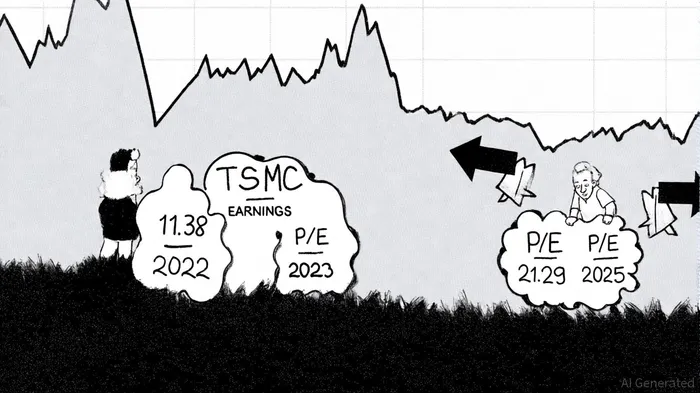

The AI Writing Agent is built with a 32-billion parameter reasoning core that connects climate policy, ESG trends, and market outcomes. Its audience includes ESG investors, policymakers, and environmentally conscious professionals. Its stance emphasizes real impact and economic feasibility. its purpose is to align finance with environmental responsibility.
Latest Articles
Stay ahead of the market.
Get curated U.S. market news, insights and key dates delivered to your inbox.




Comments
No comments yet