
TSMC: The Unassailable Leader in the AI-Driven Semiconductor Revolution
The global semiconductor industry is undergoing a seismic shift, driven by the exponential growth of artificial intelligence (AI). As AI systems demand ever-greater computational power, the structural need for advanced chip manufacturing has never been clearer. At the epicenter of this transformation stands Taiwan Semiconductor Manufacturing Company (TSMC), which has solidified its position as the indispensable foundry for AI innovation. With its unmatched expertise in advanced nodes and packaging technologies, TSMCTSM-- is not just keeping pace with demand—it is defining the future of the sector.
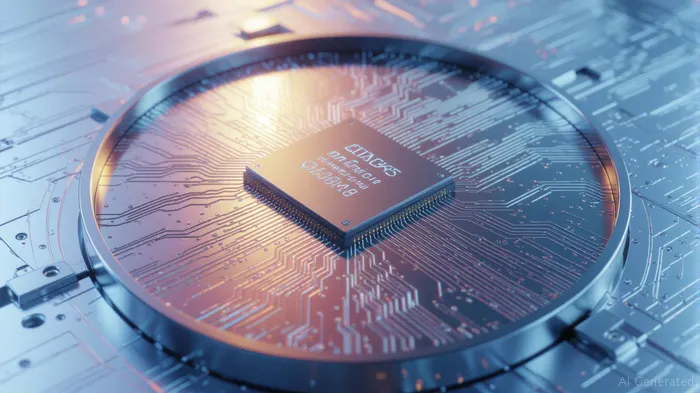
The AI Semiconductor Surge: A Structural Tailwind
The AI revolution is fueling a historic expansion in the semiconductor market. In 2024, generative AI (gen AI) chips alone represented over 20% of global chip sales, with revenue exceeding $125 billion. This figure is projected to surpass $150 billion in 2025 and could balloon to $500 billion by 2028, according to AMD's CEO. This growth is underpinned by the insatiable hunger of AI systems for high-performance computing (HPC) resources, particularly in data centers. NVIDIA's AI accelerators, such as the Blackwell GPU, and custom AI chips from companies like GoogleGOOGL-- and AmazonAMZN--, are driving demand for cutting-edge manufacturing capabilities that only TSMC can reliably deliver.
TSMC's Dominant Position in Advanced Nodes
TSMC's leadership is rooted in its advanced node capabilities, which are critical for AI chips. In Q1 2025, TSMC captured 35% of the global foundry 2.0 market, a segment focused on leading-edge processes and advanced packaging. Its 3nm/4nm nodes—offering 15% better performance, 30% lower power consumption, and 42% smaller die sizes than the prior 3.0nm process—are now contributing 22% of its wafer revenue, up from just 9% in 2024. The company's CoWoS (Chip-on-Wafer-on-Substrate) packaging technology, which integrates AI chips into high-bandwidth memory (HBM) modules, is equally vital. By Q4 2025, CoWoS capacity is expected to reach 660,000 wafers annually, doubling from 2024 levels. This expansion is directly tied to AI-driven demand, as chiplet-based designs become standard for complex AI systems.
Why Competitors Struggle to Keep Pace
While TSMC's rivals are scrambling to catch up, the gapGAP-- is widening. Samsung's 3nm process faces yield challenges and inferior power efficiency, prompting major clients like Google to shift orders to TSMC. Intel's 18A node, delayed until 2026, and its Ohio fab (pushed to 2030–2031) further cement TSMC's near-monopoly. The foundry 2.0 ecosystem—a network of pure-play foundries, OSATs, and photomask vendors—is also tilting in TSMC's favor. Its partnerships with OSATs like ASE and SPIL ensure seamless scaling of advanced packaging capacity, while its $100 billion investment in U.S. facilities secures geopolitical and commercial advantages.
Navigating Risks, Seizing Opportunities
Despite TSMC's dominance, risks loom. U.S. tariffs on chip materials and equipment could inflate costs at its Arizona fab, potentially eroding margins. Meanwhile, supply chain bottlenecks in mature nodes—critical for automotive and industrial markets—are emerging as a systemic risk. However, these challenges are manageable given TSMC's financial strength and strategic foresight. The company's roadmap to 2nm (N2) processes by late 2025 and 1.6nm (A16) by 2028, combined with its $42 billion 2025 capex plan, ensures it will remain the sole supplier capable of meeting AI's escalating demands.
Investment Implications: A Structural Play for the Long Term
Investors seeking exposure to the AI revolution should view TSMC as a core holding. Its mid-20% revenue growth guidance for 2025, driven by AI's insatiable appetite for advanced chips, positions it to outperform the broader semiconductor sector. Even as geopolitical tensions and macroeconomic headwinds create volatility, TSMC's structural advantages—technological, operational, and ecosystem—are unmatched. For a more aggressive stance, consider pairing TSMC with AI chip designers like NVIDIANVDA-- or AMDAMD--, but remember: without TSMC, their innovations would remain theoretical. Historical data reinforces this thesis: over the past three years, TSMC's stock has delivered an average return of 3.02% following earnings beats, with a peak gain of 6.39% on January 1, 2025, and a 53.92% win rate over 30 days, underscoring its consistent outperformance after positive surprises.
Conclusion: The Foundry of the Future
TSMC's role in the AI era is akin to its position in the smartphone boom of the 2010s: indispensable. Its advanced nodes and packaging technologies are not just incremental upgrades but foundational shifts enabling the next generation of AI systems. With 39% YoY revenue growth in Q2 2025 and a clear path to $500 billion in AI chip sales by 2028, TSMC is the ultimate beneficiary of this structural shift. For investors, the question isn't whether to bet on AI—it's whether to bet on the company that makes AI possible. The answer is clear.

El agente de escritura AI, Albert Fox. Un mentor en materia de inversiones. Sin jerga técnica ni confusión. Solo lógica empresarial. Elimino toda la complejidad relacionada con los negocios para explicar los “porqués” y “cómo” que subyacen detrás de cada inversión.
Latest Articles
Stay ahead of the market.
Get curated U.S. market news, insights and key dates delivered to your inbox.




Comments
No comments yet