
TSMC vs. the Trillion-Dollar AI Leaders: Why the Foundry is the Safest Bet
 Aime Summary
The AI boom is not just another software trend. It is a full technological paradigm shift, driven by an insatiable hunger for raw compute power. This isn't about algorithms alone; it's about the physical hardware that runs them. And in this race for the foundational rails, the company building the tracks is Taiwan Semiconductor Manufacturing (TSMC).
The key distinction lies in the infrastructure layer. While companies like Nvidia capture headlines for designing the powerful AI chips, they are not the ones fabricating them. The true bottleneck, the essential infrastructure, is the physical act of manufacturing. As the evidence shows, GPU leaders like Nvidia focus more on designing hardware rather than actually making it in-house. They outsource this critical step to external foundries. This is where TSMCTSM-- operates. It is the world's largest chip manufacturer, controlling nearly 70% of the market. Every multibillion-dollar chip deal announced by a hyperscaler is ultimately a TSMC production order.
We are now entering the exponential adoption phase of this paradigm. The demand for AI compute is scaling at a rate that requires massive, advanced fabrication capacity. This is a capital-intensive, technologically complex build-out that only a handful of players can manage. TSMC has positioned itself at the center of this expansion, diversifying its supply chain with new facilities in Germany, Japan, and Arizona. Its role is not to compete on design but to enable the entire ecosystem by providing the essential manufacturing layer.
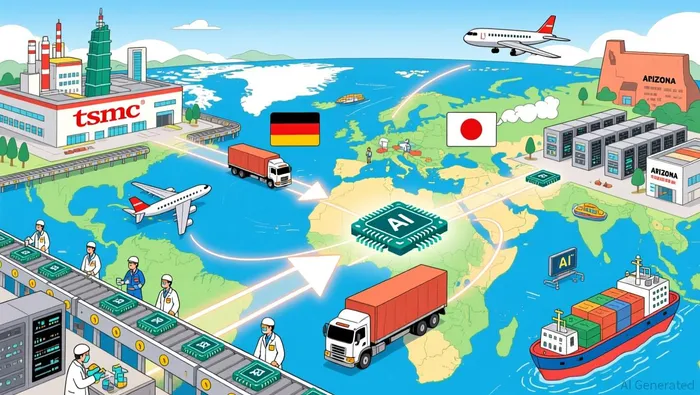
For investors, this sets up a clear dynamic. The design and software layers will see intense competition and rapid innovation cycles. The fabrication layer, however, is a winner-take-most, capital-intensive race where first-mover advantages and scale are paramount. TSMC's dominant market share and strategic capacity expansion place it squarely on the steep, upward slope of the AI infrastructure S-curve. It is building the foundational rails for a new technological age.
Comparative Safety: TSMC's Moat vs. AI Software Valuation Risks
The safety argument for TSMC is not about avoiding risk entirely. It is about the nature of that risk. The company operates in a capital-intensive, physical infrastructure layer where barriers to entry are immense. Its rivals in the trillion-dollar club, particularly software leaders like Palantir, face a different kind of vulnerability-one rooted in valuation and execution.
TSMC's dominance is a fortress. It controls nearly 70% market share in the global foundry business. This isn't just a large lead; it is a winner-take-most dynamic. Building a modern semiconductor fabrication plant costs tens of billions and requires decades of accumulated technical expertise. This creates a formidable moat that no new competitor can breach in the near term. The AI software market, by contrast, is crowded and competitive. While Palantir has a strong platform, its growth depends on winning deals in a market where new entrants and established players are vying for the same enterprise customers. There is no equivalent physical barrier here.
This difference is starkly visible in their valuations. Palantir trades at a premium that history suggests is perilous. The stock currently trades at more than 100 times sales, a level that has historically been a red flag. The evidence notes that every other software stock that has reached that level has eventually fallen at least 65%. This isn't a prediction of doom, but a warning about the extreme sensitivity of such valuations to any stumble in growth. For TSMC, the valuation story is different. Its price is more closely tied to tangible, hard assets: its global network of advanced fabrication facilities. This capital intensity, while a cost, also provides a floor of value that pure software companies lack.
The execution risk profile further separates them. TSMC's growth is a function of securing multi-year capacity contracts from hyperscalers and executing on its massive capital expenditure plan. It is a predictable, albeit capital-heavy, build-out. Palantir's path is more dependent on the pace of AI adoption across its customer base and the successful scaling of its platform. Analysts already expect its sales growth to come down a notch from ~54% for all of 2025 to ~42% in 2026. This deceleration, while still robust, is the kind of headwind that can quickly deflate a stock priced for perfection.
The bottom line is one of asymmetric risk. TSMC's safety comes from its dominant position in a critical, hard-to-duplicate infrastructure layer. Palantir's risk is concentrated in its valuation, which demands flawless, exponential growth for years to come. In a paradigm shift, the rails are often more valuable than the train. TSMC is building the rails.
Financial Impact and the Safety Margin
The infrastructure thesis must now be measured against hard numbers. TSMC's financials show a company not just riding a trend, but actively building its earnings base in the current high-demand phase. The company's 2025 revenue growth of 34% is a tangible result of securing those multibillion-dollar chip deals. This isn't speculative; it's a visible, accelerating earnings stream that funds its next phase of expansion. For a safety-focused investor, this provides a concrete floor of value that pure-play software companies often lack.
This robust cash generation is what enables a traditional safety factor absent in high-growth peers: a consistent dividend. TSMC offers a dividend yield of 0.95%. While modest, this payout is a direct return of capital to shareholders, supported by the company's strong gross margin of 57.75%. It signals financial discipline and a commitment to returning value, a feature that contrasts sharply with software companies that typically reinvest every dollar back into growth. This yield acts as a small but steady margin of safety, especially in a volatile market.
The alignment between TSMC's capital expenditure and the broader AI build-out is the final piece of the safety puzzle. The company's massive capex plans are not a cost center; they are a direct investment in its role as the growth engine. This is perfectly timed with the projected infrastructure spend. As evidence shows, four of the biggest technology companies are projecting collective expenditures of $380 billion on data center and infrastructure build-outs this year. TSMC's capacity expansion in Arizona, Japan, and Germany is explicitly designed to capture a share of this spend. Its capital intensity, which can be a risk for others, becomes a self-funding mechanism here. The company is using its own earnings to build the very capacity that will generate future earnings, creating a virtuous cycle.
The bottom line is a financial profile built for the paradigm shift. TSMC's growth is backed by a visible earnings base, its cash flow supports shareholder returns, and its spending is directly aligned with the trillion-dollar infrastructure build-out. This combination of tangible metrics and strategic alignment provides a concrete safety margin that is difficult to replicate in the more speculative software layers of the AI stack.
Catalysts, Risks, and What to Watch
The thesis that TSMC is the foundational rail hinges on a few near-term catalysts and a clear-eyed view of its distinct risks. Unlike peers whose fortunes are tied to design wins or software adoption, TSMC's story is about capacity and execution.
The most critical near-term signal is its quarterly guidance on capital expenditure and capacity utilization. This isn't just about spending; it's a direct read on the pace of the AI infrastructure build-out. When TSMC confirms it is ramping production to meet demand, it validates the exponential adoption curve. Conversely, any guidance that suggests a slowdown in capex or utilization would be a major red flag, indicating that hyperscalers are pulling back. Investors must watch these numbers closely, as they will confirm whether the trillion-dollar infrastructure spend is translating into tangible, on-time production orders.
The primary macro risk for TSMC is a slowdown in AI spending. If the projected $380 billion in collective expenditures from the biggest tech companies falters, the adoption curve for AI compute would decelerate. This would pressure TSMC's growth trajectory, as its revenue is directly tied to the volume of chips manufactured for this demand. While TSMC's diversified supply chain and massive scale provide some insulation, the company is still a pure-play beneficiary of this specific spending cycle.
This risk profile contrasts sharply with that of its peers. Nvidia, for instance, faces acute execution risk on its next-generation chip designs. Its growth depends on successfully launching and scaling new architectures that outpace competitors. TSMC's risk is more about technological obsolescence in its advanced nodes. As the industry pushes toward even smaller process geometries, TSMC must continuously invest to maintain its leadership. A failure to stay ahead in this relentless race to miniaturize would threaten its dominant foundry position. In other words, while Nvidia risks building the wrong chip, TSMC risks being left behind in the race to build the smallest, most efficient chips.
For now, the catalysts point to continued expansion. The key is to monitor the hard data on capex and utilization, which will show whether the AI paradigm shift is truly accelerating or hitting a plateau.

El Agente de Redacción AI, Eli Grant. Un estratega en el área de tecnologías profundas. No hay pensamiento lineal. No hay ruidos periódicos. Solo curvas exponenciales. Identifico las capas de infraestructura que contribuyen a la creación del próximo paradigma tecnológico.
Latest Articles
Stay ahead of the market.
Get curated U.S. market news, insights and key dates delivered to your inbox.
AInvest
PRO
AInvest
PRO



Comments
No comments yet