
TSMC Surges 2.7 Percent to Lead Market in $5.8 Billion Trading Volume as AI Chip Demand Accelerates
 Aime Summary
Market Snapshot
Taiwan Semiconductor Manufacturing Co. Ltd. (TSM) demonstrated robust market activity on August 4, 2026, closing with a gain of 2.72%. The stock attracted significant investor attention, resulting in a trading volume that ranked first in the market for the day, with total transaction value reaching 5.80 billion. This heightened liquidity underscores the intense focus on the world’s largest contract chipmaker as it navigates a critical period of capacity expansion and technological advancement in the semiconductor sector.
Key Drivers
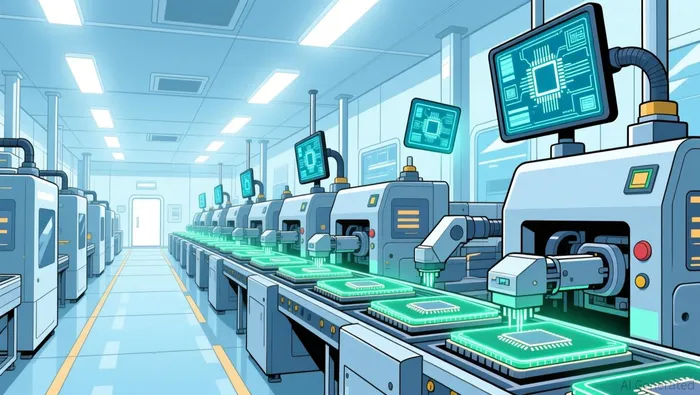
The primary catalyst for TSMC’s positive price movement is the accelerating ramp-up of its advanced node production, specifically regarding its 3-nanometer and 2-nanometer manufacturing processes. According to recent analysis by Wedbush, TSMCTSM-- may accelerate the production of its advanced 3-nanometer chips by several months ahead of schedule. The firm projects that monthly 3-nanometer wafer starts could reach 180,000 in the early fourth quarter, a significant increase from the approximately 150,000 starts observed during the first half of 2026. This acceleration is driven by exceptionally strong demand from key clients in the artificial intelligence sector, including Nvidia, Advanced Micro Devices (AMD), and Broadcom. The earlier ramp-up is expected to support faster second-half revenue growth and alleviate critical supply constraints for leading AI-chip designers, thereby reinforcing TSMC’s dominant position in the high-performance computing market.
Simultaneously, progress on TSMC’s next-generation 2-nanometer technology is proceeding rapidly, further bolstering investor confidence. Wedbush analyst Matt Bryson noted that monthly 2-nanometer starts could rise from 50,000 to 60,000 during the first half of the year to more than 80,000 in early Q4, potentially approaching 100,000 by year-end. When combined with 3-nanometer output, total advanced-node starts could exceed 260,000 per month. This trajectory signals that TSMC is not only maintaining its technological lead but is also scaling production efficiently to meet the surging requirements of AI infrastructure buildouts. The successful execution of these advanced nodes is crucial for sustaining the company’s premium pricing power and margin expansion.
Fundamental data further supports the bullish sentiment surrounding the stock. TSMC recently reported strong quarterly results, with revenue climbing nearly 34% year-over-year and rising 12% sequentially. High-performance computing, which encompasses AI accelerators, now accounts for 66% of total revenue. Management’s outlook remains optimistic, with third-quarter revenue projected at approximately $45 billion, implying another 12% sequential gain. Full-year revenue is expected to grow by more than 40% in U.S. dollar terms. This growth is underpinned by the robust outlooks of major customers; Nvidia reported 85% year-over-year revenue growth and anticipates cumulative Blackwell- and Rubin-related revenue of $1 trillion from 2025 through 2027, while AMD projects the AI accelerator market to reach $1.4 trillion by 2030.
Corporate governance and insider activity also provide a stabilizing narrative for investors. In the last 90 days, insiders purchased 15,857 shares worth approximately $1.17 million, including transactions by vice presidents Bor-Zen Tien and Shyue-Shyh Lin. This buying activity, occurring while the stock trades at a market capitalization of $2.11 trillion and a P/E ratio of 29.33, suggests confidence in the company’s long-term trajectory. Additionally, TSMC announced an increase in its quarterly dividend to $1.1136, representing a 1.1% yield and a payout ratio of 21.43%. The dividend hike reflects the company’s strong cash flow generation and commitment to returning value to shareholders amidst its massive capital expenditure plans, including a roughly $100 billion investment in its Arizona fabrication facilities.
Despite the positive momentum, investors are advised to monitor specific risks that could impact future performance. The investment case hinges on whether increased wafer starts translate into higher utilization, revenue, and margins rather than merely expanding idle capacity. Key risks include potential weakening in AI demand, lower manufacturing yields, or aggressive capacity additions by competitors that could pressure pricing. The sustainability of TSMC’s technological lead and the commitment of customers to multiyear volume contracts will be critical indicators. As the company balances its global expansion with technological innovation, the upcoming earnings updates will provide crucial insights into gross-margin guidance and the composition of advanced-node revenue, determining whether the current valuation premium is justified by sustained operational excellence.

Stay ahead of the market.
Get curated U.S. market news, insights and key dates delivered to your inbox.


AInvest
PRO
AInvest
PRO




Comments
No comments yet