
TSMC's Strategic Resilience: Navigating Geopolitical Tensions and AI-Driven Growth


 Aime Summary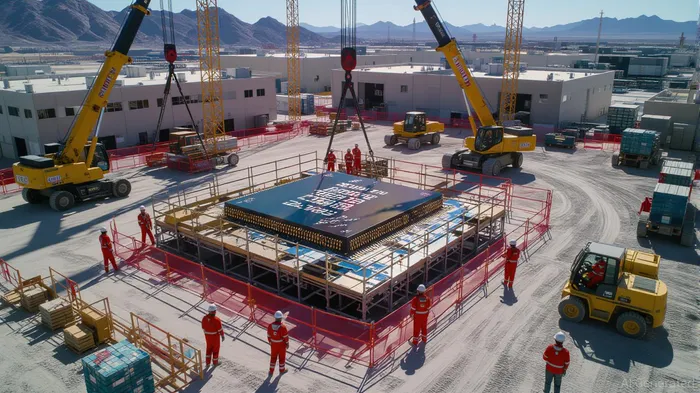
The global semiconductor industry is at a crossroads, shaped by U.S. export controls, geopolitical fragmentation, and the explosive demand for AI-driven technologies. Amid this turbulence, TSMC (NYSE: TSM) has emerged as a paragon of strategic adaptability. Its ability to navigate regulatory headwinds while capitalizing on the AI boom has positioned it as a linchpin in the global tech supply chain. With analysts now eyeing a $300 price target for TSMCTSM--, the question for investors is whether this valuation reflects the company's long-term resilience or overestimates its ability to sustain dominance in a rapidly shifting landscape.
Geopolitical Hedging and Supply Chain Diversification
The U.S. revocation of TSMC's “validated end user” (VEU) status for its Nanjing facility in 2025 forced the company to seek alternative strategies to mitigate geopolitical risks. While the Nanjing plant accounts for only 3% of TSMC's output, the regulatory uncertainty underscored the broader U.S. strategy to restrict China's access to advanced semiconductor tools. TSMC's response has been a calculated pivot to U.S.-allied regions, exemplified by its $165 billion investment in Arizona under the CHIPS and Science Act. This move not only aligns with U.S. national security goals but also secures TSMC's access to critical clients like AppleAAPL--, NVIDIANVDA--, and MicrosoftMSFT--, who demand proximity to their domestic operations.
Simultaneously, TSMC has expanded into Europe through a joint venture in Dresden and an AI research hub in Bavaria. These investments are not merely geographic diversification but strategic bets on regions where demand for EUV lithography machines (a key bottleneck for advanced node production) is surging. By 2025, TSMC's global footprint spans Taiwan, the U.S., Japan, and Europe, reducing its exposure to any single geopolitical risk.
Capital Allocation and AI-Driven Revenue Streams
TSMC's 2025 capital expenditure of $38–42 billion underscores its commitment to maintaining technological leadership. A significant portion of this spending is directed toward scaling 3nm and 2nm production, with the latter expected to enter mass production in H2 2025. The Arizona fab expansion, structured in three phases (4nm, 3nm, and sub-2nm), is a testament to TSMC's long-term vision. Despite higher U.S. manufacturing costs, TSMC's ability to pass these expenses to clients—backed by its 90%+ yield rates (vs. Samsung's <50%)—ensures its profitability remains intact.
The AI boom has further amplified TSMC's revenue potential. High-Performance Computing (HPC) now accounts for 60% of TSMC's total revenue in H1 2025, up from 52% in 2024. This shift is driven by hyperscalers like AWS, Google, and Microsoft, who rely on TSMC's advanced nodes for AI servers and GPUs. Analysts project AI-related chip revenue to double in 2025 and grow at a mid-40% annual rate through 2030. TSMC's leadership in this space is reinforced by its exclusive partnerships with NVIDIA (maker of the world's most advanced AI chips) and Apple (a key driver of 5nm and below demand).
Valuation Metrics and Analyst Consensus
Despite the risks of U.S. tariffs and currency fluctuations, TSMC's financials remain robust. Its Q2 2025 revenue of $31.93 billion (up 39% YoY) and a 61% year-on-year profit increase validate its pricing power and operational efficiency. Analysts have raised price targets to $269.76 (average of 16 Wall Street firms) and $270 (Needham), with Goldman SachsGS-- upgrading to NT$1,370 ($45.50). These targets hinge on TSMC's ability to sustain its 30% revenue growth in 2025 and maintain a gross margin of 53%+ through 2026.
From a valuation perspective, TSMC trades at a forward P/E of 24.8x and EV/EBITDA of 16.7x, metrics that appear justified given its 38% revenue growth and 43.5% EBITDA expansion in 2025. The company's market share (64.3% of the global foundry market in 2024) and client retention rates (Apple accounts for 20% of annual revenue) further bolster its investment case.
Risks and Mitigation Strategies
While TSMC's strategic positioning is formidable, risks persist. U.S. tariffs on semiconductors and potential regulatory scrutiny of its U.S. operations could pressure margins. Additionally, Samsung's 2nm node development poses a long-term threat. However, TSMC's first-mover advantage in sub-2nm technology, combined with its client lock-in (e.g., Apple's reliance on TSMC for A-series chips), provides a durable moat.
Investment Thesis
For investors navigating semiconductor sector volatility, TSMC offers a compelling blend of geopolitical resilience, AI-driven growth, and disciplined capital allocation. Its $300 price target, while ambitious, is supported by:
1. Dominance in AI/HPC: 60% of revenue from high-margin, high-growth segments.
2. Global Supply Chain Diversification: Mitigates risks from U.S.-China tensions.
3. Strong Client Retention: Long-term contracts with Apple, NVIDIA, and hyperscalers.
4. Valuation Justification: Metrics align with projected revenue and EBITDA growth.
Conclusion
TSMC's $300 price target is not a speculative leap but a calculated reflection of its strategic agility in a fractured semiconductor landscape. By hedging geopolitical risks, investing in AI infrastructure, and maintaining its technological edge, TSMC has positioned itself as the go-to foundry for the next era of computing. For investors seeking exposure to the AI revolution while mitigating sector-specific risks, TSMC remains a cornerstone holding. However, monitoring U.S. policy shifts and Samsung's 2nm progress will be critical to assessing its long-term trajectory.

Delivering real-time insights and analysis on emerging financial trends and market movements.
Latest Articles
Stay ahead of the market.
Get curated U.S. market news, insights and key dates delivered to your inbox.




Comments
No comments yet