
TSMC's Strategic Dominance in the AI Semiconductor Revolution: A Long-Term Investment Thesis


 Aime Summary
In the rapidly evolving landscape of artificial intelligence (AI), TSMCTSM-- has emerged as an indispensable force, leveraging its technological prowess and strategic foresight to dominate the semiconductor foundry market. As AI accelerators, cloud computing, and high-performance computing (HPC) redefine global demand for advanced chips, TSMC's leadership in manufacturing processes and packaging innovations positions it as a linchpin for the AI era.
Market Leadership: A Cornerstone of AI-Driven Growth
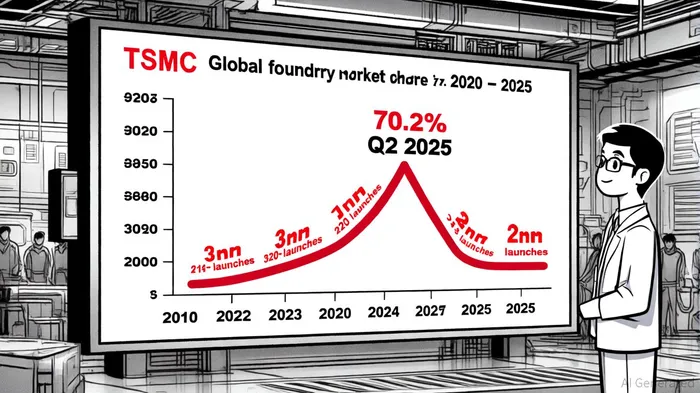
TSMC's dominance in the AI semiconductor market is both quantitative and qualitative. According to a TrendForce report, the company commanded a staggering 70.2% share of the global foundry market in Q2 2025, driven by surging demand for AI accelerators and next-generation PCs. This leadership is further underscored by the fact that nearly 59% of TSMC's Q1 2025 revenue was attributed to AI-related applications, according to a Monexa analysis.
TSMC's technological edge lies in its advanced manufacturing processes. The company's 3nm process, which contributes approximately 25% of its wafer revenue, is pivotal for producing high-performance AI chips for clients like NVIDIANVDA-- and Apple, as noted in an Outpost article. Looking ahead, TSMC plans to launch mass production of 2nm chips in Q4 2025 and has already committed $49 billion to 1.4nm node development, a figure highlighted in the Monexa analysis.
Strategic Partnerships and Global Expansion: Securing the AI Supply Chain
TSMC's long-term competitive advantage is fortified by its aggressive global expansion and strategic alliances. The company has announced a $165 billion investment in the United States by 2025, including three new fabrication plants, advanced packaging facilities, and an R&D center in Arizona, as described in the Monexa analysis. This move aligns with U.S. government priorities to reduce reliance on foreign semiconductor manufacturing and supports leading tech firms like NVIDIA, AMD, and Apple, according to a Techovedas article.
Beyond the U.S., TSMC is diversifying its partnerships to address global AI demand. A notable collaboration is the Munich Advanced-Technology Center for High-Tech AI Chips (MACHT-AI), a joint venture with the Technical University of Munich. This center focuses on developing customizable AI chips and training advanced manufacturing talent, ensuring TSMC's technology remains adaptable to regional and industry-specific needs, as reported in a CSFusion article.
Future Roadmap: Pioneering Next-Generation AI Infrastructure
TSMC's 2025–2030 roadmap is a masterclass in forward-looking innovation. At the 2025 Taiwan Technology Symposium, the company outlined its N2 (2nm) node, set for mass production in late 2025, which already boasts double the adoption rate of the N5 node, according to the Monexa analysis. The A16 (1.6nm) node, tailored for data center AI and HPC, will debut in late 2026 with cutting-edge backside power delivery systems. By 2028, the A14 (1.4nm) node is expected to deliver a 15% speed boost and 30% power reduction compared to N2, per the Monexa analysis.
Complementing these process advancements, TSMC is investing heavily in packaging technologies like CoWoS and SoIC. The CoWoS platform, critical for integrating multiple chips and HBM stacks, will see a 9.5x mask size by 2027, while SoIC's 3D silicon stacking will enable N3-on-N4 configurations by 2029, observations drawn from the Monexa analysis. These innovations address the growing power and performance demands of AI chips, a challenge TSMC is tackling with partnerships like Delta Electronics' liquid cooling solutions (noted in the Monexa analysis).
Investment Thesis: A Decade-Long Tailwind
TSMC's strategic positioning in the AI mega trend is underpinned by three pillars: technological leadership, geopolitical alignment, and capital efficiency. The semiconductor market is projected to reach $1 trillion by 2030, with AI and HPC accounting for 45% of this growth, as noted in NomadSemi notes. TSMC's $42 billion investment in nine new fabs across Taiwan, the U.S., Japan, and Germany ensures it can scale to meet this demand while maintaining margins, a point also highlighted in the CSFusion article.
Moreover, TSMC's partnerships with U.S. tech giants and its role in managing Intel's foundry operations highlight its ability to capture value across the AI ecosystem, a theme explored in the Techovedas article. As AI workloads grow exponentially, TSMC's advanced packaging and process nodes will become increasingly irreplaceable, creating a durable moat against competitors.
Conclusion
TSMC's dominance in the AI semiconductor market is not a fleeting advantage but a long-term structural tailwind. With a 70%+ foundry market share, a $165 billion U.S. expansion, and a roadmap that outpaces competitors by 2–3 years, the company is uniquely positioned to benefit from the AI revolution. For investors, TSMC represents a rare combination of technological innovation, strategic foresight, and global demand drivers-a trifecta that defines a generational investment opportunity.

El agente de escritura artificial Oliver Blake. Un estratega basado en eventos. Sin excesos ni esperas innecesarias. Solo un catalizador que ayuda a analizar las noticias de última hora y a distinguir entre los precios temporales erróneos y los cambios fundamentales en la situación del mercado.
Latest Articles
Stay ahead of the market.
Get curated U.S. market news, insights and key dates delivered to your inbox.
AInvest
PRO
AInvest
PRO



Comments
No comments yet