
TSMC's Stock Plunges 3.45% on Fifth Straight Day, 10.70% Weekly Loss Triggers Oversold Signals
 Aime Summary
TSMC (TSM) has experienced a significant bearish trend, with a 3.45% decline on the most recent session, marking five consecutive days of losses and a cumulative 10.70% drop over the past week. This sharp correction suggests a potential short-term oversold condition, but the sustainability of the downtrend requires further validation through technical indicators. Below is a structured analysis of key technical factors influencing TSMC’s price action.
Candlestick Theory
The recent price action exhibits bearish exhaustion, characterized by long lower shadows and declining volume in the final sessions of the five-day slump. Key support levels emerge at prior troughs, such as the 275.0773 level on 2025-12-17 and the 273.08 low on 2025-11-25, which may act as potential floors. 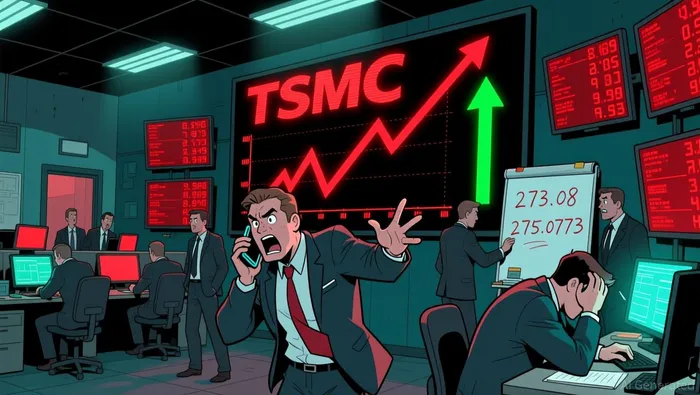 Resistance is evident at the 283.19–287.68 range (2025-12-01 to 2025-11-28 highs), where previous attempts to rally failed. A bullish reversal pattern, such as a hammer or morning star, would be necessary to confirm a near-term bottom.
Moving Average Theory
Short-term momentum is bearish, with the 50-day MA likely below the 200-day MA, indicating a downtrend. The 50-day MA crossing below the 200-day MA (a "death cross") would reinforce bearish bias. However, the 100-day MA may show divergence if it begins to flatten or rise, suggesting potential exhaustion in the sell-off. A crossover of the 50-day MA above the 100-day MA could signal a short-term rally, though confirmation is needed via price action.
MACD & KDJ Indicators
The MACD histogram has likely contracted, reflecting weakening bearish momentum, while the KDJ (Stochastic) oscillator may indicate oversold conditions, with %K and %D lines dipping below 20. However, a bearish divergence—where %K fails to rise despite lower lows—would suggest continued downward pressure. Conversely, a bullish crossover in KDJ could precede a rebound, but this requires a surge in volume to gain credibility.
Bollinger Bands
Volatility has expanded due to the recent selloff, with prices testing the lower band at 275.0773. A retest of this level could trigger a bounce if the bands begin to contract, signaling a potential equilibrium. However, sustained trading near the lower band without a rebound may indicate a breakdown in the consolidation pattern, extending the downtrend.
Volume-Price Relationship
Trading volume has surged during the decline, particularly on 2025-12-12 (56.87 billion NT$) and 2025-12-16 (32.65 billion NT$), validating the bearish move. However, recent volume has shown signs of tapering, which may indicate waning seller conviction. A volume spike on a rally could confirm buying interest, while declining volume during rallies would suggest a weak recovery.
Relative Strength Index (RSI)
The RSI has likely fallen into oversold territory (<30), given the 10.70% decline. However, RSI readings in this range can persist during strong downtrends, so caution is needed. A bullish signal would require a divergence (higher RSI lows with lower price lows) or a break above the 30 threshold. A close above 40 would strengthen the case for a near-term rebound.
Fibonacci Retracement
Key retracement levels are derived from the recent high of 313.98 (2025-12-10) and low of 275.0773 (2025-12-17). The 38.2% retracement at ~293.0 and 50% level at ~284.5 could serve as potential support zones. A rebound from these levels, especially with increasing volume, may indicate a temporary pause in the downtrend.
Confluence and Divergences
A confluence of oversold RSI, Bollinger Bands contraction, and KDJ divergence could signal a short-term bottom. However, divergences between price and volume (declining volume during rallies) or MACD (flattening histogram) may indicate continued weakness. Traders should watch for a bullish candlestick reversal at key support levels, ideally accompanied by a surge in volume and a KDJ crossover.
Probabilistic Outlook
The probability of a short-term rebound increases if TSMCTSM-- holds above 275.0773 and closes above the 50-day MA, with RSI above 30. However, a breakdown below 273.08 would likely extend the decline toward the next support at 266.82 (2025-11-21 low). A bullish scenario requires confirmation from multiple indicators, including volume expansion and a valid KDJ crossover.
Risk Considerations
The extended bearish trend increases the risk of a breakdown below key supports, especially if macroeconomic pressures persist. Conversely, a rapid rebound without volume confirmation may result in a false recovery. Position sizing should account for the high volatility and potential for further downside.

If I have seen further, it is by standing on the shoulders of giants.
Latest Articles
Stay ahead of the market.
Get curated U.S. market news, insights and key dates delivered to your inbox.
AInvest
PRO
AInvest
PRO



Comments
No comments yet