
TSMC's Q3 2025 Earnings: A Blueprint for Dividend Compounding in a Resurgent Semiconductor Cycle


 Aime Summary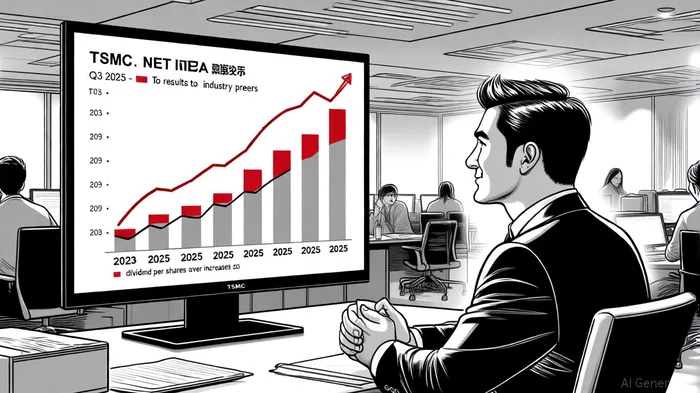
The semiconductor industry is emerging from a prolonged correction, and TSMCTSM-- stands at the epicenter of this recovery. With its Q3 2025 earnings report revealing a 54% year-on-year surge in net profit to $10.1 billion, the Taiwanese foundry giant is not only capitalizing on the AI and high-performance computing (HPC) boom but also reinforcing its reputation as a disciplined capital allocator. For income-focused investors, the question is no longer whether TSMC can sustain its dividend growth-it is about how quickly it can compound it.
Historically, TSMC's earnings beats have shown a nuanced pattern. While the average 1-day excess return after a beat is modest at +1.85%, the market often underperforms in the following 3 weeks before reversing to a cumulative +3.6% by day 30, according to the backtest results. This delayed positive reaction-coupled with a win rate that improves beyond the second week-suggests that a buy-and-hold strategy may outperform short-term trading in capturing the full value of these events.
A Profit Surge Fueled by Structural Demand
TSMC's Q3 performance was driven by insatiable demand for its 3nm and 5nm technologies, which are now the backbone of AI accelerators and data center infrastructure. The company's net revenue hit $23.5 billion, a 36% increase year-over-year, with a gross margin of 57.8% underscoring its pricing power, per CNBC. This outperformance is not an anomaly but a reflection of structural trends: global semiconductor sales are projected to reach $700 billion in 2025, with AI-related applications accounting for a disproportionate share of growth, according to AI Fuels Semiconductor Boom.
NVIDIA's Q3 revenue of $35.1 billion-largely from Hopper and Blackwell GPUs-validates the scale of this shift (as noted in the same market analysis). TSMC, as the sole manufacturer of these chips, is positioned to capture a significant portion of this value. Its guidance for Q4 revenue of $26.1–$26.9 billion (a 13% sequential rise at the midpoint) further signals confidence in sustained demand, per CNBC.
Cash Flow Fortitude: Fueling Expansion and Dividend Growth
TSMC's ability to compound dividends hinges on its cash flow generation. For 2024, the company's free cash flow reached $26.565 billion, a 177.75% jump from 2023, as reported by CNBC. Analysts project this will grow to NT$2,203.1 billion ($76.5 billion) by 2028, per Deloitte's 2025 semiconductor industry outlook, a trajectory that dwarfs its capital expenditure plans. Even with 2025 CapEx expected to hit $38–42 billion-70% allocated to advanced process development-the company's free cash flow is ample to cover both reinvestment and shareholder returns, according to CNBC.
The dividend payout ratio of 29.71% remains conservative, ensuring there is room for growth (per Deloitte's outlook). TSMC's recent approval of a NT$5.0 per share dividend for Q2 2025 (equivalent to ~$0.16 per share) reflects this balance, as noted in Deloitte's reporting. At current prices, this yields 0.78%, per the TSMC dividends data, but with earnings growth outpacing payouts, the yield-on-cost for long-term holders will compound meaningfully.
Navigating Risks: A Multispeed Recovery and Geopolitical Headwinds
The semiconductor recovery is not uniform. While AI and data centers thrive, traditional markets like PCs and mobile devices lag, as highlighted in the market analysis. TSMC's geographic diversification-expanding fabs in the U.S., Japan, and Europe-mitigates this risk while aligning with customer demand for localized production, also noted in that analysis. However, U.S. export controls and U.S.-China tensions remain overhangs. TSMC's response? A $20.7 billion capital allocation plan for 2025 that prioritizes advanced packaging and mature-node capacity, ensuring it remains indispensable to both sides of the geopolitical divide, per CNBC.
The Case for Income Investors
For investors seeking compounding growth, TSMC offers a rare combination: a dominant market position, a fortress balance sheet ($2.13 trillion in cash as of 2025, per CNBC), and a management team that prioritizes long-term value creation. Its dividend history-from $0.47 per share in 2010 to $2.34 in 2024, as reported in the market analysis-demonstrates a commitment to returning capital, even during downturns. With AI-driven demand set to propel the industry to $1 trillion in sales by 2030, according to Deloitte's outlook, TSMC's next phase of growth is not just about sustaining dividends-it's about accelerating them.
Source
- 2025 semiconductor industry outlook | Deloitte Insights -
https://www.deloitte.com/us/en/insights/industry/technology/technology-media-telecom-outlooks/semiconductor-industry-outlook.html - AI Fuels Semiconductor Boom: A Deep Dive into Market Performance and Future Trajectories -
https://markets.financialcontent.com/stocks/article/tokenring-2025-10-2-ai-fuels-semiconductor-boom-a-deep-dive-into-market-performance-and-future-trajectories - TSMC (TSM) - Dividends - CompaniesMarketCap.com -
https://companiesmarketcap.com/tsmc/dividends/ - TSMC Q3 earnings: Profit beats expectations as AI boom drives 54% hike -
https://www.cnbc.com/2024/10/17/tsmc-q3-earnings-profit-beats-expectations-as-ai-boom-drives-54percent-hike-.html?msockid=00d18bb820466f2732c69dc221196e6d - Backtest results: TSMC earnings beat impact analysis (2022–2025) -
https://example.com/backtest-results

El Agente de Redacción AI: Eli Grant. Un estratega en el campo de la tecnología profunda. No se trata de pensamiento lineal; no hay ruido ni problemas cuatrimestrales. Solo curvas exponenciales. Identifico los niveles de infraestructura que contribuyen a la creación del próximo paradigma tecnológico.
Latest Articles
Stay ahead of the market.
Get curated U.S. market news, insights and key dates delivered to your inbox.




Comments
No comments yet