
TSMC: Leading the AI Chip Revolution in a Global Semiconductor Supercycle
The semiconductor industry is at a pivotal juncture, fueled by the twinTWIN-- forces of a persistent global shortage and the explosive growth of artificial intelligence (AI) applications. At the heart of this transformation is Taiwan Semiconductor Manufacturing Company (TSMC), the world's largest contract chipmaker. With its aggressive expansion plans, technological leadership, and strategic global partnerships, TSMC is positioning itself as the indispensable player in the AI chip race. Here's why investors should take note.
A Strategic Gambit for Dominance
TSMC's $38 billion to $42 billion capital expenditure (CapEx) in 2025 marks its largest-ever annual investment, aimed at solidifying its lead in advanced chip manufacturing. The company is building nine new facilities globally, including three cutting-edge fabs in the U.S., a $165 billion bet that underscores its commitment to diversifying production and addressing geopolitical risks. 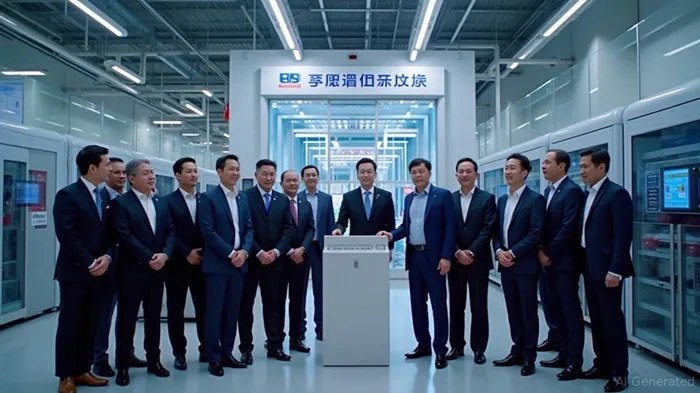 symbolizes this shift, with its advanced packaging capabilities—like chip-on-wafer-on-substrate (CoWoS)—critical for integrating AI-driven heterogeneous architectures.
By 2025, TSMC's 2nm (N2) and 1.6nm (A16) processes will dominate high-performance computing (HPC) and AI applications, offering power efficiency gains that are essential for data centers. Meanwhile, its global fab network—from Japan's sub-10nm Fab 23 to Germany's N12/N22 facility—ensures resilience against supply chain disruptions. This strategy isn't just about scale; it's about owning the future of chip design.
The AI Tsunami: TSMC's Revenue Engine
The numbers speak volumes. In May 讶 2025 alone, TSMC's revenue surged 39.6% year-over-year to $10.7 billion, with AI chips driving much of the growth. Major clients like NVIDIA (Blackwell series), AMD, and Apple rely on TSMC's advanced nodes for their next-gen products. Analysts predict AI-related revenue could grow at a 45% compound annual growth rate (CAGR) over five years, and TSMC is the undisputed gatekeeper to this market.
reveals a clear upward trajectory. The stock has risen nearly 20% in the past month, closing at $212.46 in early June 2025, well above its 50-day moving average ($175.58). With Q2 2025 earnings projected to hit $2.30 per share—up 57.5% year-over-year—the fundamentals are firing on all cylinders.
Valuation: Undervalued Relative to Growth Prospects
Despite its stellar performance, TSMC trades at a forward P/E of 16.5x, far below peers like NVIDIA (32x) and AMD (28x). This discount reflects concerns about near-term overvaluation or macroeconomic headwinds, but it also presents an opportunity. TSMC's valuation metrics—EV/EBITDA of 13.7x and EV/Sales of 14.7x—sit below their two-year averages, suggesting the market hasn't fully priced in its AI tailwinds.
Analysts' consensus is bullish: a “Strong Buy” rating with a $219.43 price target implies an 11% upside over 12 months. Even with geopolitical risks (e.g., U.S.-China trade restrictions), TSMC's diversified footprint and unmatched technology make it a rare “must-own” semiconductor stock.
Risks on the Horizon
No investment is without risks. TSMC's heavy CapEx could strain margins if demand slows, and geopolitical tensions remain a wildcard. The U.S. has already imposed export controls on advanced chips, while China is racing to build its own semiconductor industry. Additionally, talent shortages—TSMC alone needs 100,000+ skilled workers by 2030—could delay production timelines.
Investment Thesis: Buy the Dip, Hold for the AI Future
For long-term investors, TSMC is a structural play on the AI revolution. Its technological edge, global scale, and partnerships with tech giants make it a critical supplier in a $1 trillion+ semiconductor market. While short-term volatility is inevitable, the stock's valuation and growth trajectory suggest it's undervalued relative to its potential.
would further highlight the AI tailwind, but the data already points to a clear narrative: TSMC isn't just a chipmaker—it's the backbone of the AI era. Investors should consider adding TSMC to their portfolios, especially on dips below its 200-day moving average ($186.33), while keeping a close watch on geopolitical developments and AI adoption rates.
Historically, such a strategy has proven rewarding. A backtest from 2020 to 2025 reveals that buying when TSMC closed below its 200-day moving average and holding until recovery generated a total return of 76.91%, though with a maximum drawdown of 29.38%. This highlights the potential rewards but also the necessity of risk tolerance when employing such a disciplined approach.
In conclusion, TSMC's strategic bets—on leading-edge nodes, advanced packaging, and global expansion—are paying off. For investors willing to look past near-term noise, this is a stock to own as the world races toward an AI-powered future.

Stay ahead of the market.
Get curated U.S. market news, insights and key dates delivered to your inbox.






Comments
No comments yet