
TSMC to Build $15.87 Billion Fab in Central Taiwan, Aims for 2028 Production
ByAinvest
Tuesday, Oct 21, 2025 2:35 am ET1min read
TSM--
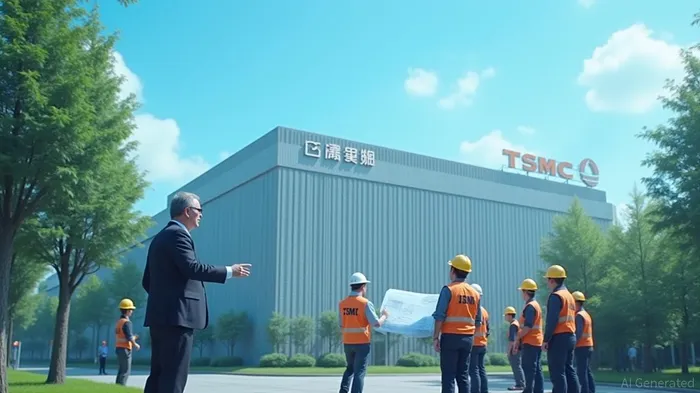
The Fab 25 project, with an initial investment of approximately $49 billion, is expected to generate NT$485.7 billion in production value and create around 4,500 job openings once fully operational. TSMC aims to commence construction by the end of 2025 and commence mass production by the second half of 2028 [1].
The A14 process, featuring TSMC's NanoFlex Pro standard cell architecture, promises substantial improvements over the current N2 process. This includes up to 15% faster performance at the same power, or 30% lower power consumption at the same speed, along with a 20% increase in logic density. These advancements are critical for meeting the growing demands of high-performance computing and artificial intelligence (AI) applications [1].
TSMC's strategic decision to expand its manufacturing footprint in Taiwan aligns with broader efforts to revitalize domestic semiconductor production. The company's collaboration with Nvidia to produce the first Nvidia Blackwell wafer in the U.S. underscores its commitment to enhancing the global supply chain and advancing AI technology capabilities onshore [2].
TSMC's financial health remains robust, with strong revenue growth and impressive profitability metrics. The company's operating margin of 48.72%, net margin of 42.46%, and EBITDA margin of 72.63% reflect its solid financial performance. Additionally, TSMC's balance sheet indicates a strong liquidity position and manageable debt levels, further bolstering its financial stability [2].
Despite its strong financial standing, TSMC faces sector-specific risks such as geopolitical tensions and supply chain disruptions. The company's high Piotroski F-Score of 8 and low Beneish M-Score of -2.77 suggest a healthy financial situation, but investors should remain vigilant regarding these risks [2].
In conclusion, TSMC's new Fab 25 facility represents a significant advancement in semiconductor manufacturing. With its robust financial health and strategic positioning, TSMC is well-positioned to continue its leadership in the industry. However, investors should consider the potential risks and valuation metrics when evaluating the company's investment prospects.
TSMC has submitted an application to build a new fab in Central Taiwan's Science Park to produce advanced high-speed wafers using the A14 technology. The fab will have initial investments of $49 billion and is expected to create NT$485.7 billion in production value and 4,500 job openings. TSMC plans to begin construction by year-end and start mass production in 2028.
Taiwan Semiconductor Manufacturing Co. Ltd. (TSMC) has taken a significant step towards advancing its semiconductor capabilities by submitting a construction permit for its new Fab 25 facility in Taichung's Science Park. This new facility, slated to produce advanced high-speed wafers using the A14 technology, marks a pivotal moment in TSMC's manufacturing strategy.The Fab 25 project, with an initial investment of approximately $49 billion, is expected to generate NT$485.7 billion in production value and create around 4,500 job openings once fully operational. TSMC aims to commence construction by the end of 2025 and commence mass production by the second half of 2028 [1].
The A14 process, featuring TSMC's NanoFlex Pro standard cell architecture, promises substantial improvements over the current N2 process. This includes up to 15% faster performance at the same power, or 30% lower power consumption at the same speed, along with a 20% increase in logic density. These advancements are critical for meeting the growing demands of high-performance computing and artificial intelligence (AI) applications [1].
TSMC's strategic decision to expand its manufacturing footprint in Taiwan aligns with broader efforts to revitalize domestic semiconductor production. The company's collaboration with Nvidia to produce the first Nvidia Blackwell wafer in the U.S. underscores its commitment to enhancing the global supply chain and advancing AI technology capabilities onshore [2].
TSMC's financial health remains robust, with strong revenue growth and impressive profitability metrics. The company's operating margin of 48.72%, net margin of 42.46%, and EBITDA margin of 72.63% reflect its solid financial performance. Additionally, TSMC's balance sheet indicates a strong liquidity position and manageable debt levels, further bolstering its financial stability [2].
Despite its strong financial standing, TSMC faces sector-specific risks such as geopolitical tensions and supply chain disruptions. The company's high Piotroski F-Score of 8 and low Beneish M-Score of -2.77 suggest a healthy financial situation, but investors should remain vigilant regarding these risks [2].
In conclusion, TSMC's new Fab 25 facility represents a significant advancement in semiconductor manufacturing. With its robust financial health and strategic positioning, TSMC is well-positioned to continue its leadership in the industry. However, investors should consider the potential risks and valuation metrics when evaluating the company's investment prospects.
Stay ahead of the market.
Get curated U.S. market news, insights and key dates delivered to your inbox.
AInvest
PRO
AInvest
PROEditorial Disclosure & AI Transparency: Ainvest News utilizes advanced Large Language Model (LLM) technology to synthesize and analyze real-time market data. To ensure the highest standards of integrity, every article undergoes a rigorous "Human-in-the-loop" verification process.
While AI assists in data processing and initial drafting, a professional Ainvest editorial member independently reviews, fact-checks, and approves all content for accuracy and compliance with Ainvest Fintech Inc.’s editorial standards. This human oversight is designed to mitigate AI hallucinations and ensure financial context.
Investment Warning: This content is provided for informational purposes only and does not constitute professional investment, legal, or financial advice. Markets involve inherent risks. Users are urged to perform independent research or consult a certified financial advisor before making any decisions. Ainvest Fintech Inc. disclaims all liability for actions taken based on this information. Found an error?Report an Issue


ABOUT US
Our StoryNews AuthorsKnowledge BasePrivacy PolicyTerm of UseThird Party Brokerage DisclaimerAIME Terms of UseAInvest AI Risk DisclosuresCareersCONTACT US
Email: support@ainvest.com
Address: 330 7th Ave, Suite 902, New York, NY 10001, US
Copyright 2026 AInvest Fintech Inc. All rights reserved.


Comments
No comments yet