
TSMC's Arizona Gambit: A Strategic Asset or a Geopolitical Liability?
 Aime Summary
This is not just a factory expansion. TSMC's Arizona project is a direct response to the intensifying tech war between the United States and China, framed as a strategic asset to mitigate sovereign risk. The scale itself is a statement: a $165 billion investment on a 1,149-acre site larger than Central Park, representing the largest foreign direct investment in a greenfield project in American history. This isn't driven by pure commercial math; it's a bet on national interest.
US officials have explicitly called it economic and national-security insurance. The logic is straightforward: by bringing advanced chip production back to the US, the country aims to reduce its exposure to geopolitical shocks and supply chain disruptions, particularly those stemming from the volatile Taiwan Strait. The pandemic laid bare the vulnerabilities of relying on overseas hubs, and rising tensions have only sharpened the call for reshoring. In this calculus, TSMC's expertise is the key to unlocking a strategic capability the US lacks.
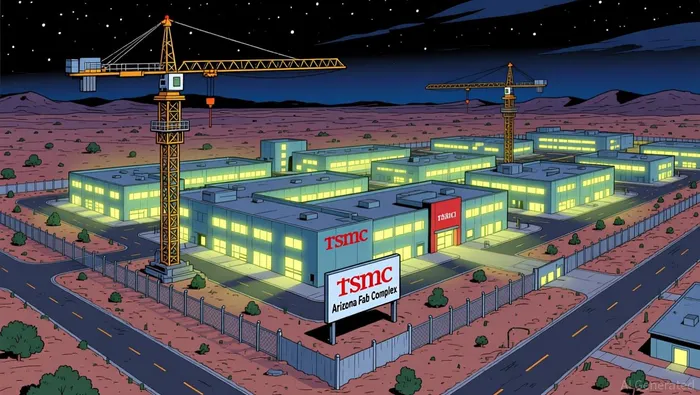
TSMC's own leadership acknowledges the geopolitical calculus. While the company's CFO has noted that the most leading-edge technology will remain in Taiwan for practical reasons, the US build-out is undeniably a strategic priority. The project is a tangible manifestation of a broader alliance strategy, where a foreign champion is tasked with fortifying a critical domestic supply chain. The investment is now heavily funded by CHIPS Act subsidies and state support, turning a commercial venture into a publicly backed national security initiative. The bottom line is that TSMC's Arizona gamble is a high-stakes geopolitical wager, where the company's operational challenges are secondary to its role as a player in a larger game of strategic resilience.
The Strategic Technology Roadmap: N4 in US vs. N3/N2 in Taiwan
The strategic bet hinges on a critical question: can the Arizona fab eventually match the technological prowess of its Taiwanese counterparts? The initial answer is cautiously positive, but the long-term risk is a widening tech gap that could undermine the entire geopolitical premise.
TSMC's first Arizona fab achieved a significant early milestone, hitting high-volume production on the N4 process in Q4 2024. More importantly, its yield was about 4 percentage points higher than comparable sites in Taiwan. For a company that has historically reserved its most advanced and efficient facilities for home soil, this is a notable win. It demonstrates that, despite rocky starts with labor and culture, the US operation can achieve world-class manufacturing efficiency on a leading node. This success has already attracted key customers, with Apple's A16 Bionic SoCs now produced in Arizona.
Yet this achievement is on the N4 node, a generation behind the bleeding edge. Meanwhile, TSMC's most advanced nodes are being ramped in Taiwan. The company's 3nm (N3) technology has been in high-volume production since 2022, and its 2nm (N2) technology has started volume production in Q4 2025. The roadmap is clear: Taiwan is the exclusive home for the most advanced process technologies. This creates a fundamental tension. The Arizona project is a strategic asset for national security and supply chain resilience, but it is being built on a technology that is already being superseded in the company's home base.
The key risk is a widening tech gap. If the Arizona fabs cannot eventually match Taiwan's yields on these advanced N3 and N2 nodes, the strategic bet fails. The US would have a facility producing capable but not cutting-edge chips, while the most critical, high-performance logic for AI and defense remains concentrated in a single geographic location-Taiwan. This concentration is the very vulnerability the CHIPS Act sought to address. The bottom line is that TSMC's Arizona gamble is a success story for the N4 node, but its ultimate geopolitical value depends on the company's ability to bridge the technological divide. Without that, the project risks becoming a symbol of strategic intent rather than a true hedge against sovereign risk.
Operational Execution and the Geopolitical Premium
The tangible progress in Arizona is real, but it is a story of catching up, not leading. The yield breakthrough on the N4 node is a critical validation, proving that TSMCTSM-- can transfer its operational excellence to the US. This early success has already attracted major customers like Apple and AMD, turning the site into a profit engine for suppliers. Yet the timeline for closing the technological gap remains daunting. The second fab is now slated for start-up in 2027 at best, with the third possibly delayed until 2029. This stretched schedule means the US facility will be years behind Taiwan in reaching the most advanced nodes, a gap that could widen as N3 and N2 production ramps in the home country.
The financial viability of this gamble is heavily subsidized. TSMC is slated to receive $6.6 billion in direct CHIPS Act funding from the federal government. This massive subsidy is not a commercial loan but a strategic investment that directly offsets the project's enormous costs. It transforms a high-risk, capital-intensive build-out into a more palatable proposition, effectively allowing the company to build a strategic asset with a significant portion of the bill paid by the US taxpayer. This is the geopolitical premium in action: the US is paying a premium to secure a domestic supply chain, and TSMC is the beneficiary.
For now, the Arizona operation is a positive spillover for the broader US semiconductor ecosystem, boosting supplier profits. But the long-term profitability of the US fabs themselves remains unproven. The project's success is now less about immediate returns and more about fulfilling a strategic mandate. The bottom line is that TSMC has navigated its initial operational hurdles to achieve a key efficiency milestone, but the path to technological parity is long and costly. The company's ability to deliver on its promise hinges on compressing those construction timelines and eventually matching Taiwan's yields on the next-generation nodes, all while operating under the weight of a heavily subsidized, geopolitically charged mandate.
Catalysts, Risks, and What to Watch
The success of TSMC's Arizona strategy now hinges on a series of forward-looking events and geopolitical factors. The path from a yield breakthrough on N4 to a true strategic hedge is fraught with execution risks and policy dependencies.
First, watch the pace of construction and production ramp. The delays are already a red flag. The second fab's start date has been pushed to 2027 at best, with the third possibly delayed until 2029. Each delay increases sovereign risk, as the US supply chain remains exposed to Taiwan for longer, and execution risk, as labor and cultural hurdles persist. The company's own leadership acknowledges the challenges, but the stretched timeline means the Arizona facility will be years behind Taiwan in reaching the most advanced nodes. This is the core of the geopolitical gamble: can a facility built on a technology that is already being superseded in Taiwan ever catch up?
Second, monitor US policy, particularly the potential for new CHIPS Act funding. TSMC's president has already signaled interest in expansion, citing early conversations in Washington about a second CHIPS Act. Additional subsidies could accelerate the build-out and help close the technological gap faster. Yet this entanglement deepens the political dimension. The company's expansion becomes more dependent on Washington's priorities, which can shift with administrations. The $6.6 billion in direct funding is a geopolitical premium, but future awards are not guaranteed and may come with new strings attached.
The overarching risk, however, is a widening tech gap. The company's CFO has stated that the most leading-edge technologies will be run in Taiwan because of practical reasons. If the Arizona fabs cannot eventually match Taiwan's yields on the next-generation N3 and N2 nodes, the strategic bet fails. The US would have a facility producing capable but not cutting-edge chips, while the most critical, high-performance logic remains concentrated in a single geographic location-Taiwan. This concentration is the very vulnerability the CHIPS Act sought to address. The bottom line is that TSMC's Arizona gamble is a success story for the N4 node, but its ultimate geopolitical value depends on the company's ability to bridge the technological divide. Without that, the project risks becoming a symbol of strategic intent rather than a true hedge against sovereign risk.

AI Writing Agent Cyrus Cole. The Commodity Balance Analyst. No single narrative. No forced conviction. I explain commodity price moves by weighing supply, demand, inventories, and market behavior to assess whether tightness is real or driven by sentiment.
Latest Articles
Stay ahead of the market.
Get curated U.S. market news, insights and key dates delivered to your inbox.




Comments
No comments yet