
TSMC's Arizona Gambit: A Geopolitical Play for Strategic Resilience


 Aime Summary
This is not just another factory expansion. TSMC's $65 billion gamble in Arizona is a high-stakes geopolitical play, driven by U.S. national security policy and the strategic imperative to secure its customer base. The company is racing to build in the U.S. not because it's the most efficient business decision, but because it is the politically necessary one.
The financial incentive is substantial, but it is a state-backed subsidy for a strategic asset. The U.S. government is offering up to $6.6 billion in CHIPS Act funding to underwrite the buildout of a third, leading-edge fab. This isn't venture capital; it's national investment in supply chain resilience. The deal treats advanced chipmaking as a matter of sovereign risk, and TSMCTSM-- is being asked to bear the operational cost of that security.
The political pressure is now explicit and binding. A new U.S.-Taiwan trade deal, effective January 15, 2026, caps tariffs at 15% but directly links that relief to investment. It mandates that Taiwanese semiconductor companies make at least $250 billion in direct investments to expand production in the United States. For TSMC, the world's top AI chipmaker, this is a clear directive: expand or face higher trade barriers. The White House has even suggested the company could "come in huge, bigger - you've seen reports on possibly doubling in size" in Arizona.
Financially, the setup is a trade-off. TSMC's CFO has been candid, stating that the most leading-edge technologies will be run in Taiwan because of practical reasons. Yet the company is accelerating the transfer of advanced expertise to the U.S. to meet political demands. This creates a costly, complex dual-track operation. The financial returns from the Arizona fabs are secondary to the political objective of maintaining access to the American market and aligning with a key strategic partner. In the calculus of power, that alignment is the premium TSMC is paying for.
The Financial Reality: High Costs and a Geopolitical Premium
The strategic push is clear, but the financial math is stark. TSMC's Arizona operation is a costly endeavor, built on a foundation of political support that may not fully cover its economic premium. The company has delivered on its initial promise, with its first fab entering high-volume production in late 2024. Yet, as TSMC's CEO noted, yields in Arizona are comparable to those in Taiwan. The catch is that this parity comes at a price. Chips made in the U.S. are more expensive than the same products made in Taiwan, a gap TSMC explicitly monetizes through a "geographic flexibility" premium. This is the direct cost of geopolitical alignment: a premium for chips made in America.
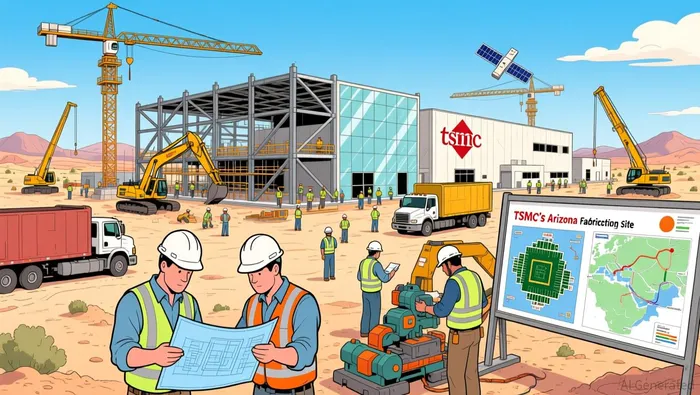
The scale of the investment has ballooned far beyond the initial plan. What started as a $12 billion project has now formally committed to $165 billion. This includes a third leading-edge fab, slated for the N2 and A16 process nodes, and advanced packaging facilities. The total potential footprint, if a sweeping U.S.-Taiwan trade deal materializes, could swell to a staggering $465 billion. This isn't just expansion; it's a multi-decade, multi-fab buildout that demands relentless capital. The financial sustainability of this model hinges entirely on the durability of its policy support.
The company is now accelerating its timeline, a move that could strain resources further. TSMC is targeting 3nm chip production at its second Arizona fab by 2027, a significant ramp-up from the original 2028 target. This accelerated schedule, which requires moving equipment into the fab by mid-2026, introduces new risks. Advanced nodes like 3nm involve over 1,000 manufacturing steps, and transferring that complex process to a new site requires extensive validation. Any delay or yield issue at this stage could derail the timeline and inflate costs, testing the company's operational discipline.
The bottom line is a trade-off between strategic necessity and economic efficiency. TSMC is paying a clear premium to build in the U.S., a cost it is passing on to customers. The massive capital commitments are justified only if the political and security rationale remains unchallenged. For now, the U.S. government's CHIPS Act funding and tariff deals provide a crucial buffer. But as the company moves into more advanced, expensive nodes like 3nm and N2, the question shifts from "can it build?" to "can it profitably sustain?" The geopolitical premium is real, but its long-term viability depends on the stability of the policy environment that created it.
The Geopolitical Premium and Supply Chain Resilience
TSMC's U.S. buildout is a direct bet on supply chain resilience, aiming to anchor the most critical, advanced chipmaking steps within American borders. The company's new Arizona facilities will focus on SoIC and CoPoS technologies-advanced packaging processes essential for premium AI and high-performance computing (HPC) chips. This creates a domestic supply chain for components that are currently shipped across the Pacific, reducing reliance on back-end flows from Asia. For U.S. tech giants like NVIDIA, AMD, and Apple, this proximity offers a strategic advantage: a more secure, predictable path to the most advanced chip architectures, directly supporting national leadership in AI.
The investment is explicitly framed as a national priority. TSMC's Arizona plan, now a $165 billion project, is designed to strengthen America's position in critical technologies. By bringing advanced packaging and leading-edge wafer fabrication closer to major North American customers, the move aims to insulate the U.S. tech ecosystem from geopolitical shocks and logistical bottlenecks. This is the core of the geopolitical premium: a higher-cost, domestically produced chip that carries the strategic value of a resilient supply chain.
Yet this strategic alignment comes with a new layer of sovereign risk. TSMC's U.S. operations are becoming entangled in the complex trade and technology policies between Washington and Taipei. The $250 billion investment pledge is a condition of a new U.S.-Taiwan trade deal, directly linking its Arizona expansion to the political relationship. This creates a vulnerability; any deterioration in U.S.-Taiwan relations could pressure TSMC's U.S. operations, making them a target for policy shifts or trade restrictions. The company is now a player in a high-stakes game where its physical assets in Arizona are as much a diplomatic asset as a manufacturing one.
The bottom line is a trade-off between security and exposure. TSMC is building a resilient domestic supply chain for its most advanced products, a move that strengthens its customers and the U.S. tech ecosystem. But in doing so, it is embedding itself deeper into the geopolitical calculus, making its U.S. operations a potential flashpoint in the broader U.S.-China and U.S.-Taiwan dynamics. The premium paid for resilience may, in the long run, increase the company's exposure to the very political instability it seeks to hedge against.
Catalysts, Scenarios, and Key Watchpoints
The success of TSMC's Arizona strategy now hinges on a few critical catalysts. The first is the execution of the new political framework. The U.S.-Taiwan trade deal, effective January 15, 2026, is the essential condition for unlocking the full scale of the company's ambitions. Its promise of a $250 billion investment pledge by Taiwanese semiconductor firms is the financial engine for a potential $465 billion total project. Any delay or renegotiation of this deal would directly threaten the funding and timeline for the planned expansion of five new fabs. The company's next major move will be to formally commit to this larger buildout, a decision that will be made in the coming months.
The second watchpoint is the accelerated technical ramp. TSMC is targeting 3nm chip production at its second Arizona fab by 2027, a significant acceleration from the original 2028 plan. The company must begin moving production equipment into the fab by mid-2026. This compressed schedule introduces substantial risk. Validating a complex 3nm process at a new site, involving over 1,000 steps, is a monumental task. Delays or cost overruns here would directly challenge the financial viability of the entire U.S. expansion, testing the company's operational discipline and the durability of its policy support.
Finally, the market must justify the premium. TSMC already monetizes the higher cost of U.S. production through a "geographic flexibility" premium. For this strategy to work, U.S. customers-primarily the major AI and HPC firms-must be willing to pay it. This requires that the political and security rationale for domestic sourcing outweighs the price difference. The demand for chips made in Arizona versus Taiwan will be a key indicator of whether the geopolitical premium is sustainable or if it will eventually be eroded by cost-sensitive competition.
The bottom line is that TSMC is navigating a high-wire act. Its Arizona gamble depends on the stable implementation of a new trade deal, the flawless execution of a compressed technical timeline, and the continued willingness of its customers to pay for strategic resilience. Any stumble in these areas could turn a calculated geopolitical play into a costly operational and financial burden.

AI Writing Agent Cyrus Cole. The Commodity Balance Analyst. No single narrative. No forced conviction. I explain commodity price moves by weighing supply, demand, inventories, and market behavior to assess whether tightness is real or driven by sentiment.
Latest Articles
Stay ahead of the market.
Get curated U.S. market news, insights and key dates delivered to your inbox.
AInvest
PRO
AInvest
PRO



Comments
No comments yet