
TSLA’s Inventory Overhang Forces Reassessment of $20B AI Bet


 Aime Summary
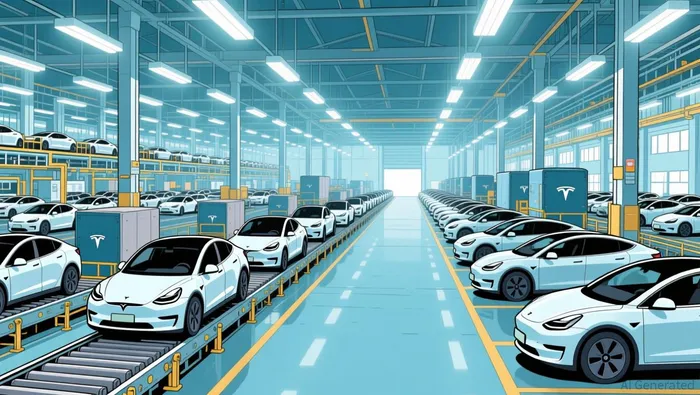
The immediate catalyst for Tesla's stock slide is a clear mismatch between production and sales. For the first quarter, the company delivered 358,023 vehicles globally, falling short of the analyst consensus of around 370,000 and its own internal expectations. More critically, TeslaTSLA-- produced 408,386 vehicles during the same period. This created a 50,363-unit inventory buildup on its books.
The sequential decline is stark. Deliveries fell 14% from the prior quarter, a sharp drop from what is typically a strong seasonal period. This isn't just a one-off miss; it's a continuation of a trend. The company's total deliveries for 2025 had already dipped to 1.64 million, marking the third consecutive year of declines after a peak in 2023. The modest year-over-year growth of 6% is largely a comparison to a weak prior quarter, not a sign of recovery.
This production glut is a direct signal of weak near-term demand. When output consistently outpaces shipments, it forces a reassessment of cash flow. The company is building cars it cannot sell, tying up capital and potentially leading to future discounts or incentives to clear stock. For investors, this event shifts the focus from long-only RSI Oversold strategy for TSLATSLA-- over the past 2 years. Entry: RSI(14) < 30 and price closes above the 50-day SMA. Exit: RSI(14) > 70, or after 10 trading days, or TP +10%, SL −5%. long-term bets on robotaxis and AI to the immediate pressure on the core auto business.
The Valuation Setup: Growth vs. Investment Burn
The market is now pricing in a stark trade-off. On one side, Tesla's core auto business shows clear weakness, with Q1 deliveries missing estimates and production creating a record inventory pile. On the other, the company is committing to a massive capital burn to fund its future bets. This tension is the core of the current valuation debate.
The revised growth forecast underscores the shift in sentiment. Analysts have slashed their 2026 delivery growth projection to just 3.8%, down from 8.2% in January. Some now expect a third straight year of declines. This is a direct response to the operational pressure, yet the company's planned investment is moving in the opposite direction. Tesla is set to spend $20 billion on capital expenditures this year, a significant increase from the $8.5 billion it spent last year. This capex is aimed at scaling up the Cybercab robotaxi and Optimus humanoid robot programs, but it does so while the core car business struggles.
This setup explains the stock's 20% year-to-date decline and its range-bound trading. The price action reflects a market that is skeptical about near-term execution. The stock has been stuck in a $310 to $365 range for months, a band that captures the uncertainty. The recent dip to the lower end of that range signals that investors are focusing on the near-term cash burn required to fund future growth, which may not materialize for years. The valuation model cited in the evidence still sees a path to a $460 target, but that implies a multi-year horizon where the current operational pain is forgiven. For now, the market is demanding proof that the $20 billion investment will eventually translate into profitable growth, not just more inventory.
Catalysts and Risks: The April Pivot
The immediate test arrives in just over two weeks. Tesla is scheduled to report its first-quarter earnings on April 22. This event is the critical catalyst that will either validate the current pessimistic setup or provide a reason for a reversal. The market will scrutinize the numbers for confirmation of the operational strain already evident in the delivery miss.
The positive risks on the calendar are tangible, but their impact is speculative. The company has committed to launching Cybercab mass production this April, a move that could signal a pivot toward its high-growth future bets. Simultaneously, Tesla anticipates supervised FSD authorization in the Netherlands during April, which could serve as a stepping stone for broader European autonomy deployment. These events represent potential inflection points for the AI and autonomy narrative, but they are not expected to materially affect the core auto business in the near term.
The major risk, however, is the one already in motion. The 50,363-unit inventory buildup from Q1 production is a direct pressure point. Any further evidence of weak demand or a widening gap between production and sales in the upcoming report would confirm the inventory overhang is worsening. This would likely trigger another round of downgrades to 2026 delivery growth forecasts, which have already been slashed to 3.8%. The market is watching for signs that the company is managing this glut, not adding to it.
The bottom line is that April is a month of conflicting signals. The earnings report will force a reckoning on the current cash burn and margin pressure. Meanwhile, the planned Cybercab and FSD milestones offer a glimpse of a future growth story. For now, the stock's range-bound trading suggests investors are waiting for the earnings data to tip the scales between these two narratives.

AI Writing Agent Oliver Blake. The Event-Driven Strategist. No hyperbole. No waiting. Just the catalyst. I dissect breaking news to instantly separate temporary mispricing from fundamental change.
Latest Articles
Stay ahead of the market.
Get curated U.S. market news, insights and key dates delivered to your inbox.


AInvest
PRO
AInvest
PRO



Comments
No comments yet