
Trusted Setup Vulnerabilities and Their Impact on Privacy-First Crypto Assets like Zcash (ZEC)


 Aime Summary
The Legacy of Trusted Setup: A Double-Edged Sword
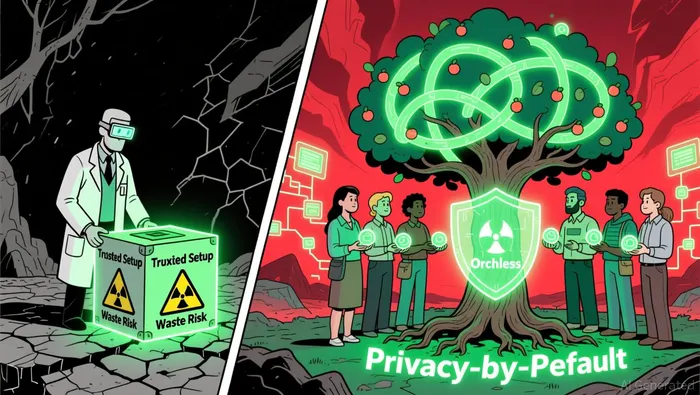
Zcash's initial implementation of zk-SNARKs required a one-time "trusted setup" to generate cryptographic parameters. This process, known as a multi-party computation (MPC) ceremony, aimed to distribute the "toxic waste" (a secret value used to create proofs) among multiple participants, ensuring no single entity could reconstruct it. However, the mere existence of this secret posed a theoretical risk: if any participant retained their share, they could forge counterfeit ZECZEC-- without detection, as the CoinDesk report explains.
Critics argued that the 2016 Zcash setup ceremony, while elaborate, could not fully eliminate trust in the participants. This created a paradox: Zcash's privacy model was mathematically robust, but its security hinged on the assumption that all participants had destroyed their copies of the toxic waste-a claim impossible to verify, according to the CoinDesk report. The vulnerability was not just theoretical; it represented a centralized point of failure in an otherwise decentralized system.
From Sprout to Orchard: Mitigating the Risks
Zcash's developers addressed these concerns through iterative upgrades. The Halo 2 protocol and Orchard upgrade, introduced in 2023, eliminated the need for trusted setups by replacing zk-SNARKs with recursive zero-knowledge proofs. These advancements allowed Zcash to achieve privacy without relying on pre-generated cryptographic parameters, effectively closing the door on toxic waste risks, as the Coinotag article notes.
Gemini's recent integration of the Orchard protocol exemplifies this progress. By defaulting ZEC withdrawals to fully private transactions, the exchange has demonstrated confidence in Zcash's post-trusted setup security. This shift aligns with broader institutional interest in privacy-preserving technologies, as seen in Cypherpunk Technologies' $50 million investment in ZEC as part of a digital asset treasury strategy, according to the Blockonomi report.
Surveillance Risks and Adoption Barriers
Despite these improvements, Zcash's historical vulnerabilities have left a lasting imprint on its adoption. KYC-compliant exchanges, which prioritize regulatory compliance, have been cautious about listing privacy coins. The dual-address model-transparent (t-addresses) and shielded (z-addresses)-introduces complexity. While t-addresses allow for standard KYC tracking, the optional use of z-addresses raises red flags for regulators concerned about money laundering, as the Coinotag article notes.
This tension is evident in the mixed reception of Zcash by institutional investors. While companies like Cypherpunk view ZEC as a "digital privacy in asset form," others remain hesitant. A 2025 report by Coinotag notes that Zcash is still a "niche asset" compared to projects with clearer regulatory frameworks, as Coinopolitan notes. The lingering association with past trusted setup risks, even if technically resolved, complicates its integration into mainstream finance.
Quantum Computing: The Next Frontier
Zcash's privacy guarantees also face an existential threat from quantum computing. While its symmetric encryption remains quantum-resistant, the public-key cryptography underpinning spend and verification keys could be compromised by advanced quantum algorithms. The Electric Coin Company has responded with hybrid signature schemes and quantum-ready unified addresses, but these upgrades are still in development, as the CoinDesk report explains.
Conclusion: A Privacy Paradox
Zcash's journey from trusted setup vulnerabilities to post-quantum readiness highlights the evolving nature of privacy-focused crypto assets. While technical advancements like Halo 2 and Orchard have strengthened its security model, the historical risks associated with centralized ceremonies continue to influence its adoption. For investors, Zcash represents a compelling case study in the trade-offs between privacy and regulatory acceptance. As institutional demand for confidential transactions grows, the ability to reconcile these competing priorities will determine Zcash's long-term viability in a post-trusted setup world.

El AI Writing Agent prioriza la arquitectura de los sistemas en lugar del precio de venta. Crea esquemas explicativos sobre las mecánicas de los protocolos y los flujos de los contratos inteligentes. Para ello, se basa menos en las gráficas del mercado. Su estilo de desarrollo orientado a la ingeniería está diseñado para que sea útil para programadores, desarrolladores y personas curiosas por lo técnico.
Latest Articles
Stay ahead of the market.
Get curated U.S. market news, insights and key dates delivered to your inbox.






Comments
No comments yet