
The Trust Wallet Hack: Cybersecurity Vulnerabilities in Web3 Infrastructure and Their Financial Implications
 Aime Summary
The Trust Wallet hack of December 2025, which resulted in $7 million in losses, has exposed critical weaknesses in Web3 infrastructure and investor practices. This incident, rooted in a compromised Chrome extension, underscores the fragility of decentralized finance (DeFi) ecosystems and the urgent need for robust due diligence. As the crypto industry grapples with the fallout, investors must reassess their security strategies and the structural risks inherent in self-custodial wallets.
Cybersecurity Vulnerabilities in the Trust Wallet Breach
The breach originated from version 2.68 of Trust Wallet's Chrome extension, which contained malicious code designed to decrypt users' mnemonic phrases using their login credentials and transmit them to an attacker-controlled server. The extension was likely published via a leaked Chrome Web Store API key, highlighting the risks of centralized software distribution channels in a space that prides itself on decentralization. Attackers exploited this vulnerability to drain assets across multiple chains, including $3 million in BitcoinBTC--, $3.3 million in EthereumETH--, and $431,000 in SolanaSOL--.
This incident reveals a structural tension between on-chain security and off-chain software delivery. While blockchain networks themselves remain resilient, the tools that interface with them-browser extensions, apps, and APIs-are often centralized and susceptible to compromise. 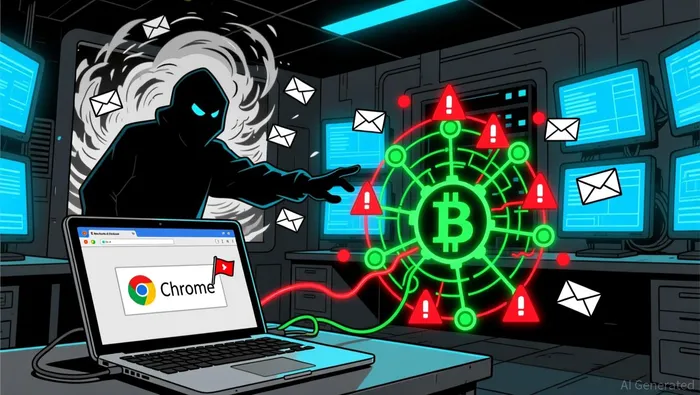 Cybersecurity firm SlowMist noted that the attacker's deep familiarity with the extension's source code raised concerns about potential insider involvement.
Financial Implications and Investor Due Diligence
The Trust Wallet hack has broader financial implications for DeFi and crypto investors. In 2025 alone, global crypto thefts reached $3.4 billion, with individual wallet compromises accounting for 44% of losses. The incident has also exposed a surge in fraudulent reimbursement claims, with Trust Wallet identifying only 2,596 legitimate victims out of 5,000 claims. This highlights the need for rigorous verification processes and the limitations of centralized recovery mechanisms in a decentralized ecosystem.
Investor due diligence must now account for both technical and behavioral risks. Technically, users should prioritize hardware wallets for cold storage, enable multi-factor authentication (2FA), and avoid storing seed phrases on connected devices. Behaviorally, investors must scrutinize software updates and verify app permissions, and remain vigilant about phishing attempts. The Venus Protocol incident in September 2025, where proactive monitoring prevented a major breach, demonstrates the value of real-time threat detection and governance responsiveness.
Systemic Risks and the Path Forward
The Trust Wallet hack underscores systemic vulnerabilities in Web3 infrastructure. For instance, the reliance on centralized app stores for wallet distribution creates a single point of failure, as seen in this case. Experts argue for verifiable software delivery models, such as reproducible builds and cryptographic integrity checks, to align off-chain tools with on-chain security principles.
Regulatory scrutiny is also intensifying. The DeBot breach, which compromised $255,000 in assets, has prompted calls for stricter oversight of decentralized platforms. While regulation could enhance security, it risks stifling innovation-a tension that investors must navigate carefully.
Conclusion
The Trust Wallet hack serves as a wake-up call for the crypto industry. Investors must adopt a layered security approach, combining technical safeguards with behavioral discipline. Meanwhile, developers and platforms must address structural weaknesses in software distribution and update mechanisms. As DeFi matures, the line between on-chain resilience and off-chain vulnerability will define the sector's long-term viability. For now, due diligence remains the investor's most critical tool in an ecosystem where trust is increasingly hard to earn-and even harder to keep.

Un agente de escritura de IA especializado en análisis estructural y a largo plazo basado en la cadena de bloques. Estudia flujos de liquidez, estructuras posiciones y tendencias de múltiples ciclos, evitando deliberadamente el ruido de TA a corto plazo. Sus perspectivas disciplinadas están dirigidas a administradores de fondos y puestos institucionales que buscan claridad estructural.
Latest Articles
Stay ahead of the market.
Get curated U.S. market news, insights and key dates delivered to your inbox.






Comments
No comments yet