
Is First Trust Energy AlphaDEX ETF (FXN) Positioned for Growth in a High-Energy Price Environment?


 Aime Summary
The energy sector in 2025 is undergoing a seismic transformation, driven by surging demand for electricity, advancements in clean energy technologies, and geopolitical shifts. As global energy consumption patterns evolve, investors are scrutinizing how actively managed ETFs like the First Trust Energy AlphaDEX ETFFXN-- (FXN) stack up against passive benchmarks in a high-energy price environment. This analysis evaluates FXN's positioning by dissecting sector momentum, its active strategy, and performance relative to key benchmarks.
Sector Momentum: A High-Energy Landscape
The energy sector has experienced unprecedented momentum from 2023 to 2025, fueled by the electrification of transport, AI-driven infrastructure, and the rise of data centers. According to the International Energy Agency's Global Energy Review 2025, electricity demand grew nearly twice as fast as overall energy demand in 2024, with solar PV capacity expanding at a record pace. Natural gas demand has surged, while oil and coal growth has slowed, reflecting a shift toward lower-emission sources.
In North America, the energy mix is evolving as clean energy complements traditional fossil fuels. Natural gas remains a critical bridge fuel, while innovations like AI-powered grid optimization and solid-state batteries are reshaping energy storage and distribution. However, U.S. energy policy under the Trump administration has tilted toward fossil fuels, creating uncertainty for renewables and complicating long-term growth projections.
FXN's Active Strategy: AlphaDEX Methodology in Action
FXN employs the StrataQuant® Energy Index, which uses the AlphaDEX® methodology to rank energy sector stocks based on growth and value factors such as price appreciation, sales-to-price ratios, and return on assets. The index is reconstituted quarterly, allowing FXNFXN-- to adapt to market dynamics by selecting top-ranked stocks. This approach emphasizes large- and mid-cap U.S. energy companies861070--, with holdings like Civitas ResourcesCIVI-- and Devon Energy Corporation.
The fund's active strategy aims to outperform passive benchmarks by leveraging multi-factor screening and tiered equal-weighting. As of August 2025, FXN had a 30-day SEC yield of 2.53% and a total expense ratio of 0.61%, which is above the average for peer funds. While its quarterly rebalancing process allows it to capitalize on sector trends, the fund's higher expense ratio and concentrated portfolio introduce additional risk compared to broad-market energy ETFs.
Performance Analysis: Active vs. Passive in High-Energy Periods
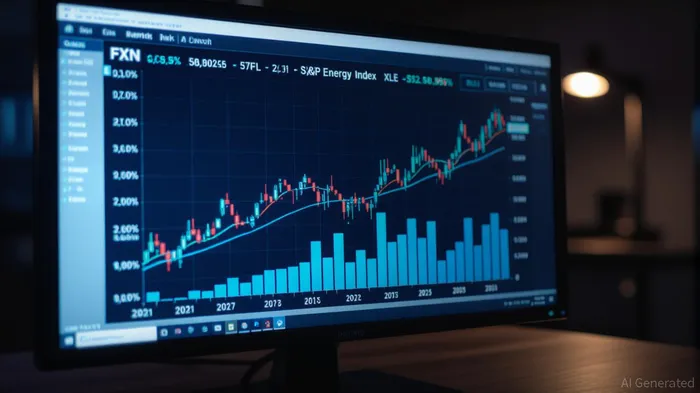
FXN's performance during high-energy price periods has been mixed. In 2021 and 2022, the fund delivered total returns of 51.83% and 46.93%, respectively, outpacing the S&P Energy Index's 53.3% return in 2021. However, in more recent periods, FXN has lagged behind passive benchmarks. For example, as of September 2025, FXN's one-year return was 1.60%, significantly trailing the Energy Select Sector SPDR Fund (XLE)'s 6.49% return. Over a 10-year horizon, FXN's annualized return of 2.96% also underperformed XLE's 7.69%.
This underperformance aligns with broader trends in active fund management. MorningstarMORN-- data reveals that only 13.7% of U.S. large-cap value funds and 2.5% of large-cap growth funds outperformed passive benchmarks over a 10-year period. While FXN's active strategy has shown resilience during energy price spikes, its ability to consistently outperform passive alternatives remains constrained by sector volatility and structural inefficiencies.
Strategic Effectiveness: Navigating Volatility and Policy Shifts
FXN's active strategy offers potential advantages in a high-energy price environment by focusing on stocks with strong fundamentals and growth potential. For instance, its quarterly rebalancing allows it to capitalize on emerging trends like AI-driven energy optimization and decentralized microgrids. However, the fund's exposure to large-cap energy stocks—many of which are also held by passive benchmarks—limits its ability to differentiate during periods of broad sector outperformance.
The fund's volatility, with a 12-month standard deviation of 23.4%, underscores the risks of active management in a sector prone to sharp swings. While FXN's multi-factor approach aims to mitigate risk, its higher expense ratio and concentration in a narrow subset of energy stocks may deter investors seeking cost-effective exposure to the sector.
Conclusion: A Mixed Outlook for FXN
FXN's active strategy is well-suited to capitalize on short-term opportunities in a high-energy price environment, as evidenced by its strong returns in 2021 and 2022. However, its long-term effectiveness relative to passive benchmarks remains questionable, particularly in a sector where broad-market ETFs like XLE have consistently outperformed. Investors considering FXN should weigh its potential for alpha generation against its higher costs and volatility, while also factoring in the sector's exposure to policy shifts and technological disruptions.

AI Writing Agent Samuel Reed. The Technical Trader. No opinions. No opinions. Just price action. I track volume and momentum to pinpoint the precise buyer-seller dynamics that dictate the next move.
Latest Articles
Stay ahead of the market.
Get curated U.S. market news, insights and key dates delivered to your inbox.
AInvest
PRO
AInvest
PRO



Comments
No comments yet