
Trump and Zelenskyy Finalize $100 Billion U.S. Arms Deal Backed by Europe
 Aime Summary
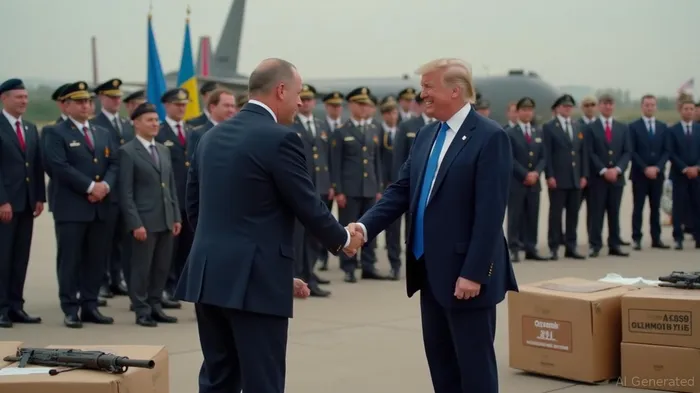
The stock market showed little reaction Monday following the conclusion of a high-profile meeting between U.S. President Donald Trump and Ukrainian President Volodymyr Zelenskyy, which lasted several hours at the White House. Despite the presence of multiple European leaders, including German Chancellor Friedrich Merz, French President Emmanuel Macron, and Italian Prime Minister Giorgia Meloni, the meeting did not result in a ceasefire agreement between Ukraine and Russia [1]. Instead, it ended with a $100 billion U.S. weapons procurement plan, fully funded by European governments, in exchange for U.S. security guarantees for Ukraine [3].
During the meeting, Zelenskyy presented a detailed proposal to Trump, which included a $50 billion joint drone production initiative between U.S. and Ukrainian companies. The proposal was designed to align with Trump’s emphasis on bolstering domestic military manufacturing, and the Ukrainian leader sought to counter the U.S. president’s recent shift in stance—following a meeting with Russian President Vladimir Putin—toward favoring a full peace deal without preconditions. Zelenskyy, in contrast, maintained that any progress toward peace must begin with a ceasefire [3].
Trump, for his part, appeared to reinforce the commercial nature of the arrangement, stating, “We’re not giving anything. We’re selling weapons.” This shift from direct military aid to a sale-based model could have long-term implications for U.S. arms manufacturers and the broader defense sector [3].
While Zelenskyy pushed for a ceasefire, Merz argued during a joint press conference that a ceasefire must precede any further negotiations with Moscow, saying, “I can’t imagine that the next meeting would take place without a ceasefire.” Ukraine, in its document, also reiterated that any agreement should not involve territorial concessions and called for full financial compensation from Russia for war damages, potentially drawing from the $300 billion in Russian assets frozen in Western jurisdictions [1].
The market’s muted response reflected a lack of surprise, as investors had anticipated the meeting would not yield an immediate resolution to the conflict. The Dow Jones Industrial Average ended the day down slightly by 0.08%, while the S&P 500 and Nasdaq Composite remained nearly flat [1]. Futures markets also showed minimal movement, with no significant shifts in investor sentiment. Tech giants like Meta PlatformsMETA-- and MicrosoftMSFT-- saw slight declines, dragging down the broader tech sector [1].
Investors are now turning their focus to Federal Reserve Chair Jerome Powell’s speech at the Jackson Hole summit, which could provide clearer signals on the direction of U.S. monetary policy. According to CME’s FedWatch tool, investors are currently pricing in an 83% probability of a rate cut at the Fed’s next policy meeting in September [1].
Despite the diplomatic efforts at the White House, the broader geopolitical landscape remains volatile. Recent Russian strikes in Kharkiv and Zaporizhzhia have claimed at least 10 lives, complicating prospects for a quick resolution. Meanwhile, Russian state media has mocked Trump’s influence, with prominent Kremlin talk show host Vladimir Solovyov downplaying U.S. leverage and suggesting that Russia could “destroy the U.S. with nuclear weapons” [1].
The meeting underscored the deep divides between the U.S. and its European allies, as well as the internal contradictions within Trump’s foreign policy approach. While he has sought to engage with Putin in ways that differ from previous administrations, Zelenskyy’s firm stance on territorial integrity and security guarantees has constrained the potential for rapid progress. The lack of a clear path forward left both leaders in a delicate balancing act—Trump trying to project peacemaking credentials, and Zelenskyy seeking to defend Ukraine’s sovereignty without alienating Washington [1].
The involvement of multiple European leaders in the meeting highlighted the growing importance of the Ukraine-Russia war to the transatlantic community. It also demonstrated the evolving nature of U.S. diplomacy under Trump, as he continues to chart a course that blends commercial interests with strategic engagement [1].
Source:
[1] Mitrade, [url](https://www.mitrade.com/insights/news/live-news/article-3-1049238-20250819)
[3] The New York Times, [url](https://www.nytimes.com/live/2025/08/18/us/trump-zelensky-ukraine-putin)

Stay ahead of the market.
Get curated U.S. market news, insights and key dates delivered to your inbox.


AInvest
PRO
AInvest
PRO



Comments
No comments yet