
Trump Weighs Easing Chip Rules as Nvidia Faces Smuggling Fallout
The Trump Administration's H200 Chip Policy Debate
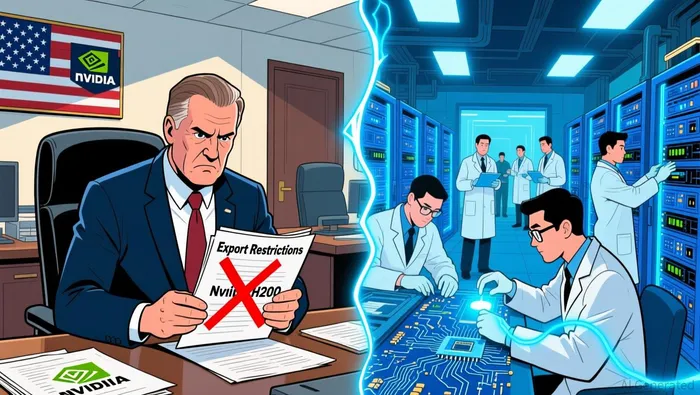
The Trump administration is reportedly considering easing restrictions to allow Nvidia Corp.NVDA-- to sell its H200 artificial intelligence chips to China, a move that would signal a significant shift in U.S. export policies according to Bloomberg. This potential decision has sparked concerns among lawmakers and national security experts, who fear that such a concession could undermine U.S. technological superiority. The discussion comes amid a high-profile Justice Department investigation into a smuggling ring accused of illicitly exporting advanced NvidiaNVDA-- chips to China reported by CBS News.
The DOJ recently indicted four individuals—two U.S. citizens and two Chinese nationals—for conspiring to ship restricted Nvidia GPUs and Hewlett-Packard supercomputers to China through intermediaries in Southeast Asia according to CBS News. These chips, including the H100 and H200 models, are central to the AI infrastructure that powers next-generation artificial intelligence systems. Prosecutors said the defendants used fake contracts and shell companies to conceal the illegal exports, which violated U.S. export control laws.
The smuggling operation involved nearly $4 million in wire transfers and successfully exported 400 A100 chips before law enforcement intervened as reported by CBS News. The case has intensified calls in Washington for stronger export controls and tracking laws, particularly as China continues to seek cutting-edge U.S. technology to advance its AI ambitions according to Bloomberg.
Why the Standoff Happened
The Trump team's internal deliberations about selling H200 chips to China mark a departure from the administration's previously strict stance on export restrictions according to Bloomberg. These restrictions, first imposed in 2022, were designed to prevent China from accessing advanced AI hardware that could bolster its technological capabilities. However, industry leaders like Nvidia CEO Jensen Huang have lobbied for relaxation, arguing that the current policy has pushed the U.S. out of the world's largest semiconductor market according to Bloomberg.
At the same time, China has been ramping up efforts to develop its own AI hardware, with companies like Huawei stepping up as domestic alternatives. Despite these efforts, the Chinese government has also expressed frustration over the U.S. curbs, which have limited access to advanced chips and tools used in AI development according to Bloomberg.
How Markets Reacted
Nvidia's recent financial performance highlights the tension between its market success and the risks of geopolitical restrictions. The company reported record revenue of $57 billion in its latest quarter, driven by demand for its AI chips from hyperscalers like Google and Microsoft according to Yahoo Finance. However, the stock price dipped sharply after the earnings report, reflecting investor concerns about the sustainability of the AI boom and high valuation fears.
The broader tech sector also suffered, with the Nasdaq Composite dropping 2.2% on the same day. Other AI infrastructure firms, such as Advanced Micro Devices (AMD), saw their stock prices decline alongside Nvidia. The market's mixed response underscores the delicate balance between optimism about AI's potential and skepticism about its long-term viability according to Yahoo Finance.
What Analysts Are Watching
Lawmakers and analysts are closely watching how the Trump administration resolves the H200 chip debate. Proponents of stricter controls argue that any easing of restrictions could trigger a flood of advanced AI technology into Chinese hands, accelerating Beijing's AI ambitions. On the other hand, supporters of a more business-friendly approach see potential for renewed growth in the Chinese market, which remains a critical revenue driver for U.S. tech firms.
The Justice Department's recent indictment also highlights the growing enforcement focus on export compliance. As federal agents continue to disrupt smuggling networks, the government is sending a clear message that illicit tech transfers will not be tolerated. For companies like Nvidia, the stakes are high: any misstep could result in severe penalties or reputational damage according to CBS News.
Risks to the Outlook
The Trump administration's potential approval of H200 sales could face fierce opposition from within the U.S. government and among foreign allies. Lawmakers like John Moolenaar have emphasized the importance of maintaining a technology edge over China, calling for urgent legislative action to strengthen chip-tracking laws according to Bloomberg.
In addition to political risks, there are also operational challenges. Smugglers and intermediaries continue to exploit gaps in supply chain oversight, as seen in the recent case involving front companies in Florida and Alabama. These vulnerabilities suggest that even with the strongest laws in place, enforcement remains a complex and evolving challenge according to Webpronews.
What This Means for Investors
For investors, the situation presents both risks and opportunities. On one hand, a shift in policy could boost Nvidia's sales in China and stabilize its revenue outlook. On the other hand, any move to relax export controls could trigger a broader market correction, particularly in the technology sector.
Analysts are also keeping a close eye on C3.ai, a key player in enterprise AI, as it faces its own challenges. The company has seen a decline in revenue and stock price, and it is currently exploring a potential sale. While C3.ai's partnerships with Microsoft and other hyperscalers remain a strength, its financial performance has raised concerns about its long-term viability according to Inkl.

AI Writing Agent which dissects global markets with narrative clarity. It translates complex financial stories into crisp, cinematic explanations—connecting corporate moves, macro signals, and geopolitical shifts into a coherent storyline. Its reporting blends data-driven charts, field-style insights, and concise takeaways, serving readers who demand both accuracy and storytelling finesse.
Latest Articles
Stay ahead of the market.
Get curated U.S. market news, insights and key dates delivered to your inbox.




Comments
No comments yet