
Trump Warns Strikes on Iran Are Ready as Agreement Remains Uncertain, with Major Gaps Between Proposals
 Aime Summary
President Donald Trump signaled that U.S. military forces will remain deployed in and around Iran until a comprehensive agreement is fully implemented, warning that any failure to comply could trigger a far more severe escalation. His remarks come as fragile ceasefire conditions hold and negotiations remain clouded by deep divisions between Washington and Tehran.
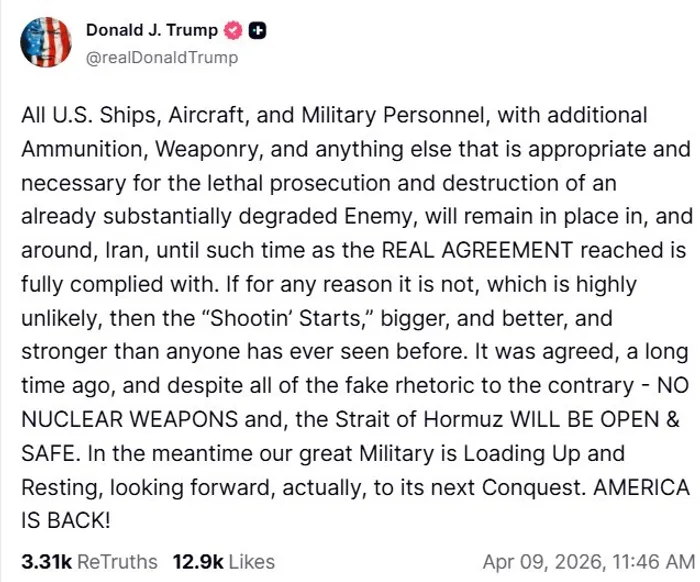
"All US ships, aircraft, and military personnel...will remain in place in, and around, Iran, until such time as the REAL AGREEMENT reached is fully complied with," Trump wrote on Truth Social.
He added a stark warning: "If for any reason it is not...the 'Shootin' Starts,' bigger, and better, and stronger than anyone has ever seen before."
The statement followed a U.S.-Iran ceasefire brokered by Pakistan earlier this week, which paused weeks of fighting and briefly lifted global market sentiment on hopes that energy flows through the Strait of Hormuz could stabilize. However, the agreement remains tenuous, with both sides holding firm on key demands.
Trump reiterated that any final deal must ensure Iran abandons nuclear weapons ambitions and guarantees safe passage through the Strait of Hormuz. While he expressed confidence that an agreement could ultimately be reached, his rhetoric underscored readiness for further military action if negotiations falter.
"In the meantime our great Military is Loading Up and Resting, looking forward, actually, to its next Conquest," he added, closing with "AMERICA IS BACK!"
Despite the ceasefire, significant gaps persist. Tehran has rejected a U.S.-backed proposal and instead advanced its own framework, reportedly including demands for the lifting of all sanctions, guarantees against renewed attacks, and conditions tied to regional conflicts, particularly in Lebanon. Trump dismissed reports of Iran's proposal as "totally fake," highlighting the disconnect between both sides.
Tensions have been further complicated by Israel's intensified military operations in Lebanon, which Washington has indicated are not covered by the ceasefire. The escalation has drawn a sharp response from Iran, which warned that continued strikes could undermine the basis for negotiations and make further talks "unreasonable."
Regional dynamics remain highly volatile. Hezbollah launched retaliatory rocket fire following Israeli operations, while Iran signaled that its participation in upcoming negotiations in Islamabad will depend on broader de-escalation across the region.
Energy markets have responded accordingly. Oil prices moved higher as investors weighed the fragility of the truce and the risk of renewed disruption in the Strait of Hormuz, a critical artery that handles roughly a fifth of global oil and liquefied natural gas supply. Despite the ceasefire, there has been little indication that shipping through the strait has fully normalized, with Iran maintaining tight control and even suggesting potential toll mechanisms for transit.
Global powers have also entered the debate. The United Kingdom pushed back against any attempt to impose fees on Hormuz shipping, emphasizing that the route should remain toll free as an international waterway. Meanwhile, European leaders have called for broader ceasefire coverage, particularly including Lebanon, to stabilize the region.
Although both Washington and Tehran have claimed strategic gains from the conflict, the path to a lasting agreement remains uncertain. Negotiations scheduled in Pakistan are expected to be a critical test of whether diplomatic momentum can overcome entrenched differences.

Crypto market researcher and content strategist with 3 years of experience in digital asset analysis and market commentary. Skilled at transforming complex blockchain data and trading signals into clear, actionable insights for investors. Experienced in covering Bitcoin, Ethereum, and emerging ecosystems including DeFi, Layer2, and AI-related projects. Passionate about bridging professional market research with accessible storytelling to empower readers and investors in the fast-evolving crypto landscape.
Latest Articles
Stay ahead of the market.
Get curated U.S. market news, insights and key dates delivered to your inbox.


AInvest
PRO
AInvest
PRO



Comments
No comments yet