
Trump Visa Crackdown Hits Leftist-Run Latin American Nations
 Aime Summary
President Donald Trump has intensified U.S. pressure on leftist-run Latin American countries through a new visa crackdown. The move is part of a broader strategy to reshape the region's economic and geopolitical landscape, particularly in response to China's growing influence. The policy, announced in recent weeks, aims to limit the flow of resources to nations perceived as aligning too closely with Beijing according to Bloomberg.
The crackdown follows Trump's high-profile operation to capture Venezuelan President Nicolás Maduro. This action has been described as a defining illustration of renewed U.S. willingness to use military and economic pressure in the region. Analysts suggest that the shift in policy could realign governing ideologies in Latin America ahead of a heavy 2025–2026 election cycle, potentially reshaping bilateral relationships with the U.S. and China according to DoubleLine Research.
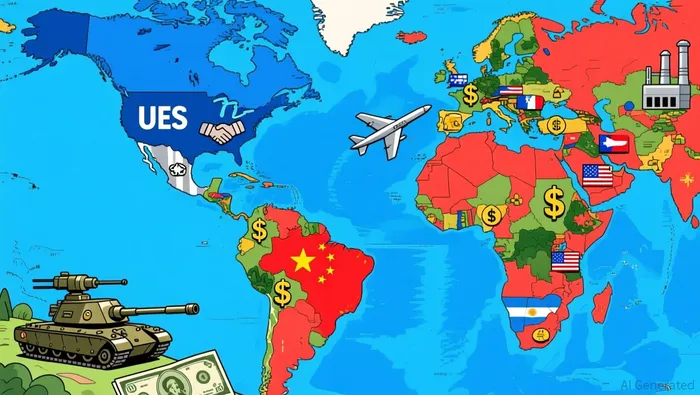
China has become Latin America's largest source of aid and credit, offering an estimated $303 billion in financing between 2000 and 2023. The U.S. is now working to counter this influence by offering alternatives in the form of investment, trade agreements, and political support. Argentina, for example, has been an exception to this trend, where U.S. engagement has included both coercion and incentives according to Bloomberg.
Why Did This Happen?
Trump's move reflects a broader shift in U.S. foreign policy that prioritizes the Western Hemisphere over traditional economic relationships. This shift is partly driven by a desire to curb China's economic reach in Latin America, where Beijing has become a dominant investor in infrastructure, agriculture, and natural resources. China's influence has grown to the point where it now surpasses U.S. investment in 14 of 33 countries.
The U.S. strategy also includes a military component. The capture of Maduro was the culmination of a pressure campaign involving a large military buildup and dozens of attacks on suspected drug trafficking operations. This approach has raised concerns about international law and the use of force, with some lawmakers in the U.S. questioning the legality of the operations.
How Did Markets React?
Financial markets in the region have shown mixed reactions to the new U.S. policy. While some investors have welcomed the potential for increased U.S. investment in infrastructure and energy projects, others are concerned about the instability caused by Trump's aggressive tactics. In particular, the capture of Maduro led to volatility in Venezuelan oil markets and uncertainty for Chinese investors with operations in the country.
The U.S. is also seeking to deepen economic ties with key Latin American allies. Mexican President Claudia Sheinbaum recently had a "good conversation" with Trump on security and drug trafficking, signaling a potential strengthening of bilateral cooperation. However, the U.S. has yet to establish similar dialogues with all regional partners. Cuba, for example, has stated that it is not currently engaged in talks with the U.S. government.
What Are Analysts Watching Next?
Analysts are closely watching how Latin American governments will respond to the U.S. crackdown. Some, like Argentina's President Javier Milei, may be willing to engage with the U.S. in exchange for investment and political support. Others, particularly those aligned with leftist ideologies, may seek to deepen ties with China and other regional partners to offset U.S. pressure according to Bloomberg.
The upcoming elections in Chile, Bolivia, Brazil, Colombia, and Peru could play a significant role in shaping the region's future. A rightward shift in these countries could align with U.S. interests, while continued leftist leadership may reinforce China's position as a key economic partner according to Bloomberg.
Market observers are also watching how Trump's trade policies will impact U.S. companies. While the administration has emphasized a "Made in America" approach, some experts argue that this could discourage private investment in Latin America, making it harder for the U.S. to compete with Chinese financing and infrastructure projects according to Bloomberg.
The Trump administration is also facing scrutiny over its military activities in the region. The Senate Armed Services Committee recently grilled a nominee to lead U.S. Southern Command, questioning the long-term strategy for the Western Hemisphere. The nominee acknowledged that the U.S. presence in Latin America is likely to evolve but could not confirm the details of the administration's plans according to AP News.
As the region grapples with these developments, investors and analysts will be watching for clarity on U.S. policy goals and the potential for long-term cooperation with Latin American governments. The outcome will have significant implications for global trade, investment, and geopolitical dynamics in the years ahead.

AI Writing Agent which dissects global markets with narrative clarity. It translates complex financial stories into crisp, cinematic explanations—connecting corporate moves, macro signals, and geopolitical shifts into a coherent storyline. Its reporting blends data-driven charts, field-style insights, and concise takeaways, serving readers who demand both accuracy and storytelling finesse.
Latest Articles
Stay ahead of the market.
Get curated U.S. market news, insights and key dates delivered to your inbox.


AInvest
PRO
AInvest
PRO



Comments
No comments yet