
Trump's Venezuelan Oil Gambit: A Structural Miscalculation
 Aime Summary
The political narrative is clear and compelling: a swift U.S. intervention has removed a hostile leader, and the promise is a quick, profitable win for American energy firms. President Trump has explicitly framed the operation as a chance for U.S. companies to rebuild Venezuela's infrastructure and share in the spoils. Yet this promise collides with the harsh structural math of a sector in deep decline. The investment thesis hinges on this gap between a political gamble and a physical reality that demands a decade of capital and stability.
The scale of the challenge is immense. Venezuela's current production is stuck at about 1.1 million barrels per day, a mere shadow of its 3.5 million bpd peak from the 1970s. Restoring even a fraction of that capacity is not a matter of flipping a switch. According to analysts, maintaining output at its current depressed level already requires more than the industry standard of $5.5 billion in annual investment. This figure is a baseline, not a ceiling. To meaningfully grow output, let alone approach historic highs, would require sustained commitments far beyond this, with one estimate calling for $183 billion over more than a decade just to return to a 1990s-era level. This is capital expenditure on a scale that dwarfs most national budgets.
The heavy crude composition adds another layer of complexity. Venezuela's reserves are dominated by heavy oil in Orinoco, which is technically simple to produce but expensive to refine. This creates a built-in market penalty, limiting the crude's appeal and profitability. More critically, the political risk is the ultimate deterrent. As analysts note, producers and traders would wait for a proper legal and fiscal framework before committing to long campaigns. The precedent is sobering: history shows that forced regime change rarely stabilizes oil supply quickly, with Libya and Iraq offering clear examples of protracted recoveries. The industry's caution is understandable. After all, the only major U.S. oil company still operating there, ChevronCVX--, is a rare exception to a broader exodus sparked by contract reneging and unpaid debts.
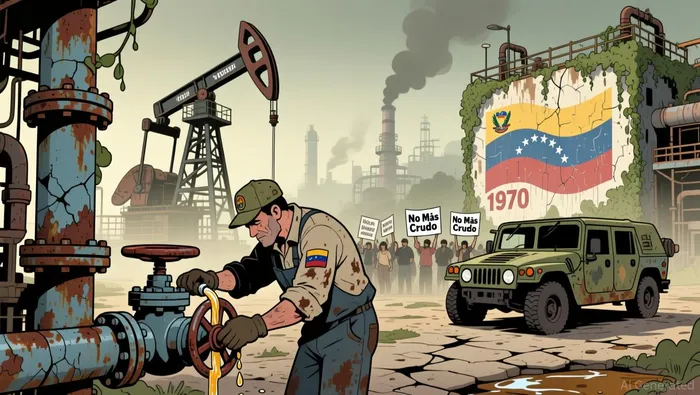
The bottom line is that the political narrative of a quick win ignores the structural prerequisites for any recovery. It requires not just the removal of a leader, but the establishment of a stable, investment-grade environment over many years. Until that framework is credible, the promise of billions in new oil remains a distant prospect, not a near-term opportunity.
The Decade-Long Timeline and Capital Barrier
The expectation of a rapid turnaround is a structural miscalculation. The physical reality of Venezuela's oil sector dictates a timeline measured in years, not quarters. The country's aging well stock and processing network are the primary bottleneck. Restoring even modest output requires billions in spending, and the path to any meaningful recovery is paved with a multi-year investment program that must begin in 2026. Analysts from ANZ and Rystad Energy are clear: project cycles from appraisal to final investment decision are likely to be longer in Venezuela, with little chance that increased producer spending would affect supply before the end of the decade.
This isn't a theoretical delay. It is a direct consequence of the sector's degradation. Rystad Energy's detailed mapping shows that while about 300,000–350,000 bpd could be added quickly with limited spend, growth beyond 1.4 million barrels per day demands sustained commitments to pipelines and upgraders. A full return to historic levels by 2040 would require roughly $183 billion in cumulative oil and gas CAPEX from 2026. This is capital expenditure on a scale that requires not just private interest, but a credible, stable legal and fiscal framework-a condition that remains absent.
The immediate market reaction underscores this timeline. Despite the dramatic political shift, oil prices fell and energy shares saw only a muted rally. This lack of panic is telling. It reflects a market that has already priced in the oversupply from other sources and understands that any new Venezuelan barrels will be incremental, not disruptive. As one analyst noted, even a full return of sanctioned Venezuelan barrels would represent less than 1 percent of global supply. The market's calm suggests it is planning for a delayed, managed recovery, not a sudden flood.
The bottom line is that the capital barrier is as formidable as the physical one. The industry's caution is not just about political risk; it is about the sheer scale and duration of the investment required. Until a stable framework emerges, the promise of a quick win remains a political narrative, while the structural math points to a decade-long grind.
Geopolitical and Competitive Repercussions
The U.S. intervention is not just a domestic political gamble; it is a direct challenge to established global energy alliances and a test of the administration's strategic vision. By seizing control of oil flows, Washington is actively disrupting a key trade relationship, particularly with China, and positioning itself to capture the proceeds. This reshapes the competitive landscape and introduces new layers of instability.
The immediate impact is on China's discounted oil supply. The intervention jeopardizes the flow of Venezuelan crude to Chinese 'teapot' refineries, which rely on this low-cost feedstock. More broadly, it threatens contracts with Chinese companies like China Concord Petroleum and casts doubt on future Chinese investments in Latin America. This is a direct hit to Beijing's influence in the Western Hemisphere, a core element of the Trump administration's stated goal to limit non-hemispheric competitors. The move signals that Venezuela's natural resources are now a U.S. strategic asset, not a bargaining chip for regional allies.
This creates a new investment battleground. The U.S. is not merely opening a door; it is attempting to control the entire pipeline. President Trump has stated that Venezuelan authorities will turn over to the U.S. between 30 million and 50 million barrels of sanctioned oil, which will then be sold at market price with proceeds controlled by the administration. This establishes a direct fiscal incentive for the U.S. to manage the assets, but it also imposes a long-term stewardship burden. The U.S. is effectively stepping into the role of a de facto sovereign wealth fund for Venezuelan oil, a role that requires sustained political and economic management far beyond a simple military operation.
Yet the political transition itself is unstable. The U.S. has designated an interim leader as "absolutely temporary", a label that underscores the lack of a clear, credible path forward. This ambiguity raises the specter of continued civil unrest and governance vacuums, which are the ultimate deterrents to private capital. For all the talk of U.S. companies rebuilding infrastructure, the immediate reality is one of heightened geopolitical risk. The market's muted reaction to the intervention reflects this calculation: the promise of future profits is being weighed against the very real costs of operating in a politically volatile environment with an unclear legal framework.
The bottom line is that the political narrative is being tested in a far more complex arena. The U.S. gambit reshapes global oil flows, directly challenges a major trading partner, and assumes a costly stewardship role. But without a stable, long-term governance model, the promise of capturing proceeds and attracting investment risks becoming a self-imposed burden. The geopolitical repercussions are already in motion, and they are complicating the very investment thesis the administration is trying to build.
Catalysts, Scenarios, and Watchpoints
The path from political narrative to physical recovery is now defined by a series of forward-looking events and metrics. The thesis of a slow, capital-intensive recovery will be validated or invalidated by the pace of tangible investment and the stability of the new arrangement. The critical catalyst is the deployment of U.S.-backed capital into infrastructure repair, with 2026 marking the start of any meaningful program. Analysts from ANZ and Rystad Energy have made it clear that normal project cycles of one to five years from appraisal to final investment decision are likely to be longer in Venezuela, and little chance that increased producer spending would affect supply before the end of the decade. The first real test will be whether the promised $183 billion over more than a decade can begin to materialize in the form of binding contracts and visible work by year-end.
A key source of near-term uncertainty is the political process itself. The Senate is expected to vote on a measure to limit President Trump's war powers in Venezuela, a resolution that could constrain the U.S. intervention timeline. This legislative action introduces a direct channel of oversight that may not align with the administration's stated view that its control will be "much longer" than a simple military operation. The outcome will be a major watchpoint, as a constrained mandate could create policy instability and deter long-term planning by potential investors.
More immediately, the financial viability of the new arrangement must be monitored. The U.S. has announced plans to take over and sell Venezuelan oil, with proceeds controlled by the administration. The market will be watching the actual volume and price of these sales against prevailing benchmarks. If the sales are consistently at a discount or fail to meet expected volumes, it will signal that the new governance model is not yet credible or efficient. Conversely, smooth, market-rate sales would be a positive signal, but they would also highlight the scale of the challenge: even a full return of sanctioned barrels would represent less than 1 percent of global supply, meaning the financial windfall for the U.S. and any partner companies would be incremental, not transformative.
The bottom line is that the investment thesis hinges on a multi-year sequence of events. The first catalyst is the start of capital deployment in 2026, which must be followed by a stable political framework and successful oil sales. Any stumble in this chain-whether from legislative constraints, project delays, or financial underperformance-will reinforce the structural barriers and likely keep the promise of a quick win firmly in the political realm.

El Agente de Redacción AI: Julian West. El estratega macroeconómico. Sin prejuicios. Sin pánico. Solo la Gran Narrativa. Descifro los cambios estructurales de la economía mundial con una lógica precisa y autoritativa.
Latest Articles
Stay ahead of the market.
Get curated U.S. market news, insights and key dates delivered to your inbox.




Comments
No comments yet