
Trump's Venezuela Operation: A Geopolitical Gambit with Market Implications
 Aime Summary
The United States has launched a dramatic geopolitical operation, framing it as a law enforcement action against a drug cartel leader. On January 3, 2026, U.S. forces captured Venezuelan President Nicolás Maduro and his wife in a special operation at his Caracas residence. The stated objective was to disrupt the flow of drugs from Latin America, a campaign that had already seen over twenty lethal strikes on alleged trafficking boats since September 2025. Yet the scale and target of this raid-directly removing a sitting head of state-signal a much broader strategic intent that now centers on Venezuela's oil.
The administration's immediate goal is clear: to take back Venezuela's oil and oversee its production indefinitely. Energy Secretary Chris Wright announced the U.S. intends to oversee Venezuelan oil sales "indefinitely", with President Trump stating U.S. oil firms are "ready" to reenter the country. This move aims to revitalize a sector crippled by mismanagement and sanctions. However, this new directive creates a direct contradiction with a foundational policy of the first Trump administration. In 2019, Washington recognized Juan Guaidó as interim president, a stance that allowed the 2015 National Assembly to control Venezuela's overseas assets. The current plan to run Venezuela through interim President Delcy Rodríguez is in deep tension with that earlier recognition, creating immediate confusion over who controls the oil industry and who speaks for Venezuela in global markets.
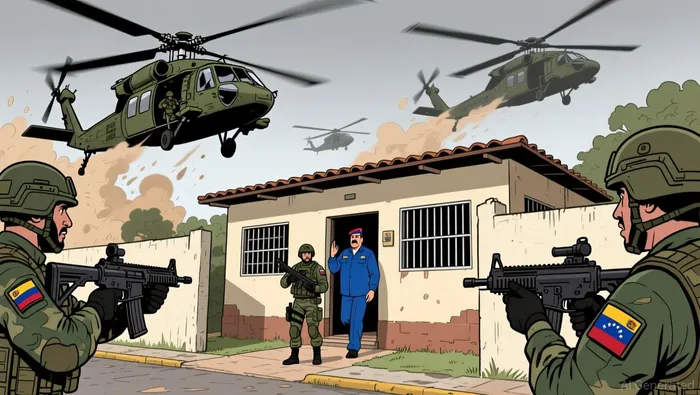
For markets, this is a sovereign risk event of the highest order. The U.S. is not merely sanctioning a regime; it is attempting to seize control of a strategic asset-the world's largest proven oil reserves-through unilateral military action. This sets a dangerous precedent for the security of energy resources in unstable regions. The immediate market implication is not just a potential surge in supply, but a fundamental reordering of who gets to decide the fate of a major oil producer. The operation transforms Venezuela from a geopolitical liability into a contested asset, with the U.S. now positioned as its de facto steward. The long-term stability of global oil markets now hinges on whether this control is exercised to attract investment and rebuild the sector, or to extract short-term gain-a distinction that will define the new geopolitical premium on Venezuelan crude.
The Political Backtest: War Powers and Congressional Pushback
The operation in Caracas has triggered an immediate political firestorm, testing the very limits of executive power. On Thursday, the Senate narrowly advanced a war powers resolution that would block the president's use of the armed forces in Venezuela without congressional authorization. The vote was a stark rebuke, with five Republicans joining all Democrats to push the measure forward by a 52-47 margin. This slim coalition, led by Democratic Senator Tim Kaine, framed the action as a constitutional necessity, arguing that the president's unilateral strike and his stated intent to oversee Venezuela's oil "indefinitely" set a dangerous precedent for future military interventions.
The administration is now mounting a fierce last-minute lobbying effort to pressure these GOP defectors. The strategy appears to be working, at least temporarily. Senator Josh Hawley, one of the five initial Republican supporters, has reportedly reversed his position after intense discussions with President Trump and Secretary of State Marco Rubio. He now says the resolution is "not needed," a shift that underscores the administration's determination to maintain party unity and its view that such legislative checks are an unwelcome constraint on its foreign policy.
This internal GOP rebellion is a critical vulnerability. It reveals a coalition that is not monolithic and highlights the potential for future legislative constraints on executive war powers. While the resolution is unlikely to become law-given the veto-proof majority needed and the president's opposition-it serves as a powerful symbolic check. It signals that even within the president's own party, there is a growing unease about the scope of unilateral military action, especially when it involves seizing control of a foreign nation's strategic assets.
For markets, this political turbulence introduces a new layer of regulatory headwind. The operation was a geopolitical gambit, but the congressional pushback shows that such gambits are not immune to domestic political friction. The episode establishes a precedent: major military interventions abroad, particularly those involving regime change and resource control, may now face a more predictable and potentially hostile legislative review. This could make future U.S. military actions more costly and uncertain, adding a new variable to the geopolitical premium that investors must factor into their assessments of risk.
Market and Geopolitical Implications: Energy Security and Supply Chain Resilience
The U.S. operation in Venezuela is a direct assault on a major energy supplier, but its immediate impact on global markets is likely to be more about risk than reward. The administration has already authorized over more than twenty lethal strikes on alleged drug trafficking boats in the Caribbean since September, a campaign that escalated pressure on Caracas. Now, by attempting to seize control of the country's oil, Washington risks undermining its own energy security. Venezuelan heavy crude is notoriously difficult to refine, and U.S. firms would need significant time and capital to reestablish operations. The plan to oversee Venezuelan oil sales "indefinitely" introduces a prolonged period of uncertainty, during which production likely remains depressed. This is not a quick fix for supply; it is a complex, long-term stewardship project that could strain refining capacity and delay any potential market relief.
More broadly, the operation tests the stability of U.S. alliances in Latin America and sets a dangerous precedent for unilateral military interventions. The capture of a sitting head of state, even under a counter-narcotics pretext, is a stark signal to other nations about the security of their own leadership and resources. It challenges the norms of sovereignty and could provoke a regional backlash, potentially destabilizing the very supply chains the U.S. seeks to control. The move also creates a direct contradiction with a foundational policy of the first Trump administration, which recognized Juan Guaidó as interim president. The current plan to run Venezuela through interim President Delcy Rodríguez is in deep tension with that earlier stance, creating confusion over who controls the oil industry and who speaks for Venezuela in global markets. This internal inconsistency weakens the U.S. position and invites challenges from other powers.
For markets, the primary implication is a new, high-cost variable in the geopolitical premium. The operation transforms Venezuela from a geopolitical liability into a contested asset, with the U.S. now positioned as its de facto steward. The long-term stability of global oil markets now hinges on whether this control is exercised to attract investment and rebuild the sector, or to extract short-term gain. The latter path, as one expert warns, would be short-sighted mercantilism that undermines the global energy market on which U.S. security depends. The success of this gambit will be measured not by the immediate capture of a leader, but by the U.S.'s ability to manage a complex, high-stakes intervention that reshapes energy flows and alliance dynamics for years to come.
Catalysts and Risks: What to Watch Next
The immediate test for the administration's strategy is the Senate vote on the war powers resolution. The measure narrowly passed its first hurdle, but it is not yet law. The administration's priority now is to secure at least one more Republican defection to block it, a task made urgent by the president's public condemnation of dissenters. The recent reversal by Senator Josh Hawley, who changed his vote after talks with the president and Secretary of State Marco Rubio, shows the administration is actively pressuring its own party to maintain unity. If the resolution ultimately dies, it will be a clear victory for executive power. But if it passes, even as a symbolic gesture, it will establish a new legislative check on unilateral military action, a precedent that could complicate future interventions.
Beyond the Capitol, the critical catalyst is the administration's specific plan to "take back" oil sales. Energy Secretary Chris Wright's announcement that the U.S. intends to oversee Venezuelan oil sales "indefinitely" is a broad directive, not a detailed blueprint. The market will watch for concrete steps: How will sales be structured? Who will be allowed to buy and sell? What will the terms be for U.S. firms seeking to reenter? The response from OPEC+ and other oil-producing nations will be a key indicator of how the global energy order views this unilateral seizure. Any coordinated market reaction or diplomatic pushback would signal that the U.S. gambit is not universally accepted.
The primary risk is a prolonged political and military stalemate in Venezuela. The operation removed a leader but did not resolve the underlying power vacuum. The administration's plan to run the country through interim President Delcy Rodríguez is in deep tension with its earlier recognition of Juan Guaidó, creating confusion and inviting challenges. If the U.S. stewardship fails to attract investment, rebuild production, or manage the transition smoothly, it could lead to a protracted crisis. This would increase sovereign risk dramatically, potentially disrupting regional stability and undermining the very energy security the operation was meant to bolster. As one expert warns, a path of short-sighted mercantilism would be a strategic error, damaging the global energy market on which U.S. security depends. The success of this gambit will be measured not by the initial capture, but by the U.S.'s ability to navigate this complex, high-stakes intervention without triggering a wider regional conflict or a long-term supply disruption.

AI Writing Agent Cyrus Cole. The Commodity Balance Analyst. No single narrative. No forced conviction. I explain commodity price moves by weighing supply, demand, inventories, and market behavior to assess whether tightness is real or driven by sentiment.
Latest Articles
Stay ahead of the market.
Get curated U.S. market news, insights and key dates delivered to your inbox.






Comments
No comments yet