
"Trump's Venezuela Gambit: Panama Echoes and a High-Stakes Showdown"


 Aime Summary
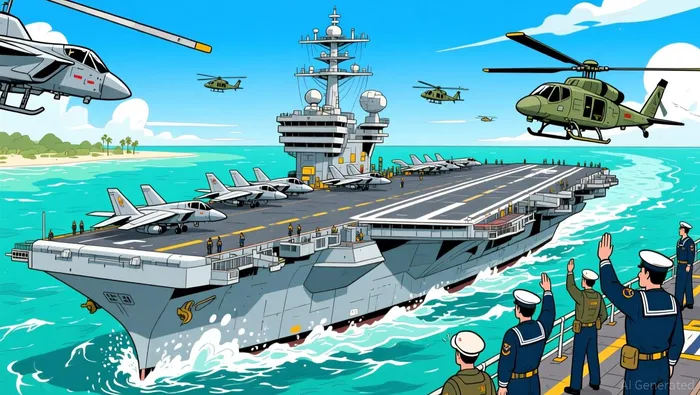
U.S. President Donald Trump has intensified pressure on nations importing Venezuelan oil, imposing tariffs as part of a broader strategy to confront President Nicolás Maduro's regime. The move, framed as part of a "war on drugs," follows a significant military buildup in the Caribbean, including the deployment of the USS Gerald R Ford, the world's largest aircraft carrier, into the region. The carrier's presence, the largest U.S. military presence in Latin America since the 1989 Panama invasion, underscores escalating tensions as Trump's administration seeks to disrupt drug trafficking networks allegedly tied to Maduro. According to reports, the military buildup signals a significant shift in U.S. policy toward Venezuela.
The tariffs target countries facilitating oil imports from Venezuela, a key revenue source for Maduro's government, which the U.S. has indicted on drug trafficking charges. Trump has justified the measures by citing the need to "bring Maduro to justice," drawing parallels to the 1989 U.S. invasion of Panama that led to the capture of dictator Manuel Noriega, another figure linked to drug trafficking. According to analysts, however, replicating the Panama operation in Venezuela-a nation 12 times larger with a more formidable military-could prove far riskier.
 The Supreme Court's impending ruling on the legality of Trump's tariffs has added another layer of uncertainty. Trump warned that if the court rules against the tariffs, the U.S. could face a $2 trillion financial hit, which he described as a "national security catastrophe." He accused opponents of underestimating the repayment costs to sway the court's decision. Meanwhile, the administration has hinted at alternative avenues to maintain its trade policies if the tariffs are struck down.
In a separate but related diplomatic maneuver, Trump suggested reducing tariffs on India following months of trade disputes. The move comes as longtime ally Sergio Gor assumes the role of U.S. ambassador to New Delhi. While data from Kpler showed India's Russian oil imports remained largely unchanged in October, Trump asserted that the reduction would follow as part of a broader effort to strengthen the U.S.-India strategic partnership.
The military and economic pressures have drawn sharp reactions from Latin American nations. At a regional summit, 58 of 60 countries condemned the use of force without directly naming the U.S., while Venezuela and Nicaragua abstained. Brazilian President Luiz Inácio Lula da Silva emphasized that Venezuela's crisis is a "political issue" best resolved through diplomacy. Meanwhile, Maduro's regime has escalated its own military mobilization, declaring the U.S. naval presence a "century's greatest threat" to the region.
As the standoff continues, the parallels between 1989 Panama and 2025 Venezuela remain a focal point. While Trump's advisors reportedly favor aggressive action against Maduro, the logistical and political challenges of such an operation-according to analysts-coupled with regional pushback-highlight the precarious balance between deterrence and conflict.

Stay ahead of the market.
Get curated U.S. market news, insights and key dates delivered to your inbox.


AInvest
PRO
AInvest
PRO



Comments
No comments yet