
Trump's Trade Deals and Global Market Reactions: Navigating Equity Gains Amid Shifting Trade Policies
 Aime Summary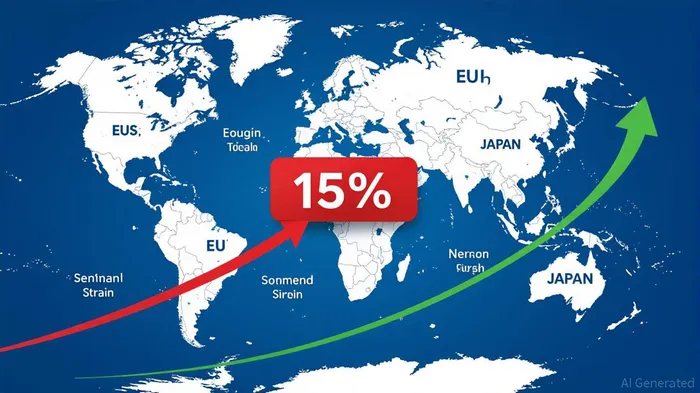
The world of investing has always been a chess game of anticipating the next move, and in 2025, the boldest pieces on the board are the U.S.-Japan and U.S.-EU trade agreements. These deals, forged under the Trump administration's aggressive renegotiation strategy, have sent shockwaves through global markets, reshaping supply chains, recalibrating investor sentiment, and creating both tailwinds and headwinds for specific sectors. But are the recent equity gains sustainable, or are we seeing a temporary lull before the next storm? Let's break it down.
The Trump Trade Reset: Winners and Losers
The U.S.-Japan trade deal, finalized in July 2025, is a masterclass in leveraging geopolitical leverage. By slashing tariffs on Japanese imports from 25% to 15% (and 27.5% to 15% on autos), the U.S. secured a $550 billion investment from Japan into American industries like semiconductors, energy, and defense. This isn't just a trade agreement—it's a strategic realignment. Japanese automakers, from ToyotaTM-- to HondaHMC--, saw their shares surge by double digits post-announcement, as the tariff risk evaporated. shows a sharp upward spike in July 2025, validating the market's relief.
Meanwhile, the U.S.-EU deal, which replaced a threatened 30% tariff with a 15% flat rate, has been a mixed bag. European automakers, particularly German brands like Volkswagen and BMW, initially cheered the reduction from 27.5% to 15% on U.S. exports. But the EU's $750 billion energy purchase commitment to the U.S. raises questions about feasibility. hints at optimism, but investors should watch for slippage if U.S. LNG production can't meet demand.
Supply Chains: Resilience or Fragility?
Both deals aim to reduce reliance on adversarial supply chains, but their execution will determine long-term success. The U.S.-Japan agreement's focus on semiconductorON-- manufacturing and rare earths is a hedge against China's dominance, while the EU's energy pivot to the U.S. seeks to wean itself off Russian gas. However, the devil is in the details. For instance, Japan's investment in U.S. LNG infrastructure—a $250 billion commitment over three years—could boost companies like Cheniere EnergyLNG-- and Kinder MorganKMI--. suggests a strong correlation, but volatility remains if geopolitical tensions flare.
The EU's “zero-for-zero” tariff list for strategic goods (e.g., aircraft, semiconductors) is a win for BoeingBA-- and ASML, but the asymmetry in tariffs—U.S. tariffs on EU goods at 15% versus EU tariffs on U.S. goods at 1.2%—creates a lopsided playing field. This could lead to retaliatory measures or further renegotiations, adding a layer of uncertainty.
Investor Sentiment: Complacency or Caution?
Markets have rallied on the back of these deals, but complacency is creeping in. The VIX (fear index) remains below 20, and European equities trade at a 35% discount to the S&P 500. highlights this gap, which could be a buying opportunity—if the EU can maintain its fiscal discipline. However, the EU's reliance on U.S. energy and investments introduces new risks. If Trump's team doubles down on tariffs (as hinted for pharmaceuticals and semiconductors), sectors like healthcare and tech could face headwinds.
Japan's equity market, on the other hand, is in a sweet spot. The Bank of Japan's potential rate hike in late 2025 and the $550 billion investment into U.S. manufacturing have boosted confidence. shows a divergent trend, suggesting that Japanese stocks could outperform if inflation stabilizes.
Strategic Outlook: Sectors to Watch
1. U.S. Energy and Defense
The U.S. is the big winner here. LNG producers, oil refiners, and defense contractors (e.g., Boeing, Lockheed Martin) are set to benefit from both the Japan and EU deals. The Alaskan LNG project with Japan alone could be a $50 billion tailwind for energy infrastructure.
2. Japanese Automotive and Semiconductors
Toyota, Honda, and SonySONY-- Semiconductor are in a golden period. The tariff reduction and U.S. investment in manufacturing mean these companies can scale production without fear of sudden trade barriers.
3. European Energy and Defense
The EU's energy pivot to the U.S. is a long-term play. Companies like TotalEnergiesTTE-- and E.ON could see demand for LNG terminals and grid modernization. However, defense contractors (e.g., Airbus, Leonardo) might struggle if the EU's $250 billion military procurement pledge doesn't materialize.
4. U.S. Pharmaceuticals and Semiconductors
Watch for volatility here. While the EU deal includes zero tariffs on certain chemicals, Trump's threat of 200% tariffs on pharmaceutical imports could disrupt supply chains. shows a correlation between policy shifts and stock moves.
The Bottom Line: Position for Agility
The sustainability of these equity gains hinges on two factors: the Trump administration's ability to enforce these deals and the resilience of global supply chains. While the current climate is bullish for U.S. energy, Japanese manufacturing, and European energy, investors should remain agile. Diversify across sectors, hedge against geopolitical risks (e.g., gold, Treasury bonds), and keep an eye on the August 1 deadline for snapback tariffs.
The market isn't in a bubble—it's in a recalibration. Those who position for the next phase of trade wars or alliances will come out ahead. But in this game, complacency is the enemy. Stay sharp, stay informed, and let the data guide your bets.

Stay ahead of the market.
Get curated U.S. market news, insights and key dates delivered to your inbox.
AInvest
PRO
AInvest
PRO



Comments
No comments yet