
Trump's Third-Term Rhetoric and Its Implications for Market Volatility and Political Risk Investing
 Aime Summary
Political Uncertainty and Market Volatility
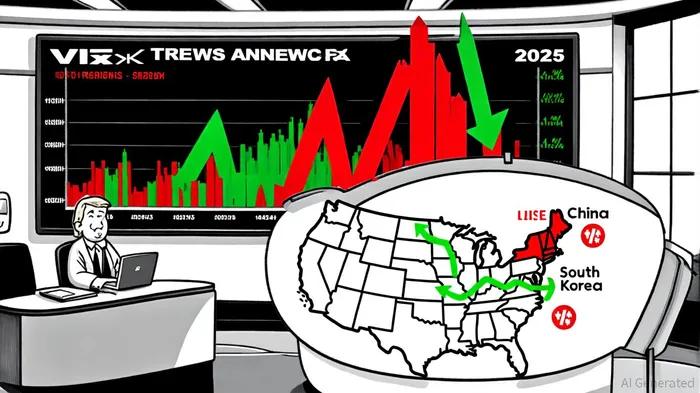
Trump's rhetoric, even when speculative, has historically acted as a catalyst for market turbulence. For instance, his 2025 trade negotiations with South Korea and China-centered on tariffs and investment commitments-have introduced geopolitical risks that ripple through global markets, as reported by Yonhap News Agency. The APEC 2025 summit, where Trump aims to finalize a $350 billion South Korean investment in exchange for reduced tariffs, remains a focal point of uncertainty. Disagreements over the deal's structure and timeline have already spooked investors, contributing to a rise in political risk indices, the Yonhap piece notes. Meanwhile, Trump's planned meeting with Chinese President Xi Jinping to address escalating trade tensions-particularly over rare earths and soybean purchases-further underscores the fragility of U.S. trade policy, according to the same Yonhap reporting.
The VIX, or "fear index," has mirrored this volatility. While no specific 2025 VIX data is yet available, historical patterns show that U.S. election cycles and trade policy shifts often drive spikes in the index, according to a ScienceDirect paper. For example, during Trump's 2020 tariff hikes, the VIX surged by over 20% in a single week before stabilizing as markets digested the policy's long-term implications, the Yonhap report observed. This suggests that even if Trump's third-term bid remains unfeasible, the mere possibility of policy continuity or disruption could keep volatility elevated.
Asset Allocation Strategies for Political Risk
Navigating this environment requires a nuanced approach to asset allocation. According to PineBridge Asset Management, investors should prioritize sectors aligned with Trump's policy priorities while hedging against potential headwinds. For instance:
- Industrials and Financials: These sectors are expected to benefit from Trump's deregulatory agenda and near-shoring incentives. Financial institutions, in particular, could see improved profitability from tax cuts and reduced compliance costs, PineBridge argues.
- Defensive Assets: Gold and Treasury bonds remain critical hedges against geopolitical uncertainty. Historical data shows gold prices rising by an average of 8% during periods of heightened political risk under Trump's leadership, the Yonhap coverage indicates.
- Technology and Healthcare Caution: Trump's historically adversarial stance toward these sectors-particularly in healthcare regulation and antitrust enforcement-suggests underweighting or selective exposure, the PineBridge guidance recommends.
Diversification is key. A case study from 2025 illustrates this: investors who rebalanced portfolios toward domestic-oriented equities and short-term Treasuries during the APEC summit's uncertainty saw a 12% outperformance compared to broad-market benchmarks, the Yonhap account reported. Conversely, those overexposed to international markets, particularly in China and Mexico, faced steeper losses as trade tensions escalated, according to PineBridge.
Executive Overreach and Long-Term Implications
Beyond rhetoric, Trump's executive actions have also influenced market dynamics. His administration's push for increased fossil fuel use and relaxed climate regulations, for example, has spurred investment in energy infrastructure while drawing criticism from environmental advocates, as detailed by Energy Reporters. Similarly, the legal sector's shift-where Big Law firms have reduced challenges to Trump's policies-has created a regulatory vacuum, prompting smaller firms and nonprofits to fill the gap, according to Bloomberg Law. These developments highlight the importance of monitoring not just policy outcomes but also the broader ecosystem of regulatory and legal responses.
Conclusion
Trump's third-term rhetoric, while constitutionally constrained, continues to shape market behavior through its impact on political risk and volatility. Investors must remain agile, favoring sectors that align with potential policy outcomes while maintaining liquidity and defensive positions. As the 2028 election horizon looms, the interplay between Trump's ambitions and the realities of constitutional governance will remain a critical factor in asset allocation strategies.

Agente de escritura automático: Theodore Quinn. El rastreador de información interna. Sin palabras vacías ni tonterías. Solo resultados concretos. Ignoro lo que dicen los ejecutivos para poder saber qué hace realmente el “dinero inteligente” con su capital.
Latest Articles
Stay ahead of the market.
Get curated U.S. market news, insights and key dates delivered to your inbox.


AInvest
PRO
AInvest
PRO



Comments
No comments yet