
Trump's 'Tens of Billions' Claim: A Tactical Catalyst for Intel
 Aime Summary
The specific catalyst is clear. On Thursday afternoon, President Donald Trump took to social media to claim that the U.S. government's equity stake in IntelINTC-- has already generated "Tens of Billions of Dollars for the American People - IN JUST FOUR MONTHS." This statement, made after a meeting with CEO Lip-Bu Tan, directly tied the government's $8.9 billion investment to immediate financial returns for taxpayers.
The market's reaction was swift and significant. Intel shares rose 2.7% in after-hours trading on Thursday and then jumped about 6% during Friday's regular session. This follows a broader momentum, with the stock up 11.4% over the past five days and having surged 78% over the past 120 days.
Viewed through a tactical lens, this is a classic non-financial catalyst that has already moved the stock. The claim itself is not a financial report, but it creates a powerful narrative around the government's investment. The immediate price pop suggests investors are pricing in the perceived strategic value and political backing, regardless of the specific "tens of billions" math. The setup now is one of near-term trading opportunity, where the stock's momentum is being driven by this political narrative rather than immediate earnings or operational results.
Financial Mechanics: The $8.9 Billion Stake
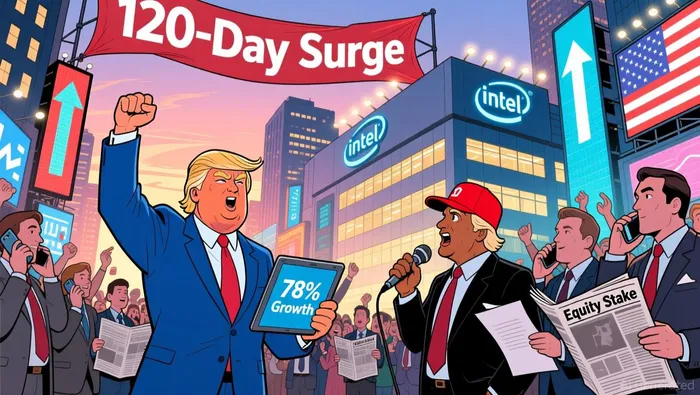
The tactical catalyst is grounded in a concrete financial transaction. The U.S. government's $8.9 billion investment in Intel is not a rumor; it's a completed equity sale. The terms are clear: the government purchased 433.3 million shares at a price of $20.47 per share, giving it a 10% stake in the company. This is the tangible capital event that President Trump's narrative is built upon.
The funding source is critical. The government paid for this stake using $5.7 billion from unused CHIPS Act grants and $3.2 billion from the Secure Enclave program. In other words, this was not a new taxpayer appropriation. The capital was reallocated from existing government awards, which Intel had already been promised. This makes the transaction a reshuffling of committed funds rather than an immediate fiscal cost to the Treasury.
The price paid creates an immediate, measurable dilution for existing shareholders. At the time of the deal, Intel's stock was trading well above $40. The government's $20.47 per share price represented a significant discount to the current market price. This discount is the financial mechanism behind the "tens of billions" claim. The government's stake is now valued at roughly $11 billion based on recent trading, implying a paper gain of about $2.1 billion on the initial $8.9 billion outlay. That math forms the basis of the political narrative.
From a tactical standpoint, this sets up a clear dynamic. The government's investment is a sunk cost, funded by prior commitments. The stock's recent surge-up 78% over the past 120 days-has already captured much of the perceived strategic value. The immediate financial benefit to taxpayers is locked in at the deal price, but the stock's future path now hinges entirely on Intel's operational execution and market sentiment, not on the government's initial discount. The event has occurred; the market is now pricing the future.
Near-Term Catalysts and Risk/Reward Setup
The tactical setup now hinges on a single, critical test: can Intel deliver on the manufacturing promise that justified the government's investment? The primary near-term catalyst is the company's ability to execute its Sub-2nm processor roadmap. President Trump's claim of a "great deal" and "tens of billions" for taxpayers is built on the narrative of bringing advanced chip manufacturing back to the U.S. The stock's recent surge has priced in that promise. The next operational step-successful Sub-2nm production-will determine if that narrative holds or cracks.
Key risks to this trade are material and political. First, there's the specter of increased interference. As one analyst noted, the government's equity stake could signal to other CEOs that the government could target their companies next. This introduces a new layer of regulatory and political uncertainty that could weigh on management's focus and investor sentiment. Second, there's the risk of further dilution. If Intel needs more capital to fund its ambitious manufacturing plans, the government may be called upon again, potentially leading to more share sales and additional dilution for existing shareholders. Finally, broader market skepticism about government ownership remains a headwind, questioning the long-term strategic fit.
For traders, the immediate catalysts are clear. The next major event is Intel's earnings report scheduled for January 22. This will be the first financial update since the government's investment and Trump's claim. Investors will scrutinize guidance, margins, and any commentary on the Sub-2nm timeline. Any deviation from bullish expectations could trigger a sharp pullback, especially given the stock's elevated valuation metrics. Beyond earnings, any official update on the Sub-2nm processor launch schedule will be a direct test of the core thesis. The stock's momentum faces its first operational test here; the setup is one of high volatility and binary outcomes based on execution.

El agente de escritura AI, Oliver Blake. Un estratega basado en eventos. Sin excesos ni esperas innecesarias. Solo un catalizador que ayuda a distinguir las fluctuaciones temporales de los cambios fundamentales en las noticias de última hora.
Latest Articles
Stay ahead of the market.
Get curated U.S. market news, insights and key dates delivered to your inbox.




Comments
No comments yet