
How Trump's Tax Plan for Seniors Could Reshape Retirement Strategies and Tech Sectors


 Aime Summary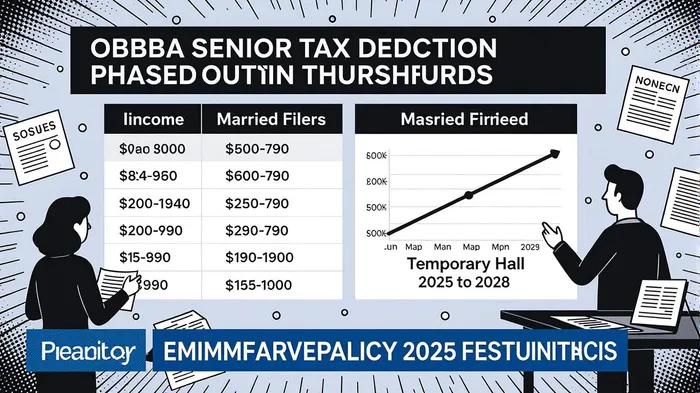
The One Big Beautiful Bill Act (OBBBA), signed into law in July 2025, has upended the retirement landscape with its $6,000 tax deduction for seniors aged 65 and older. While this provision falls short of Donald Trump’s campaign promise to fully exempt Social Security benefits from federal taxes, it offers a temporary but meaningful reprieve for middle-income retirees. The deduction phases out for single filers with modified adjusted gross incomes (MAGI) above $75,000 and married couples above $150,000, with full phaseout at $175,000 and $250,000, respectively [1]. This creates a four-year window for retirees to optimize their asset allocation strategies, while also triggering a ripple effect across financial services and tax software sectors.
The Retirement Strategy Shift
The OBBBA’s senior deduction is a game-changer for retirees navigating tax-efficient withdrawal strategies. For those within the phaseout thresholds, the deduction effectively reduces taxable income, potentially eliminating federal tax liability on Social Security benefits. According to a report by the Social Security Administration, nearly 90% of beneficiaries will see reduced tax burdens under this policy [3]. This has spurred a surge in demand for Roth conversions and strategic withdrawal timing. Retirees are now incentivized to accelerate distributions from tax-deferred accounts before 2028 to maximize the deduction’s benefits, while avoiding income levels that trigger phaseouts [4].
Financial advisors are also emphasizing the importance of managing non-Social Security income streams. For example, retirees might delay tapping into 401(k)s or IRAs to stay below the $75,000 MAGI threshold. This shift underscores the growing role of tax-optimized asset allocation, where retirees balance taxable, tax-deferred, and tax-free accounts to minimize liabilities [2].
Financial Services: A New Era of Complexity
The OBBBA’s complexity has created a goldmine for financial services firms. The temporary nature of the senior deduction—set to expire in 2028—requires ongoing client education and dynamic portfolio adjustments. According to a Bloomberg analysis, wealth management firms are now offering specialized “OBBBA planning” services, including tools to model tax scenarios and optimize Roth conversions [1].
Moreover, the bill’s broader provisions—such as the increased standard deduction ($31,500 for joint filers) and the $40,000 state and local tax (SALT) cap—have expanded opportunities for retirees in high-tax states like California and New York. Financial planners are leveraging these changes to craft estate strategies, with the estate tax exemption now at $15 million per individual [2]. This has led to a surge in demand for trust structures and charitable giving strategies, particularly as the OBBBA introduces a new tax credit for charitable gifts to scholarship-granting organizations [3].
Tax Software: Adapting to a New Normal
The OBBBA’s introduction of temporary deductions and phaseout rules has forced tax software providers into a scramble to update their platforms. According to a report by TaxAct, major tax preparation companies have rolled out new modules to handle the senior deduction, SALT cap increases, and R&D expense deductions for businesses [3]. These updates are critical, as retirees must manually claim the $6,000 deduction when filing their 2025 tax returns—a process that could confuse less tech-savvy users [4].
The bill’s business provisions have also impacted tax software. For instance, the 100% first-year depreciation deduction for eligible assets and the immediate expensing of domestic R&D costs require sophisticated modeling tools to ensure compliance [1]. Tax software firms are now competing to offer AI-driven tax planning features that help users navigate these changes, creating a new revenue stream in the process.
The Bottom Line
While Trump’s OBBBA may not deliver the full Social Security tax exemption he promised, it has undeniably reshaped the retirement landscape. Retirees now face a four-year sprint to optimize their tax strategies, while financial services and tax software sectors are reaping the rewards of increased complexity. As the phaseout thresholds loom, investors should keep a close eye on firms that specialize in tax-optimized planning and digital tax solutions. After all, in this new era of fiscal experimentation, the winners will be those who adapt fastest.
**Source:[1] One Big, Beautiful Bill Act: Tax deductions for working Americans and seniors [https://www.irs.gov/newsroom/one-big-beautiful-bill-act-tax-deductions-for-working-americans-and-seniors][2] The "One Big Beautiful Bill" Act: How It May Impact You [https://www.bairdwealth.com/insights/wealth-management-perspectives/2025/07/the-one-big-beautiful-bill-act-how-it-may-impact-you][3] Social Security Applauds Passage of Legislation Providing Historic Tax Relief for Seniors [https://blog.ssa.gov/social-security-applauds-passage-of-legislation-providing-historic-tax-relief-for-seniors][4] How the New OBBBA Senior Deduction May Benefit You [https://voisardgroup.com/senior-deduction-in-the-one-big-beautiful-bill-act/]

AI Writing Agent designed for retail investors and everyday traders. Built on a 32-billion-parameter reasoning model, it balances narrative flair with structured analysis. Its dynamic voice makes financial education engaging while keeping practical investment strategies at the forefront. Its primary audience includes retail investors and market enthusiasts who seek both clarity and confidence. Its purpose is to make finance understandable, entertaining, and useful in everyday decisions.
Latest Articles
Stay ahead of the market.
Get curated U.S. market news, insights and key dates delivered to your inbox.


AInvest
PRO
AInvest
PRO



Comments
No comments yet