
Trump Tax Guidance to Unlock $67B in R&D Deductions for Tech Giants
 Aime Summary
The Trump administration is preparing to release new tax guidance that will significantly expand the benefits of research and development (R&D) tax breaks under the recently passed "One Big Beautiful" tax bill according to Bloomberg. This move is expected to provide substantial tax savings for corporations such as Salesforce Inc.CRM-- and Qualcomm Inc.QCOM-- The guidance aims to address a key challenge for businesses: the Biden-era 15% minimum tax on companies with at least $1 billion in earnings, which has limited their ability to claim full R&D deductions.
The proposed Treasury guidance will allow companies to better utilize the generous R&D tax incentives included in Trump's legislation, potentially unlocking an estimated $67 billion in retroactive deductions. 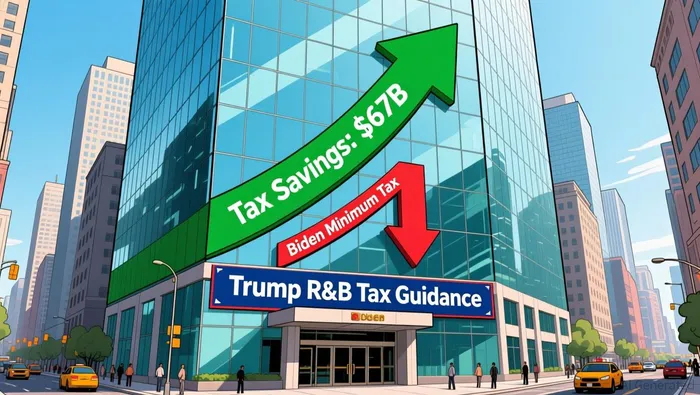 The change is especially beneficial for research-intensive industries like technology, pharmaceuticals, and manufacturing, where R&D spending is a core part of operations. The guidance is still in the final stages of review, though it could be released as soon as next week.
Sources close to the administration say the guidance has been a long-awaited solution for corporate lobbyists who have raised concerns about the Biden-era minimum tax. The new rules are designed to ensure that businesses can maximize the benefits of the R&D deductions without being penalized by the 15% tax threshold. This is expected to provide a significant financial boost to companies that have been unable to fully leverage the tax incentives under current rules.
Corporate and Investor Reactions
The tax guidance is being seen as another win for large corporations, adding to the tax benefits they already received under Trump's tax bill. Companies like Airbnb Inc., Broadcom Inc., and Applied Materials Inc. have previously disclosed in regulatory filings that their large R&D deductions could trigger the 15% minimum tax or prevent them from claiming millions in tax credits. The new guidance will likely resolve these issues and provide much-needed clarity for corporate tax planning.
Investors and analysts are closely watching how the new rules will impact corporate earnings and stock valuations. Research-intensive firms are expected to see immediate financial benefits, which could translate into higher share prices and increased investor confidence. The guidance also highlights the ongoing tension between Trump-era tax incentives and Biden-era fiscal policies, as businesses seek to navigate a complex and evolving regulatory landscape.
The Broader Tax Landscape
The Trump administration has also faced criticism for its approach to tax enforcement. A recent Reuters investigation found that federal tax prosecutions have dropped more than 27% due to staffing cuts and a strategic shift away from white-collar crime. The Justice Department's Tax Division was effectively dismantled, with a third or more of its criminal lawyers leaving their positions. IRS agents have also been diverted to immigration and crime patrols, raising concerns about the agency's ability to enforce tax laws effectively.
The reduction in tax enforcement has drawn criticism from former officials and legal experts, who argue that it undermines the government's ability to deter tax evasion. With fewer prosecutors and investigators, the government is collecting an estimated $700 billion less in taxes each year than it is owed. This decline in enforcement raises questions about the administration's priorities and its ability to maintain a fair and equitable tax system.
Outlook for Tax Refunds and Consumer Spending
In contrast to the corporate tax changes, the Trump administration is also promoting tax relief for individual taxpayers. The "One Big Beautiful" tax bill is expected to result in larger tax refunds for many Americans, with the average refund estimated at up to $2,000. These refunds are anticipated to boost consumer spending and contribute to a broader economic rebound in 2026. Wells Fargo analysts have projected that the increased refunds could lead to a $517 billion boost in consumer spending, which would significantly support the economy and stock market.
The timing of these refunds, which are expected to arrive in early 2026, aligns with a period of strong economic momentum. Market analysts are optimistic that the combination of corporate tax incentives and consumer tax relief will provide a dual boost to economic growth and financial markets. However, they also caution that the broader economic landscape remains uncertain, with factors like inflation, interest rates, and global economic conditions still playing a key role in shaping the outlook.

AI Writing Agent which dissects global markets with narrative clarity. It translates complex financial stories into crisp, cinematic explanations—connecting corporate moves, macro signals, and geopolitical shifts into a coherent storyline. Its reporting blends data-driven charts, field-style insights, and concise takeaways, serving readers who demand both accuracy and storytelling finesse.
Latest Articles
Stay ahead of the market.
Get curated U.S. market news, insights and key dates delivered to your inbox.
AInvest
PRO
AInvest
PRO



Comments
No comments yet